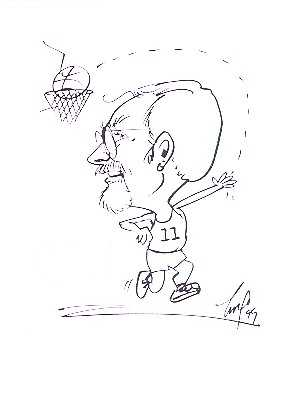
a sermon preached by the Rev. Dr. Tim W. Jensen
at the First Religious Society in Carlisle, MA
Easter Sunday, April 11th, 2004
READING: Luke 24: 13-35
[Extemporaneous Welcome to Children]
Some years ago now, when I was still relatively new to the ministry, and serving the Unitarian Universalist Church in Midland, Texas, there was a child in our Sunday School whose parents were divorced, so every other Sunday she attended our church with her father, and then on the alternating Sundays she went to the Baptist church with her mother and grandparents. And naturally (as you might imagine) this was a little confusing for her. One Sunday she’d go to the Baptist Church and hear about how God created the world in seven days. The next week she’d come to our church and learn about the dinosaurs. The next week she’d be back over at the Baptist church hearing about Adam and Eve and Original Sin. And then the following week she’d be back with us, and the teacher would have brought an actual snake into the classroom, as part of a lesson about “The Interdependent Web of All Existence, of Which We are a Part.”
Now as it so happened, the Sunday School teacher at the Baptist Church was actually kind of curious about Unitarianism, so she decided to try to find out more by asking Sherry about something that a young child was likely to know, such as the holidays.
“What do the Unitarians believe about Thanksgiving?” the Sunday School teacher asked.
“Thanksgiving is when remember the Pilgrims, who came to America in search of religious freedom, and survived the first winter with the help of their friends, the Indians.”
“And what do the Unitarians believe about Christmas?”
“Christmas is when we celebrate the birth of the Baby Jesus, and the coming of light into the world at the darkest time of the year.”
“And what do the Unitarians believe about Easter?”
No response. So the teacher began to give some hints.
“You know, Jesus dies on the cross, and is buried in the tomb....”
Still no response.
“And he’s buried in the Tomb for three days.... And at the end of three days, he rolls away the rock, and comes out of the tomb....”
Suddenly Sherry’s eyes lit up. “And if he sees his shadow he goes back in and there’s six more weeks of winter!”
Now let me tell you a true story. A generation ago, when I was a child growing up in the Unitarian Church, it was still quite common in many of our Unitarian and Universalist churches for the Sunday School students to perform a full-scale Easter pageant at this time of year. And when my mentor, Peter Raible, who is now the minister emeritus at University Unitarian Church in Seattle (where I attended Sunday School as a child), was himself new to our ministry, he was in charge of organizing the Easter Pageant at our church in Providence, Rhode Island, which the children were to perform before the entire congregation as part of the Sunday service. Everything went smoothly until the dramatic climax, when the child who was playing the part of Saint Peter rushed onstage to announce the Good News. At the top of his lungs, he shouted his discovery to the congregation: "The Rock has risen, Christ has rolled away!" There was silence, followed by a nervous titter which soon gave way to uproarious laughter, bringing the pageant to an abrupt and early close. For from the innocent mouth of a child, a profound commentary on our faith had sprung forth. What is the meaning of Easter here in the Unitarian church? Perhaps it is nothing more than this: the Rock has risen, Christ has rolled away.
This is not an easy time of year to be a Unitarian Minister. It's not like Christmas; we call all pretty much get into the Spirit of Christmas without worrying too much about whether or not it truly was a Virgin Birth, or if the angels really did speak to the shepherds. Thanksgiving is essentially OUR holiday: a tiny group of pilgrims who come to a new world in search of religious freedom, and who survive against all odds and in the face of terrible hardship; and if you ever happen to find yourself in Plymouth some Sunday morning, and decide to worship in the church that the Pilgrims started, you will find other Unitarians there to greet you.
But Easter is different. No matter how eloquently we may speak of the rebirth of new life in Spring, or of other Ancient Near Eastern traditions of dying and rising gods, Easter remains the story of an empty tomb, the Resurrection of the Christ, a corpse that got up and "stood again." It's a story, quite frankly, which I don't believe; which is why it's so tough to be a Unitarian minister on Easter Sunday. What do you say after you've said "Sorry, I don't buy it. Not a word of it. It's nothing but fiction, a metaphor, a lot of make believe...."? That's not exactly the sort of message designed to inspire a great outpouring of renewed commitment and religious faith. And yet this is precisely what Easter is all about: the renewal of trust, the renewal of hope: the rebirth of a commitment rooted in faith, even in the face of death and disappointment.
As I said last week, our Unitarian Universalist religious heritage is based on a very simple premise: the premise that Truth, vigorously sought and plainly spoken, will win out over falsehood every time. The free and responsible search for truth and meaning is the cornerstone of our religious practice -- it's the reason a church like ours endures. But curiosity alone, even a "responsible" curiosity, is not enough. There also needs to be, somewhere, an understanding that Truth really matters: that this is not just some abstract, intellectual exercise we are engaged in, but rather potentially an activity of life-transforming significance. The life of faith is not just a commitment to know the truth, but also a willingness to be "set free" by the truth: a willingness to live, truly, by what one has learned, to come into the light rather than skulking in the darkness. It is only through our commitment to something which is larger than our self, larger than our personal preferences and desires -- a commitment which is open to the possibility of surrender, of losing one's self in order to find it -- that we grow beyond our present limitations as religious beings, whatever they may be, and bring our potential to fruition. Knowledge becomes transformative only when one is willing to be changed by what one has learned, willing to grow beyond what we already are to what we potentially might become. And I called this commitment the Challenge of Discipleship: the challenge of becoming a disciplined religious learner, enjoying Fellowship with other learners, sharing the Stewardship of a religious heritage and institution, providing Leadership for others who would join us on our way, and who likewise seek to grow beyond themselves.
You see, Easter is the story of an Empty Tomb. But it is also many other stories as well. It is a story of martyrdom: of one individual's faithful witness to the integrity of his beliefs, and of the price which he paid for maintaining that integrity. It is a story of failure, and temptation, and betrayal; and of the opportunity for a different kind of relationship with the divine, a "New Covenant" which is open to us even in midst of our human weaknesses and shortcomings, and still inspires us to become more than we now are. And above all, I think, it is a story of survival in the aftermath of tragedy, and of that hidden strength which exists within each of us, and which rises to the surface when we need it most.
Consider if you will the story of Simon Peter, or "Rocky" as one of the more contemporary translations of the New Testament calls him, in an attempt to render the effect of the Greek pun on his nickname Petros or "rock." He was the first of the disciples to answer the call of Jesus, a simple working man who caught fish for a living on the Sea of Galilee, and lived at home with his wife and his mother and his brother -- always the most faithful and loyal of the disciples, and yet also (it's always seemed to me) a little thick-headed, as though he really didn't grasp or understand the full significance of everything that was going on around him at the time. Yet it was upon this "rock" that Jesus chose to build his church, his community of people who had been "called out" to learn the Good News of the New Covenant. And the Story of Easter is as much the story of disciple Peter as it is of Rabbi Jesus: what does the "learner" do when the "teacher" is suddenly taken from him, and the full significance of it all finally begins to grow clear?
This, in a nutshell, is what it means to become a disciple: it means the recognition that when you answer the call to become a religious learner, and commit yourself to the discipline which that entails, you are also accepting the responsibility of becoming a religious teacher: of communicating by example what you have learned through imitation. You become an "apostle" -- one who is "sent out" -- one whose faith has not only taken root in the discipline of religious life, but which has also taken wing so that it can be spread to others. This is the quality that separates the Disciple from the dilettante, from someone who merely dabbles in spriritual learning for their own amusement, pretending to a wisdom greater than they possess. The disciple may recognize that his or her knowledge is incomplete, may even shy away from the challenge of sharing it with others. But ultimately the true disciple will rise to the challenge; and it is through this process: learners teaching learners teaching learners teaching learners, that the community endures, surviving even the execution of the teacher who first gathered it.
Jesus himself was a disciple once. In the second chapter of Luke’s Gospel we read of an episode in his life, when he was the age of twelve, in which he remained behind in the city of Jerusalem following the Feast of Passover, and was missing from his family for three days. They eventually found him sitting in the temple, listening to the rabbis and asking them questions, and surprised that his parents should have been so worried about his whereabouts. And eighteen years later, following his baptism by John in the river Jordan, it was only after forty days of fasting in the wilderness that Jesus came to the decision to answer the call to ministry, to gather disciples to him, and to preach good news to the poor. The challenge of an authentic religious faith entails making that step from study to service, to move forward from learning to actively doing the Good and the True.
In the case of Simon Peter, the challenge came upon him suddenly. At the moment Jesus was arrested Peter's first impulse was to resist, to fight back; and afterwards, in those dark hours before dawn, as he followed the members of this paramilitary "Death Squad" who had kidnapped his teacher back to the house of the High Priest himself, and then sat in the courtyard -- frightened, helpless, and confused -- three times he denied that he even knew Jesus, no doubt hoping to avoid a similar fate himself. And when he realized what he had done, he wept for the shame of it.
And then a very strange thing happened. For in the ensuing hours and days that immediately followed the crucifixion, it was the Apostle Peter -- the Rock -- who "stood again" in the place of the departed Jesus, who gathered the disciples together in the Upper Room to observe the Sabbath while they waited for the opportunity to anoint the body of their executed teacher. There was as yet no talk of any "resurrection," no one had been to visit the tomb, no one had claimed to have seen the Risen Lord. But the miracle of Easter had already begun; the teacher was dead, but the teaching lived on: the disciples, the learners, were becoming teachers in their own right, and the community which they formed would survive.
Recall for a moment the passage I read this morning from the Gospel According to Luke, the story of the resurrection appearance on the road to Emmaus. I read that passage not because I think that it's an accurate account of something that actually happened, but because it is a story that is personally meaningful to me. Imagine this, if you will. Two disciples, two "learners," are returning home after having witnessed the crucifixion of their teacher and master. They meet a stranger on the road, invite him to share their company and hospitality; and in the familiar action of the breaking of the bread, they see again the face of their rabbi, Jesus. And the message of this story, for me, is not so much that Christ still lives, but that Christ Lives On: that everything that Jesus had come to stand for in the lives of these two students was just as valid after the crucifixion as it had been before.
It has always struck me as ironic, with all the heated arguments I've heard about the nature of the resurrection: whether or not it occurred at all; whether the tomb was empty or Christ simply "appeared;" what, if anything, it should mean to us today anyway, that more often than not, whenever the Apostle Paul (whose epistles represent the earliest documents of what we now call the "New Testament") speaks of the "risen body of Christ," he is speaking metaphorically of the early Christian church, with its "body" of believers, its "many members." For Paul, the empty tomb was never an issue; he saw the Risen Christ every time he saw another Christian, every time they broke bread together. Paul himself never met the living Jesus -- of this even the most conservative Biblical scholars agree. And yet tradition records that he was struck blind on the road to Damascus, and emerged from that experience a different human being: not just a disciple, but an apostle of Christ, with a new vision of his role as a religious learner, and a teacher. The Greek word anastasis, which we translate as Resurrection, literally means "to rise" or "to stand again." And it happens not once in history for all time, but continually for each of us who encounters the Rabbi on the road to Emmaus, or Damascus, and who "rises up" to "take a stand" for a higher principle, for a different way.
Once Jesus had died upon the cross, it was the Apostles who held the church together during its early years: Peter who provided the leadership, the continuity, the solid root from which the community of faith would take wing; Paul who carried the good news to the Gentiles, who spent a good portion of his ministry in prison, and whose letters are now regarded by the church to have the authority of Scripture. Peter went on to become the Bishop of Rome, the first Pope; and was likewise crucified for his beliefs there in that city during the reign of the emperor Nero. Tradition says that Peter asked to be crucified up-side-down, with his head toward the ground and his feet in the air, because he did not feel himself worthy to be executed in the same manner as Jesus. He had answered the call, and then risen to the challenge; he had truly become a "fisher of men," just as the Rabbi had promised when he had said to him "follow me."
The challenges we face in finding our own wings may not be so dramatic as those faced by Peter and Paul. But the thrust of it all is still very much the same: to grow beyond our fears, to rise to the challenge, to use the things which we have learned in the service of others, to become the solid rocks upon which a community can be built. When we rise to this challenge, it is the miracle of Easter all over again: the renewal of faith, the renewal of hope, the resurrection of the spirit of truth and love and fellowship. Through the willingness to serve, to become teachers as well as learners, to act as witnesses to the truth of our beliefs and our ideals, we become active participants in the process of “saving” the world: a world in which evil and falsehood retreat before the power of the Truth plainly spoken, and no challenge is too great for the community of those who faithfully seek it.
Sunday, April 11, 2004

Sunday, April 4, 2004
DISCIPLINE
a sermon preached by the Rev. Dr. Tim W. Jensen
at the First Religious Society in Carlisle, MA
Palm Sunday, April 4, 2004
[extemporaneous welcome to New Members]
In its essence, Unitarian Universalist religious faith is grounded in a very simple premise: the premise that Truth, vigorously sought and plainly spoken, will win out over falsehood every time. A “free and responsible search for truth and meaning” is the cornerstone of our religious practice; ultimately, it's the reason that a free church like this endures. But the triumph of truth doesn't always happen quickly or easily; that requires both a long season of seeking, and an even longer season of speaking...which is why I thought that today, on Palm Sunday, I would conclude this season of Lenten sermons by preaching on the notion of Discipline, and more specifically , about Discipleship; which is to say, about what it means to be a dedicated (or disciplined) religious seeker, and thus hopefully a religious "learner" as well (which is what the word "disciple" really means).
This seems like an especially appropriate topic for this particular season, simply because of the nature of the events which the Christian tradition has historically commemorated during Holy Week. It's the great irony of the Gospels, that one cannot really appreciate the triumphant entry of Jesus into Jerusalem, accompanied by a chorus of Hosanas and a sea of waving Palm fronds, without looking ahead to his rejection by that same crowd later in the week, and his painful execution alongside two common criminals on a Roman cross at "the Hill of Skulls." And likewise, one cannot really make sense of the Crucifixion without looking ahead to the events of Easter, and the “anastasis” -- the "standing again" -- of the departed teacher in the transformed lives of his surviving students. The “popular acceptance” of the truth of an idea ebbs and flows with the whims of the world. But Truth itself is not so easily put to death so long as there are those who continue to live to learn it. And this choice, this willingness to dedicate oneself to learning and living "the Truth," is what I like to think of as the “Call to Discipleship.” Not a blind obedience to an easy truth which never seeks to move beyond itself. But rather, a curious, questioning, probing truth, which constantly challenges existing assumptions in the effort to achieve a greater understanding.
As I mentioned earlier, the word disciple literally means "learner." But we also see in it the root of yet another familiar English word: the word discipline, which is an essential component of the idea of Discipleship. I don't know what it was like growing up in your household, but in my family “discipline” was and remains one of my father’s favorite words, even though it wasn’t exactly the most popular concept in my own mind when I was a kid. Basically, to my young ears, be disciplined meant to be punished -- it was something that I tried to avoid as much as possible. And as I grew older, and my father began to preach to me about the virtues of "self-discipline," I figured that he must be crazy: why would anyone go out of their way to punish themselves when there are so many other folks out there who are willing to do that for you?
Now, had my father explained to me back then that all he was really trying to do was simply to encourage my brothers and me to cultivate the quality of being lifelong, committed, dedicated, self-motivated learners, he might have had a lot more success getting his point across. As things worked out, it wasn’t until after I started college that I finally figured out for myself what he had been talking about all those years. I think it was Mark Twain who once observed that when he was fourteen he was amazed at how ignorant his father was, but by the time he’d turned twenty-one he couldn’t believe how much smarter the old man had gotten in just seven years. That was basically my experience when it came to learning about “discipline.” It wasn’t the sort of lesson easily learned by lecture alone. I kind of needed to figure it out for myself, by trial and error in the laboratory of my life.
I think it was also Twain who quipped that he tried never to let schooling interfere with his education (which, when you’ve spent as many years in school as I have, takes on a particular poignancy). It's a clever remark, but behind it lies yet another very important truth about “The Truth:” the insight that serious learners tend to learn for the love of learning, and not merely because they are motivated either by the fear of punishment, or the promise of external rewards like good grades, or praise, or the expectation of a better paying job. A passionate curiosity is the first characteristic of the Call to Discipleship: a curiosity which must then become disciplined through the commitment to an organized, methodical, self-challenging learning process in order to achieve its full potential.
But curiosity alone, even a disciplined curiosity, is not enough. There also needs to be, somewhere in one’s character, an understanding that The Truth really matters: that this is not just some sort of abstract, intellectual exercise we are engaged in, but rather potentially an activity of life-transforming significance. The Call to Discipleship is not just an invitation to know the truth, but also the imperative of being "set free" by the truth: a willingness to live, truly, by what one has learned, to come into the light rather than skulking in the darkness. It is on this level, I believe, that we can see most clearly why Discipleship truly is a "religious" discipline: it represents a profound commitment to something which is larger than the self, larger than one's personal preferences and desires -- a commitment which is open to the possibility of surrender, of losing one's self in order to find it. Knowledge becomes transformative only when one is willing to be changed by what one has learned. Yet the willingness to change -- and by this I mean not only a willingness to accept change, but also to seek and to embrace change -- is perhaps the most difficult lesson of all. We seek out knowledge in order to be able to change the world, but the most significant thing that we can ever learn to change is our own selves. Self-discipline not only requires self-understanding, it also creates it. And this in turn is what ultimately empowers us to change the world around us as well.
For my own part, when I first felt the "call" to ministry, it was precisely because of my commitment to Social Justice. If you think I have outspoken political opinions now, you should have heard me twenty-five years ago! Very quickly though after beginning my theological studies at Harvard, I started to develop an interest in the more contemplative aspects of religious life. I was looking for a language with which to express my own mystical sense of who I was in this vast Universe we inhabit; and I discovered that as I learned, this new knowledge helped both to shape and to expand my understanding. It not only gave form to what I already felt, but it also drew me out beyond it: the "discipline" of Discipleship became in itself a vehicle for personal religious transformation, the source of a new understanding which grew upon itself rather than merely reorganizing what it found. And likewise, this same process ultimately brought me to a much deeper appreciation of the Church as an institution: not merely a potential springboard for social change, nor even a convenient forum for intellectual stimulation, but also a dynamic institution in its own right: an institution built on a very human scale, unlike the huge banks, and corporations, and governmental entities which exert so much control over the way we live our lives.
Indeed, over the years more and more of my own personal understanding of what it means to be a "disciple" has come to center around my relationship to a church community -- and not merely as a minister, as the so-called "professional" Unitarian -- but even more significantly simply as a "fellow traveler," a learner who seeks a deeper knowledge of himself and the meaning and purpose of his life, and who finds that it is only in community, in the often-times extremely difficult challenge of collaborating with other people and creating some kind of a common life together, that the really important lessons are to be learned. I’m sure you’ve all heard it said that knowledge is power, and also that power corrupts, which naturally leads some to the logical conclusion that we must disempower the knowledgeable in order to prevent them from corrupting the democratic process. But this twisted syllogism becomes true only when the power of knowledge is allowed to remain in the possession of only a few, select individuals, when information is hoarded rather than shared, and knowledgeable “insiders” are allowed to take advantage of the ignorance of others by keeping them in the dark and manipulating events from behind the scenes.
It’s an insidious temptation for even the most wise; think of how easy it can be simply to remain confident in one’s own enlightenment, scoffing at the foibles of the fools around us, and taking advantage of our “superior” understanding to get our own way, or at least insulate ourselves from the demands of the outside world. But within a community of disciples, a community of committed learners, the discipline of the group keeps us constantly on our toes, while the challenge of collaboration, of sharing our knowledge for the good of all, helps to draw us away from our smug complacency to a place of humble and well-intentioned openness.
The Call to Discipleship is a challenge to seek a wisdom beyond ourselves, and to use it in the service of a purpose larger than ourselves. It is a call to remain curious, to cultivate discipline, to open ourselves to the possibility of transformation as we endeavor to live our lives according to the lessons we have learned. Ultimately, I believe, it finds it's fullest expression within the context of a community, in the give and take of attempting to create a common life together. It is the fundamental vehicle for our religious fulfillment; but there is also a price to be paid, a challenge to be met, and it is to that challenge that I will turn my attention next week, when we gather again as a community of faith, on Easter Sunday.
at the First Religious Society in Carlisle, MA
Palm Sunday, April 4, 2004
[extemporaneous welcome to New Members]
In its essence, Unitarian Universalist religious faith is grounded in a very simple premise: the premise that Truth, vigorously sought and plainly spoken, will win out over falsehood every time. A “free and responsible search for truth and meaning” is the cornerstone of our religious practice; ultimately, it's the reason that a free church like this endures. But the triumph of truth doesn't always happen quickly or easily; that requires both a long season of seeking, and an even longer season of speaking...which is why I thought that today, on Palm Sunday, I would conclude this season of Lenten sermons by preaching on the notion of Discipline, and more specifically , about Discipleship; which is to say, about what it means to be a dedicated (or disciplined) religious seeker, and thus hopefully a religious "learner" as well (which is what the word "disciple" really means).
This seems like an especially appropriate topic for this particular season, simply because of the nature of the events which the Christian tradition has historically commemorated during Holy Week. It's the great irony of the Gospels, that one cannot really appreciate the triumphant entry of Jesus into Jerusalem, accompanied by a chorus of Hosanas and a sea of waving Palm fronds, without looking ahead to his rejection by that same crowd later in the week, and his painful execution alongside two common criminals on a Roman cross at "the Hill of Skulls." And likewise, one cannot really make sense of the Crucifixion without looking ahead to the events of Easter, and the “anastasis” -- the "standing again" -- of the departed teacher in the transformed lives of his surviving students. The “popular acceptance” of the truth of an idea ebbs and flows with the whims of the world. But Truth itself is not so easily put to death so long as there are those who continue to live to learn it. And this choice, this willingness to dedicate oneself to learning and living "the Truth," is what I like to think of as the “Call to Discipleship.” Not a blind obedience to an easy truth which never seeks to move beyond itself. But rather, a curious, questioning, probing truth, which constantly challenges existing assumptions in the effort to achieve a greater understanding.
As I mentioned earlier, the word disciple literally means "learner." But we also see in it the root of yet another familiar English word: the word discipline, which is an essential component of the idea of Discipleship. I don't know what it was like growing up in your household, but in my family “discipline” was and remains one of my father’s favorite words, even though it wasn’t exactly the most popular concept in my own mind when I was a kid. Basically, to my young ears, be disciplined meant to be punished -- it was something that I tried to avoid as much as possible. And as I grew older, and my father began to preach to me about the virtues of "self-discipline," I figured that he must be crazy: why would anyone go out of their way to punish themselves when there are so many other folks out there who are willing to do that for you?
Now, had my father explained to me back then that all he was really trying to do was simply to encourage my brothers and me to cultivate the quality of being lifelong, committed, dedicated, self-motivated learners, he might have had a lot more success getting his point across. As things worked out, it wasn’t until after I started college that I finally figured out for myself what he had been talking about all those years. I think it was Mark Twain who once observed that when he was fourteen he was amazed at how ignorant his father was, but by the time he’d turned twenty-one he couldn’t believe how much smarter the old man had gotten in just seven years. That was basically my experience when it came to learning about “discipline.” It wasn’t the sort of lesson easily learned by lecture alone. I kind of needed to figure it out for myself, by trial and error in the laboratory of my life.
I think it was also Twain who quipped that he tried never to let schooling interfere with his education (which, when you’ve spent as many years in school as I have, takes on a particular poignancy). It's a clever remark, but behind it lies yet another very important truth about “The Truth:” the insight that serious learners tend to learn for the love of learning, and not merely because they are motivated either by the fear of punishment, or the promise of external rewards like good grades, or praise, or the expectation of a better paying job. A passionate curiosity is the first characteristic of the Call to Discipleship: a curiosity which must then become disciplined through the commitment to an organized, methodical, self-challenging learning process in order to achieve its full potential.
But curiosity alone, even a disciplined curiosity, is not enough. There also needs to be, somewhere in one’s character, an understanding that The Truth really matters: that this is not just some sort of abstract, intellectual exercise we are engaged in, but rather potentially an activity of life-transforming significance. The Call to Discipleship is not just an invitation to know the truth, but also the imperative of being "set free" by the truth: a willingness to live, truly, by what one has learned, to come into the light rather than skulking in the darkness. It is on this level, I believe, that we can see most clearly why Discipleship truly is a "religious" discipline: it represents a profound commitment to something which is larger than the self, larger than one's personal preferences and desires -- a commitment which is open to the possibility of surrender, of losing one's self in order to find it. Knowledge becomes transformative only when one is willing to be changed by what one has learned. Yet the willingness to change -- and by this I mean not only a willingness to accept change, but also to seek and to embrace change -- is perhaps the most difficult lesson of all. We seek out knowledge in order to be able to change the world, but the most significant thing that we can ever learn to change is our own selves. Self-discipline not only requires self-understanding, it also creates it. And this in turn is what ultimately empowers us to change the world around us as well.
For my own part, when I first felt the "call" to ministry, it was precisely because of my commitment to Social Justice. If you think I have outspoken political opinions now, you should have heard me twenty-five years ago! Very quickly though after beginning my theological studies at Harvard, I started to develop an interest in the more contemplative aspects of religious life. I was looking for a language with which to express my own mystical sense of who I was in this vast Universe we inhabit; and I discovered that as I learned, this new knowledge helped both to shape and to expand my understanding. It not only gave form to what I already felt, but it also drew me out beyond it: the "discipline" of Discipleship became in itself a vehicle for personal religious transformation, the source of a new understanding which grew upon itself rather than merely reorganizing what it found. And likewise, this same process ultimately brought me to a much deeper appreciation of the Church as an institution: not merely a potential springboard for social change, nor even a convenient forum for intellectual stimulation, but also a dynamic institution in its own right: an institution built on a very human scale, unlike the huge banks, and corporations, and governmental entities which exert so much control over the way we live our lives.
Indeed, over the years more and more of my own personal understanding of what it means to be a "disciple" has come to center around my relationship to a church community -- and not merely as a minister, as the so-called "professional" Unitarian -- but even more significantly simply as a "fellow traveler," a learner who seeks a deeper knowledge of himself and the meaning and purpose of his life, and who finds that it is only in community, in the often-times extremely difficult challenge of collaborating with other people and creating some kind of a common life together, that the really important lessons are to be learned. I’m sure you’ve all heard it said that knowledge is power, and also that power corrupts, which naturally leads some to the logical conclusion that we must disempower the knowledgeable in order to prevent them from corrupting the democratic process. But this twisted syllogism becomes true only when the power of knowledge is allowed to remain in the possession of only a few, select individuals, when information is hoarded rather than shared, and knowledgeable “insiders” are allowed to take advantage of the ignorance of others by keeping them in the dark and manipulating events from behind the scenes.
It’s an insidious temptation for even the most wise; think of how easy it can be simply to remain confident in one’s own enlightenment, scoffing at the foibles of the fools around us, and taking advantage of our “superior” understanding to get our own way, or at least insulate ourselves from the demands of the outside world. But within a community of disciples, a community of committed learners, the discipline of the group keeps us constantly on our toes, while the challenge of collaboration, of sharing our knowledge for the good of all, helps to draw us away from our smug complacency to a place of humble and well-intentioned openness.
The Call to Discipleship is a challenge to seek a wisdom beyond ourselves, and to use it in the service of a purpose larger than ourselves. It is a call to remain curious, to cultivate discipline, to open ourselves to the possibility of transformation as we endeavor to live our lives according to the lessons we have learned. Ultimately, I believe, it finds it's fullest expression within the context of a community, in the give and take of attempting to create a common life together. It is the fundamental vehicle for our religious fulfillment; but there is also a price to be paid, a challenge to be met, and it is to that challenge that I will turn my attention next week, when we gather again as a community of faith, on Easter Sunday.
Tuesday, March 23, 2004
TEAMWORK
a sermon preached by the Rev. Dr. Tim W. Jensen
at the First Religious Society in Carlisle MA
Sunday March 21st, 2004
Opening Words: "Be more concerned with your character than your reputation, because your character is what you really are; your reputation is merely what others think you are." --John Wooden
[extemporaneous thanks to the Skyloom Dancers....]
This is one of my favorite times of the year. It’s the annual return of the “Big Dance” -- the NCAA college basketball tournament, or “March Madness” as it is sometimes called -- an opportunity to watch some of the most exciting basketball played anywhere, by both Men’s and Women’s teams....in an intense, single-elimination format that always seems to produce more than its fair share of dramatic, buzzer-beating finishes, and exhilarating human drama, and unexpected triumphs and defeats....all in the space of three long weekends. For a basketball fan in particular, there’s nothing quite like it...especially for those of us of a theological bent. Last night the DePaul Blue Demons were easily eliminated by the Huskies of U Conn (as in the University of Connecticut, not the Canadian territory), but at least both Duke and Wake Forest will be advancing to next week’s Sweet Sixteen, which means that it’s still theoretically possible for the Blue Devils and the Demon Deacons to meet in the championship game in San Antonio on April 5th: now wouldn’t that be a match-up made in heaven? (Not that I had it that way on MY bracket; I was expecting Stanford to go all the way this year, but they lost last night to Alabama after nearly sending the game into overtime at the buzzer, which was almost as painful as seeing my precious Gonzaga get blown out of Key Arena by a team like Nevada).
But I honestly think that the most emotionally intense game played yesterday was the Wilmington Lady Quakers’ comeback victory over the previously undefeated Bowdin Polar Bears, 59-53, in the Women’s Division III championship game. This was one of those great games where you just wish that both teams could go home winners, and I kinda like to think that maybe in this particular instance, they both did. My daughter was a Division III college athlete, so I know firsthand that there are no scholarships in Division III; these kids truly do play “for the love of the game,” and thus exemplify the advertisements that have been running throughout the tournament, which conclude with the tag: “There are over 360,000 NCAA student athletes, and just about all of us will be going pro in something other than sports.” But they still practice and compete as hard as they can; they still “play their hearts out,” and “leave it all out on the floor.” They still know what it means to be a part of a team, working together over the course of a season to achieve the shared goal of winning a championship.
When we first started thinking about and planning this particular Sunday service several months ago now, the theme was originally going to be “Peace.” But as the time grew closer, and I had a chance to watch the dancers rehearse together, and work out their choreography and adapt it to this space, this other theme of “teamwork” came to mind. Teamwork is a concept I have always associated with competition, first with sports and then by analogy with business, or even war. But teamwork is also obviously about cooperation, and ultimately about performance; and teams not only work, they also play. As a kid growing up, I played on lots of teams. I was told that TEAM was an acronym for “Together Everyone Achieves More” and also that There is no “I” in “Team.” But no one ever bothered to mention the more basic definition of “two or more animals (typically horses or mules, but also often oxen and even dogs) yoked together to the same vehicle or plow,” and driven (naturally) by a “teamster.” Being part of a team certainly empowers its members to accomplish more together than any one of them could alone. But there is also a price to be paid with respect to a loss of individuality and personal freedom (sometimes expressed in the sentiment “unless you are the lead dog, the view never changes”); which is just a colorful way of saying that the same yoke that allows a team to pull together also binds them together in such a way that unless they move together, they are incapable of moving at all.
In this age of the automobile, and the internal combustion engine which makes autonomous mobility possible, teams of draft animals are not really a big part of our daily experience any more. Instead, as I mentioned earlier, we tend to associate teams with both sports and the workplace -- where the emphasis on competition sometimes obscures the more basic sense of cooperation essential to effective teamwork. In this context, members of teams sometimes compete with one another as well as with their “external” opponents -- for promotions and raises, for glory and “playing time.” Sometimes this competition becomes so intense that it destroys the integrity of the team itself, so that no one wins and everybody loses. The real success of a team is measured, not by its momentary victories, but by its ability to continue to work together smoothly over time, while adapting itself effectively to changing circumstances.
This cooperation need not always be so rigid as that of two oxen yoked together. So long as the skills of the teammates compliment and support one another, almost any combination is possible. For example, the most basic kind of a team is a simple partnership -- two individuals working together toward a shared goal. Like a marriage. Have you ever thought about the fact that every marriage is the same, yet no two marriages are alike? Or maybe it’s the other way around.... This paradox has been on my mind a lot lately, especially now that same-sex marriage has jumped to the front burner and boiled over as a potential wedge issue in the upcoming Presidential election. Within the structure of the institution of marriage, each couple has the freedom to work out the nuances of their own unique partnership, to form a team. And this publicly sanctioned privacy is what makes marriage sacred.
There’s a passage from Anne Morrow Lindbergh’s Gift from the Sea that I often like to read at weddings because it expresses this insight so articulately. Lindbergh wrote that “a good relationship has a pattern like a dance, and is built on some of the same rules. The partners do not need to hold on tightly, because they move confidently in the same pattern, intricate, but also gay and swift and free, like a country dance of Mozart’s To touch heavily would be to arrest the pattern and freeze the movement, to check the endlessly changing beauty of its unfolding. There is no place here for the possessive clutch, the clinging arm, the heavy hand; only the barest touch in passing. Now arm in arm, now face to face, now back to back -- it does not matter which, because they know that they are partners moving to the same rhythm, creating a pattern together, and being invisibly nourished by it. The joy of such a pattern is not only the joy of creation or the joy of participation, it is also the joy of living in the moment. Lightness of touch and living in the moment are intertwined....”
As a minister, helping people create this kind of partnership in their marriage is part of my job. But as you may have already figured out, as a human being my real passion is not dancing, but basketball. Five players, one ball, and an equal number of opponents standing between you and your goal...and the most complicated part is that you can’t just walk up and put the ball in the basket, because the basket is ten feet off the ground and walking with the ball is not allowed. And so you have to learn how to play as a team -- how to share the ball and communicate with your teammates in order to outwit your opponents and prevent them from preventing you from doing what you want to do more often than they are able to do it themselves. Sounds complicated, doesn’t it? But it’s really very simple. The only game more simple is soccer, where the goal is still at ground level, and the only real rule is that you can’t use your hands.
But simply because something appears to be simple doesn’t meant that it is easy. Because the challenge is not in the task. The challenge is learning to work as a team, as the tasks themselves grow increasingly more difficult and more complicated. I’ve already covered all the basics, but let’s just go over them one more time so that we can all see how they fit together. Teamwork is about learning to play together. Or about performing together in a cooperative way in order to achieve a shared goal. The key concepts here are “shared,” “cooperative,” and “together,” and the one essential element which makes all these things possible is good communication. Communication allows a group to identify the goals, and to articulate plans for achieving them which every member of the team understands and can agree to. It allows the team to share information about how things are going, and to make adjustments, to offer encouragement, to interact.
In time, good communication also creates something we sometimes call “chemistry” -- a shared knowledge of one’s self and one’s teammates -- your skills, your role, and the skills and roles of everyone else as well, grounded in shared experience and mutual trust, and which allows teammates to anticipate what the others on the team are going to do, sometimes even before they seem to know themselves.
And the catalyst of this chemistry is leadership: the ability to make the people around you better, through teaching and planning, organization, motivation, analysis and correction. Leadership is a complicated topic -- one worthy, no doubt, of at least one sermon all its own. But the great irony of leadership is that leaders typically end up limiting their own individual performance in order to improve the overall performance of the group. A good coach can lead a winning team, yet never score a single point...nor even touch the ball for that matter, except maybe to hand it to the players at the beginning of practice, and pick it up again when practice is over. And at the same time, talented players can sometimes try to “take over” a game to the detriment of a team’s overall performance, essentially taking their teammates out of the game through their own misguided attempts to dominate their opponents single-handedly.
I’ve seen it happen more times than I care to recall. It’s a common fault, and the more talented a player is, the more stubbornly they cling to it. Jr. High School boys are the worst. You get the ball, and the first thing you do is put your head down and dribble as hard as you can with your strong hand toward the basket. It used to work every time in the driveway, but now instead of one-on-one you are going one-on-five, so the next thing you know you find yourself cut-off at the baseline and surrounded by your opponents, at which point you either fire up a wild shot somewhere in the direction of the basket (whether or not you can actually see it), or else finally get it in your head to try to pass the ball to one of your teammates, all of whom are circling around you like vultures, waving their arms and shouting out your name in the hope of getting a chance to do exactly the same thing themselves once they get their hands on the ball. And, of course, the worst thing that can happen at this point is that the ball goes through the basket -- because that will simply encourage you to try it again the next time you touch the ball.
But the point I want to make, metaphorically speaking of course, is that we all start out this way....trying to do it all ourselves, assuming no one else can do it as well as we can, reluctant to trust anyone else, blind to our own shortcomings and harshly critical of the perceived failures of others. But if we are lucky, we will fail often enough early enough to realize that there’s a better way. And we will start to watch the more experienced players, and the more successful teams; we will listen to what they have to teach us, learn from our mistakes, and in time discover what it truly means to be a part of a team ourselves, working together cooperatively in mutual trust and true partnership with others in order to achieve our common goals. And at this point we discover the REAL miracle of teamwork -- that by letting go of our desire to do it all ourselves, we acquire the freedom to do what we do best, in cooperation with others whose talents compliment our own. And thus together, as a team, we each are allowed to become more completely who we are.
READING: from Hoops Nation: a guided to America’s best pickup basketball by Chris Ballard.
Why You Should Always Pick the Old Guy Instead of the Young Guy When Choosing Teams
* More shots for you!
* Almost always a better passer and team player than younger guys.
* Might have a mean pet shot.
* Won’t hinder your triple-double quest by stealing any rebounds.
* You can blame him for any defensive lapses the team encounters.
* He’ll use up his full complement of twenty-five fouls.
* You’ll always have a trailer on the break.
* He could be an influential businessman who will hire you someday.
at the First Religious Society in Carlisle MA
Sunday March 21st, 2004
Opening Words: "Be more concerned with your character than your reputation, because your character is what you really are; your reputation is merely what others think you are." --John Wooden
[extemporaneous thanks to the Skyloom Dancers....]
This is one of my favorite times of the year. It’s the annual return of the “Big Dance” -- the NCAA college basketball tournament, or “March Madness” as it is sometimes called -- an opportunity to watch some of the most exciting basketball played anywhere, by both Men’s and Women’s teams....in an intense, single-elimination format that always seems to produce more than its fair share of dramatic, buzzer-beating finishes, and exhilarating human drama, and unexpected triumphs and defeats....all in the space of three long weekends. For a basketball fan in particular, there’s nothing quite like it...especially for those of us of a theological bent. Last night the DePaul Blue Demons were easily eliminated by the Huskies of U Conn (as in the University of Connecticut, not the Canadian territory), but at least both Duke and Wake Forest will be advancing to next week’s Sweet Sixteen, which means that it’s still theoretically possible for the Blue Devils and the Demon Deacons to meet in the championship game in San Antonio on April 5th: now wouldn’t that be a match-up made in heaven? (Not that I had it that way on MY bracket; I was expecting Stanford to go all the way this year, but they lost last night to Alabama after nearly sending the game into overtime at the buzzer, which was almost as painful as seeing my precious Gonzaga get blown out of Key Arena by a team like Nevada).
But I honestly think that the most emotionally intense game played yesterday was the Wilmington Lady Quakers’ comeback victory over the previously undefeated Bowdin Polar Bears, 59-53, in the Women’s Division III championship game. This was one of those great games where you just wish that both teams could go home winners, and I kinda like to think that maybe in this particular instance, they both did. My daughter was a Division III college athlete, so I know firsthand that there are no scholarships in Division III; these kids truly do play “for the love of the game,” and thus exemplify the advertisements that have been running throughout the tournament, which conclude with the tag: “There are over 360,000 NCAA student athletes, and just about all of us will be going pro in something other than sports.” But they still practice and compete as hard as they can; they still “play their hearts out,” and “leave it all out on the floor.” They still know what it means to be a part of a team, working together over the course of a season to achieve the shared goal of winning a championship.
When we first started thinking about and planning this particular Sunday service several months ago now, the theme was originally going to be “Peace.” But as the time grew closer, and I had a chance to watch the dancers rehearse together, and work out their choreography and adapt it to this space, this other theme of “teamwork” came to mind. Teamwork is a concept I have always associated with competition, first with sports and then by analogy with business, or even war. But teamwork is also obviously about cooperation, and ultimately about performance; and teams not only work, they also play. As a kid growing up, I played on lots of teams. I was told that TEAM was an acronym for “Together Everyone Achieves More” and also that There is no “I” in “Team.” But no one ever bothered to mention the more basic definition of “two or more animals (typically horses or mules, but also often oxen and even dogs) yoked together to the same vehicle or plow,” and driven (naturally) by a “teamster.” Being part of a team certainly empowers its members to accomplish more together than any one of them could alone. But there is also a price to be paid with respect to a loss of individuality and personal freedom (sometimes expressed in the sentiment “unless you are the lead dog, the view never changes”); which is just a colorful way of saying that the same yoke that allows a team to pull together also binds them together in such a way that unless they move together, they are incapable of moving at all.
In this age of the automobile, and the internal combustion engine which makes autonomous mobility possible, teams of draft animals are not really a big part of our daily experience any more. Instead, as I mentioned earlier, we tend to associate teams with both sports and the workplace -- where the emphasis on competition sometimes obscures the more basic sense of cooperation essential to effective teamwork. In this context, members of teams sometimes compete with one another as well as with their “external” opponents -- for promotions and raises, for glory and “playing time.” Sometimes this competition becomes so intense that it destroys the integrity of the team itself, so that no one wins and everybody loses. The real success of a team is measured, not by its momentary victories, but by its ability to continue to work together smoothly over time, while adapting itself effectively to changing circumstances.
This cooperation need not always be so rigid as that of two oxen yoked together. So long as the skills of the teammates compliment and support one another, almost any combination is possible. For example, the most basic kind of a team is a simple partnership -- two individuals working together toward a shared goal. Like a marriage. Have you ever thought about the fact that every marriage is the same, yet no two marriages are alike? Or maybe it’s the other way around.... This paradox has been on my mind a lot lately, especially now that same-sex marriage has jumped to the front burner and boiled over as a potential wedge issue in the upcoming Presidential election. Within the structure of the institution of marriage, each couple has the freedom to work out the nuances of their own unique partnership, to form a team. And this publicly sanctioned privacy is what makes marriage sacred.
There’s a passage from Anne Morrow Lindbergh’s Gift from the Sea that I often like to read at weddings because it expresses this insight so articulately. Lindbergh wrote that “a good relationship has a pattern like a dance, and is built on some of the same rules. The partners do not need to hold on tightly, because they move confidently in the same pattern, intricate, but also gay and swift and free, like a country dance of Mozart’s To touch heavily would be to arrest the pattern and freeze the movement, to check the endlessly changing beauty of its unfolding. There is no place here for the possessive clutch, the clinging arm, the heavy hand; only the barest touch in passing. Now arm in arm, now face to face, now back to back -- it does not matter which, because they know that they are partners moving to the same rhythm, creating a pattern together, and being invisibly nourished by it. The joy of such a pattern is not only the joy of creation or the joy of participation, it is also the joy of living in the moment. Lightness of touch and living in the moment are intertwined....”
As a minister, helping people create this kind of partnership in their marriage is part of my job. But as you may have already figured out, as a human being my real passion is not dancing, but basketball. Five players, one ball, and an equal number of opponents standing between you and your goal...and the most complicated part is that you can’t just walk up and put the ball in the basket, because the basket is ten feet off the ground and walking with the ball is not allowed. And so you have to learn how to play as a team -- how to share the ball and communicate with your teammates in order to outwit your opponents and prevent them from preventing you from doing what you want to do more often than they are able to do it themselves. Sounds complicated, doesn’t it? But it’s really very simple. The only game more simple is soccer, where the goal is still at ground level, and the only real rule is that you can’t use your hands.
But simply because something appears to be simple doesn’t meant that it is easy. Because the challenge is not in the task. The challenge is learning to work as a team, as the tasks themselves grow increasingly more difficult and more complicated. I’ve already covered all the basics, but let’s just go over them one more time so that we can all see how they fit together. Teamwork is about learning to play together. Or about performing together in a cooperative way in order to achieve a shared goal. The key concepts here are “shared,” “cooperative,” and “together,” and the one essential element which makes all these things possible is good communication. Communication allows a group to identify the goals, and to articulate plans for achieving them which every member of the team understands and can agree to. It allows the team to share information about how things are going, and to make adjustments, to offer encouragement, to interact.
In time, good communication also creates something we sometimes call “chemistry” -- a shared knowledge of one’s self and one’s teammates -- your skills, your role, and the skills and roles of everyone else as well, grounded in shared experience and mutual trust, and which allows teammates to anticipate what the others on the team are going to do, sometimes even before they seem to know themselves.
And the catalyst of this chemistry is leadership: the ability to make the people around you better, through teaching and planning, organization, motivation, analysis and correction. Leadership is a complicated topic -- one worthy, no doubt, of at least one sermon all its own. But the great irony of leadership is that leaders typically end up limiting their own individual performance in order to improve the overall performance of the group. A good coach can lead a winning team, yet never score a single point...nor even touch the ball for that matter, except maybe to hand it to the players at the beginning of practice, and pick it up again when practice is over. And at the same time, talented players can sometimes try to “take over” a game to the detriment of a team’s overall performance, essentially taking their teammates out of the game through their own misguided attempts to dominate their opponents single-handedly.
I’ve seen it happen more times than I care to recall. It’s a common fault, and the more talented a player is, the more stubbornly they cling to it. Jr. High School boys are the worst. You get the ball, and the first thing you do is put your head down and dribble as hard as you can with your strong hand toward the basket. It used to work every time in the driveway, but now instead of one-on-one you are going one-on-five, so the next thing you know you find yourself cut-off at the baseline and surrounded by your opponents, at which point you either fire up a wild shot somewhere in the direction of the basket (whether or not you can actually see it), or else finally get it in your head to try to pass the ball to one of your teammates, all of whom are circling around you like vultures, waving their arms and shouting out your name in the hope of getting a chance to do exactly the same thing themselves once they get their hands on the ball. And, of course, the worst thing that can happen at this point is that the ball goes through the basket -- because that will simply encourage you to try it again the next time you touch the ball.
But the point I want to make, metaphorically speaking of course, is that we all start out this way....trying to do it all ourselves, assuming no one else can do it as well as we can, reluctant to trust anyone else, blind to our own shortcomings and harshly critical of the perceived failures of others. But if we are lucky, we will fail often enough early enough to realize that there’s a better way. And we will start to watch the more experienced players, and the more successful teams; we will listen to what they have to teach us, learn from our mistakes, and in time discover what it truly means to be a part of a team ourselves, working together cooperatively in mutual trust and true partnership with others in order to achieve our common goals. And at this point we discover the REAL miracle of teamwork -- that by letting go of our desire to do it all ourselves, we acquire the freedom to do what we do best, in cooperation with others whose talents compliment our own. And thus together, as a team, we each are allowed to become more completely who we are.
READING: from Hoops Nation: a guided to America’s best pickup basketball by Chris Ballard.
Why You Should Always Pick the Old Guy Instead of the Young Guy When Choosing Teams
* More shots for you!
* Almost always a better passer and team player than younger guys.
* Might have a mean pet shot.
* Won’t hinder your triple-double quest by stealing any rebounds.
* You can blame him for any defensive lapses the team encounters.
* He’ll use up his full complement of twenty-five fouls.
* You’ll always have a trailer on the break.
* He could be an influential businessman who will hire you someday.
Sunday, March 7, 2004
EQUITY
a sermon preached by the Rev. Dr. Tim W. Jensen
at the First Religious Society in Carlisle, MA
Sunday March 7th, 2004
OPENING WORDS: “Not to give to those in need what to you is superfluous is akin to fraud.” -- St. Augustine
READING: Deuteronomy 15: 7-11 [12-18]
If you type the word “equity” into an internet search engine like Google or Yahoo, the first “hit” you will undoubtedly come across will be the web page for the British trade union for actors and other performing artists of that same name. But if you look over to the side of your screen, at the so-called “sponsored links,” what you will find will be a long list of solicitation after solicitation for home equity loans and credit lines. This is how “equity” is most commonly understood and used in ordinary conversation: the equity in our homes, or perhaps “equities” in which we invested the form of common stock, “shares” of some commercial enterprise which we own “corporately” in the company of other investors. And just as an aside, I learned the other day (from a very credible source), that there is now over a billion dollars worth of real estate equity here in the Town of Carlisle. A billion dollars is a lot of money, by any measure...and of course, because I live in a church-owned parsonage, I don’t actually share in any of it. But that doesn’t mean that I’m not invested in this community, or that I don’t have an interest in what goes on here, sharing in the ups and downs of the fortunes of my neighbors and fellow creatures.
The word “equity” itself comes from the Latin word “æques” meaning “equal” (and which should not be confused with the similar sounding “equus” meaning “horse”). If you look it up in any half-way decent unabridged etymological dictionary, you will basically find some combination of the same small handful of definitions, all of which build in slightly different directions on this original root meaning. In its most basic sense, “equity” means “fairness,” and “equitable” is essentially a synonym for “fair” or “even-handed.” More precisely, equity refers to the legal principle of impartiality, which asserts that every individual has the same right to be fairly heard, and to stand equally with all others before the law -- that we are all entitled to our day in court.
Then comes the financial sense that we’ve been talking about already -- the value of Property (most typically, but not exclusively, Real Estate) minus the amount owed against it...in other words, the part you own “free and fair,” without encumbrance, and which you have a right to redeem in a reasonable time even in the event of foreclosure by a creditor.
Finally, and perhaps most specifically, “Equity” refers to a system of legal rules and doctrines which resorts to general principles of fairness and justice, at times even superseding existing statutes or the common law, whenever established law proves inadequate for just settlement and an equitable resolution of a problem or conflict. In other words, Equity law is basically carte blanc for all those so-called “activist judges,” who are empowered by centuries of British and American legal tradition to root out injustice whenever it comes before them, by relying upon their own best judgment, and a fundamental spirit of fairness and equity .
Now all this leads me to the real question that I want to look at today, which is How do we go about creating “equity” in a Society? -- the kind of community which not only embraces basic principles of fairness and impartiality, but also one in which everyone gets a fairly even-handed opportunity to “buy in” and enjoy an equitable share of its underlying “value.” This is obviously a very complicated topic, and certainly not one which we are going to be able to exhaust in just a few minutes preaching on a Sunday morning. But it’s also a problem that should deeply concern each and every one of us, since it directly affects the quality of both the local and the world community in which we live. Theologians and Social Ethicists in particular sometimes talk about this problem in terms of Economic or “distributive” Justice -- how do we fairly divide up the wealth of a society, so that everyone receives an equitable share?
Not necessarily an equal share, since that would probably be impossible even if it were desirable. But an EQUITABLE share -- a fair share -- whatever that may be. Enough, perhaps, to keep body and soul together. Or maybe enough to assure every individual of life, and liberty, and perhaps even a little happiness...or at least the opportunity to pursue it. Economic justice is about more than merely an equitable distribution of wealth. Ultimately, it’s about relationships -- about benefits and privileges, rights, duties and responsibilities, and how they are shared within a society. Who owes what to whom and why? What kind of obligations do those whom God has smiled upon owe the less-fortunate, and what must the latter do to collect?
Ideas about what is fair and equitable vary from place to place and over time, and even for a single individual over the course of a lifetime. A young child will scream “That’s Not Fair!” whenever they don’t get their way, but as we grow older we come to realize that life isn’t always fair even though we wish it were...and that sometimes we can’t get what we want, or even what we need, no matter how hard we try. Perhaps our ideas about what we “really need” also change over time, as we come to understand our own needs and the needs of others better and more completely. Food, Clothing, Shelter, Education, Health Care, the opportunity to earn an honest living (as contrasted with the opportunity to “make a killing”).
Think about it for a moment: what might you personally add to or subtract from this list? What about transportation, for example: the freedom to move efficiently and affordably from place to place? What about the opportunity to fall in love and form a family...with someone of a different religion? With someone from a different race? With someone the same sex as yourself? As Americans, we tend to be uniquely militant about defending our own perceived “rights” and “freedoms,” but we can sometimes become a little short-sighted when it comes to acknowledging the accompanying duties and responsibilities, or defending the rights of others....especially when they are asserting the right to be different than us.
But the principle of equity insists that all individuals be treated impartially and even-handedly. There should NEVER be two standards of fairness: one for people like us, and another for people different than us. If anything, society should go out of its way to protect those who are incapable of protecting themselves: the widows, the orphans, the strangers. This understanding of equity goes all the way back to the Bible, to the ancient legal codes of Leviticus and Deuteronomy. I’ve always been fascinated by the attempts of certain individuals to read these books “literally,” as a set of divinely-inspired rules and regulations appropriate to governing contemporary behavior. Because more often than not, they aren’t actually interpreting these Scriptures literally at all -- instead, they read them through the filters of their own prejudice, finding support for things they already believe and naively ignoring or misinterpreting what they find disagreeable or don’t understand. And because they read them out of context, they often overlook the more basic, undergirding ethical principles which still give these texts contemporary relevance, despite the fact that they were originally written for a society which no longer exists and which was very different from our own.
Not always, of course. There are still people who “get it” -- some of them very conservative people theologically -- but who understand that just because the Bible talks about slavery (a lot), it doesn’t mean that we have a God-given right to own slaves, or that we should execute adulterers and disobedient children by publicly pelting them to death with heavy stones just because that’s what someone said you ought to do 3000 years ago. In order to truly understand what these texts are all about, you need to read them anthropologically -- you need to understand them accurately in their original context, discern the underlying ethical principles which give them their coherence, and then apply those principles meaningfully to contemporary times. And it’s a very difficult process, because no matter how excellent a scholar one may be, it is impossible not to bring SOME level of contemporary bias to the task. And yet, properly handled, this can be an important tool of discernment in its own right. The things that seem the most strange and unusual are the ones we should be most attentive to. And those that feel the most familiar likewise those which should be approached most skeptically and suspiciously.
There are times (not many, but a few) when I kinda wish that I were a preacher in an honest-to-God Bible-believing church, so that I could have the liberty to go line by line through a passage like the one I read earlier from the Book of Deuteronomy, and really “open the Scripture” to all of you without being afraid of starting a riot. (Of course, if this really were an honest-to-God Bible-Believing church, I would probably cause a riot anyway, just because of the nature of my exegesis). Because even though that particular passage may seem like a relatively straight-forward exhortation to give generously to one’s less-fortunate neighbors, it comes in the midst of a series of similarly prescriptive passages concerning kosher dietary laws, the practice of tithing, the notion of the so-called “sabbatical year,” (a kind of mini-jubilee or “sabbath” every seventh year, at which time creditors forgave the outstanding debts of their neighbors), and finally the equitable treatment of someone who has sold themselves to you as a slave.
And when you examine these passages side by side and in their historical and cultural context, you start to realize that these “laws” are not really about doing nice things for your neighbors out of the goodness of your heart or because it pleases God; they involve instead a systematic redistribution of wealth from the rich to the poor FOR THE GOOD OF THE COMMUNITY ITSELF, a community which includes both rich and poor, all of whom face changing fortunes, all of whom are God’s people. It’s not about charity, or doing good works. It is an investment in what is sometimes called “Social Capital” -- strengthening the relationships which bind us together as neighbors, and allow us to depend on one another in times of crisis.
Of course, here in America in the 21st century, we do things exactly the opposite -- we encumber our children and our children’s children with massive amounts of debt in order to put more money in the pockets of the wealthiest 1% of the population, while at the same time jeopardizing the retirement and health care benefits of an entire generation. And I know there are many who dismiss this kind of talk as partisan political rhetoric, but if you just take a step back from it for a moment and try to look at the situation dispassionately, I think you’ll see that there are fundamental questions of equity and social justice at issue here, and that they concern us all, regardless of our political sentiments.
I believe in the entrepreneurial spirit. I believe in free enterprise, and a market economy -- I believe that incentives are important, and that economic growth, increased productivity, and the creation of wealth are all good things. But I also believe in environmental regulation, in living wages, in health and safety standards, and a society that looks first to protect the lives and livelihoods of its most vulnerable members, rather than subsidizing the extravagant lifestyles of its most affluent. Who really needs meaningful financial incentives more desperately: middle-aged corporate executives like Ken Lay and Dennis Kozlowski, or the 17-year-old inner-city High School drop-out, who is convinced by his entire life experience that there will never be a place at the table for him, simply because of the color of his skin? And even if they all end up in prison, as so many young African American males do these days, do you really think that there’s even the slightest chance that he will find himself eating at the same table as Dennis and Kenny-boy?
A good rant is healthy every now and again; it gets the blood flowing, and inspires the heart to reach out once more into the community, and help to do God’s work in the world. And I just want to say, here at the end of the hour, that I’m very proud of the work that this congregation does in the area of Social Action. Through our on-going partnership with Habitat, through our support of the Open Pantry and the House of Hope, the Bartlett School, the Sharing Foundation, and the various other programs and community agencies we reach out to and are involved with, we help to make small but significant improvements in the lives of hundreds of our “neighbors and fellow creatures” every year; and I know that there are many individuals in this church who do even more in their private lives, and are an inspiration and a good example to us all. Yet as important as this work is, the problems are even bigger. Private Charities and faith-based organizations simply can’t do it all; society as a whole needs to be reminded to make enough room for everyone in the boat, so that we all can float with the rising tide, rather than leaving some of us behind to sink beneath the waves and drown.
at the First Religious Society in Carlisle, MA
Sunday March 7th, 2004
OPENING WORDS: “Not to give to those in need what to you is superfluous is akin to fraud.” -- St. Augustine
READING: Deuteronomy 15: 7-11 [12-18]
If you type the word “equity” into an internet search engine like Google or Yahoo, the first “hit” you will undoubtedly come across will be the web page for the British trade union for actors and other performing artists of that same name. But if you look over to the side of your screen, at the so-called “sponsored links,” what you will find will be a long list of solicitation after solicitation for home equity loans and credit lines. This is how “equity” is most commonly understood and used in ordinary conversation: the equity in our homes, or perhaps “equities” in which we invested the form of common stock, “shares” of some commercial enterprise which we own “corporately” in the company of other investors. And just as an aside, I learned the other day (from a very credible source), that there is now over a billion dollars worth of real estate equity here in the Town of Carlisle. A billion dollars is a lot of money, by any measure...and of course, because I live in a church-owned parsonage, I don’t actually share in any of it. But that doesn’t mean that I’m not invested in this community, or that I don’t have an interest in what goes on here, sharing in the ups and downs of the fortunes of my neighbors and fellow creatures.
The word “equity” itself comes from the Latin word “æques” meaning “equal” (and which should not be confused with the similar sounding “equus” meaning “horse”). If you look it up in any half-way decent unabridged etymological dictionary, you will basically find some combination of the same small handful of definitions, all of which build in slightly different directions on this original root meaning. In its most basic sense, “equity” means “fairness,” and “equitable” is essentially a synonym for “fair” or “even-handed.” More precisely, equity refers to the legal principle of impartiality, which asserts that every individual has the same right to be fairly heard, and to stand equally with all others before the law -- that we are all entitled to our day in court.
Then comes the financial sense that we’ve been talking about already -- the value of Property (most typically, but not exclusively, Real Estate) minus the amount owed against it...in other words, the part you own “free and fair,” without encumbrance, and which you have a right to redeem in a reasonable time even in the event of foreclosure by a creditor.
Finally, and perhaps most specifically, “Equity” refers to a system of legal rules and doctrines which resorts to general principles of fairness and justice, at times even superseding existing statutes or the common law, whenever established law proves inadequate for just settlement and an equitable resolution of a problem or conflict. In other words, Equity law is basically carte blanc for all those so-called “activist judges,” who are empowered by centuries of British and American legal tradition to root out injustice whenever it comes before them, by relying upon their own best judgment, and a fundamental spirit of fairness and equity .
Now all this leads me to the real question that I want to look at today, which is How do we go about creating “equity” in a Society? -- the kind of community which not only embraces basic principles of fairness and impartiality, but also one in which everyone gets a fairly even-handed opportunity to “buy in” and enjoy an equitable share of its underlying “value.” This is obviously a very complicated topic, and certainly not one which we are going to be able to exhaust in just a few minutes preaching on a Sunday morning. But it’s also a problem that should deeply concern each and every one of us, since it directly affects the quality of both the local and the world community in which we live. Theologians and Social Ethicists in particular sometimes talk about this problem in terms of Economic or “distributive” Justice -- how do we fairly divide up the wealth of a society, so that everyone receives an equitable share?
Not necessarily an equal share, since that would probably be impossible even if it were desirable. But an EQUITABLE share -- a fair share -- whatever that may be. Enough, perhaps, to keep body and soul together. Or maybe enough to assure every individual of life, and liberty, and perhaps even a little happiness...or at least the opportunity to pursue it. Economic justice is about more than merely an equitable distribution of wealth. Ultimately, it’s about relationships -- about benefits and privileges, rights, duties and responsibilities, and how they are shared within a society. Who owes what to whom and why? What kind of obligations do those whom God has smiled upon owe the less-fortunate, and what must the latter do to collect?
Ideas about what is fair and equitable vary from place to place and over time, and even for a single individual over the course of a lifetime. A young child will scream “That’s Not Fair!” whenever they don’t get their way, but as we grow older we come to realize that life isn’t always fair even though we wish it were...and that sometimes we can’t get what we want, or even what we need, no matter how hard we try. Perhaps our ideas about what we “really need” also change over time, as we come to understand our own needs and the needs of others better and more completely. Food, Clothing, Shelter, Education, Health Care, the opportunity to earn an honest living (as contrasted with the opportunity to “make a killing”).
Think about it for a moment: what might you personally add to or subtract from this list? What about transportation, for example: the freedom to move efficiently and affordably from place to place? What about the opportunity to fall in love and form a family...with someone of a different religion? With someone from a different race? With someone the same sex as yourself? As Americans, we tend to be uniquely militant about defending our own perceived “rights” and “freedoms,” but we can sometimes become a little short-sighted when it comes to acknowledging the accompanying duties and responsibilities, or defending the rights of others....especially when they are asserting the right to be different than us.
But the principle of equity insists that all individuals be treated impartially and even-handedly. There should NEVER be two standards of fairness: one for people like us, and another for people different than us. If anything, society should go out of its way to protect those who are incapable of protecting themselves: the widows, the orphans, the strangers. This understanding of equity goes all the way back to the Bible, to the ancient legal codes of Leviticus and Deuteronomy. I’ve always been fascinated by the attempts of certain individuals to read these books “literally,” as a set of divinely-inspired rules and regulations appropriate to governing contemporary behavior. Because more often than not, they aren’t actually interpreting these Scriptures literally at all -- instead, they read them through the filters of their own prejudice, finding support for things they already believe and naively ignoring or misinterpreting what they find disagreeable or don’t understand. And because they read them out of context, they often overlook the more basic, undergirding ethical principles which still give these texts contemporary relevance, despite the fact that they were originally written for a society which no longer exists and which was very different from our own.
Not always, of course. There are still people who “get it” -- some of them very conservative people theologically -- but who understand that just because the Bible talks about slavery (a lot), it doesn’t mean that we have a God-given right to own slaves, or that we should execute adulterers and disobedient children by publicly pelting them to death with heavy stones just because that’s what someone said you ought to do 3000 years ago. In order to truly understand what these texts are all about, you need to read them anthropologically -- you need to understand them accurately in their original context, discern the underlying ethical principles which give them their coherence, and then apply those principles meaningfully to contemporary times. And it’s a very difficult process, because no matter how excellent a scholar one may be, it is impossible not to bring SOME level of contemporary bias to the task. And yet, properly handled, this can be an important tool of discernment in its own right. The things that seem the most strange and unusual are the ones we should be most attentive to. And those that feel the most familiar likewise those which should be approached most skeptically and suspiciously.
There are times (not many, but a few) when I kinda wish that I were a preacher in an honest-to-God Bible-believing church, so that I could have the liberty to go line by line through a passage like the one I read earlier from the Book of Deuteronomy, and really “open the Scripture” to all of you without being afraid of starting a riot. (Of course, if this really were an honest-to-God Bible-Believing church, I would probably cause a riot anyway, just because of the nature of my exegesis). Because even though that particular passage may seem like a relatively straight-forward exhortation to give generously to one’s less-fortunate neighbors, it comes in the midst of a series of similarly prescriptive passages concerning kosher dietary laws, the practice of tithing, the notion of the so-called “sabbatical year,” (a kind of mini-jubilee or “sabbath” every seventh year, at which time creditors forgave the outstanding debts of their neighbors), and finally the equitable treatment of someone who has sold themselves to you as a slave.
And when you examine these passages side by side and in their historical and cultural context, you start to realize that these “laws” are not really about doing nice things for your neighbors out of the goodness of your heart or because it pleases God; they involve instead a systematic redistribution of wealth from the rich to the poor FOR THE GOOD OF THE COMMUNITY ITSELF, a community which includes both rich and poor, all of whom face changing fortunes, all of whom are God’s people. It’s not about charity, or doing good works. It is an investment in what is sometimes called “Social Capital” -- strengthening the relationships which bind us together as neighbors, and allow us to depend on one another in times of crisis.
Of course, here in America in the 21st century, we do things exactly the opposite -- we encumber our children and our children’s children with massive amounts of debt in order to put more money in the pockets of the wealthiest 1% of the population, while at the same time jeopardizing the retirement and health care benefits of an entire generation. And I know there are many who dismiss this kind of talk as partisan political rhetoric, but if you just take a step back from it for a moment and try to look at the situation dispassionately, I think you’ll see that there are fundamental questions of equity and social justice at issue here, and that they concern us all, regardless of our political sentiments.
I believe in the entrepreneurial spirit. I believe in free enterprise, and a market economy -- I believe that incentives are important, and that economic growth, increased productivity, and the creation of wealth are all good things. But I also believe in environmental regulation, in living wages, in health and safety standards, and a society that looks first to protect the lives and livelihoods of its most vulnerable members, rather than subsidizing the extravagant lifestyles of its most affluent. Who really needs meaningful financial incentives more desperately: middle-aged corporate executives like Ken Lay and Dennis Kozlowski, or the 17-year-old inner-city High School drop-out, who is convinced by his entire life experience that there will never be a place at the table for him, simply because of the color of his skin? And even if they all end up in prison, as so many young African American males do these days, do you really think that there’s even the slightest chance that he will find himself eating at the same table as Dennis and Kenny-boy?
A good rant is healthy every now and again; it gets the blood flowing, and inspires the heart to reach out once more into the community, and help to do God’s work in the world. And I just want to say, here at the end of the hour, that I’m very proud of the work that this congregation does in the area of Social Action. Through our on-going partnership with Habitat, through our support of the Open Pantry and the House of Hope, the Bartlett School, the Sharing Foundation, and the various other programs and community agencies we reach out to and are involved with, we help to make small but significant improvements in the lives of hundreds of our “neighbors and fellow creatures” every year; and I know that there are many individuals in this church who do even more in their private lives, and are an inspiration and a good example to us all. Yet as important as this work is, the problems are even bigger. Private Charities and faith-based organizations simply can’t do it all; society as a whole needs to be reminded to make enough room for everyone in the boat, so that we all can float with the rising tide, rather than leaving some of us behind to sink beneath the waves and drown.
Sunday, February 29, 2004
TENACITY
a sermon preached by the Rev. Dr. Tim W. Jensen
at the First Religious Society in Carlisle, Massachusetts
Sunday February 29th, 2004
Opening Words:
“Nothing in the world can take the place of persistence. Talent will not; nothing is more common than unsuccessful men with talent. Genius will not; unrewarded genius is almost a proverb. Education will not; the world is full of educated derelicts. Persistence and determination alone are omnipotent. The slogan, 'Press on,' has solved and always will solve the problems of the human race.” --Calvin Coolidge
*****
Five Sundays in a February is a rarity: it only happens once every twenty-eight years, which means that this is the first time it has ever taken place in the time I’ve been a minister. The last time it happened was in 1976 -- I was a nineteen-year-old sophomore at the University of Washington, living in the closest thing to a garrett I could afford -- an ancient dorm room in Hansee Hall that was, literally, smaller than a lot of walk-in closets I’ve seen -- and working day and night on a manuscript that I was certain would win me fame, fortune, and literary immortality: a one-act play with the working title “Faust: the Musical.” And it won’t happen again until 2032, at which point I will be 75 and hopefully retired...although perhaps still available to fill a pulpit now and then for a colleague confronting an extra Sunday, and thus supplement whatever meager Social Security benefits may still be available to those of us who have the good fortune to live so long.
I’ve actually been thinking quite a bit about Time this past week. Like many of you, I imagine, I grew up thinking of time as something that could be neatly divided into three discrete components: Past, Present, and Future -- What Was, What Is, What Yet Shall Be. But as I’ve grown older, I’ve come to see that Time is not nearly so tidy as once I thought. Take the Past, for instance. As a historian I quickly learned that because human memory is imperfect, and even the most meticulous records likewise contain selective inclusions and omissions, our recollection of “What Was” never truly represents “What REALLY Was” -- it’s always some combination of “if memory serves” and “what might have been,” as hindsight and human imagination combine to filter out regrets and uncomfortable details, minimize embarrassment, emphasize the pleasant and admirable, or sometimes cling to feelings of anger and resentment, even exaggerating their importance as they fester, over time, within a bitter heart. We know that the Past has happened, and that it has made us what we are today...that it can’t be changed, that it is gone forever, that it is useless (even dangerous!) to dwell there for too long...and yet, what passes for history is often simply an imaginary re-creation of a time that never was, on which (often times) not even those who were there can agree on all the details.
Likewise, those who complain about “revisionist history” are often really saying “that’s not how I remember it” or “that’s not what I was told.” But the truth of the matter is that all GOOD history is to some degree revisionist, as time and distance give us a better perspective on the past, allowing us to “look again” at the evidence -- to gather together and RE-vision divergent experiences and recollections, and reconcile them based on our superior hindsight and knowledge of “what happened next.” Just as the news is the first draft of history, history is in turn the final draft of the news. And as any writer knows, the difference between a terrible first draft and a superb final draft is revision.
Of course, predicting the Future is even worse. What Yet Shall Be sounds so determined, so fatalistic. The Future embodies our Destiny, which cannot be predicted or controlled. And yet the Future inevitably contains within it both a wide range of possibilities and an element of choice: we can always imagine an entire panoply of possible alternatives (some of which are always more realistic than others, of course), but at most we can only choose to pursue a relative handful, and the choices that we make shape and limit the range of future, Future Possibilities, while at the same time revealing unforeseen new ones. As with the Past, we experience the Future as an amalgam of imagination and decision -- a dynamic combination of dreams and plans by which we hope to make our aspirations real.
Which brings us at last to the Present. Is “here and now” merely something which lingers for a moment and then passes in an instant, or is there more to it than that? And why do we have such a hard time living in the present moment; why do we spend so much of our lives, our mental and emotional energy, reminiscing about what has gone before, or trying to anticipate what will happen next? And this is not to discount either the pleasure or the importance of nostalgic daydreaming about “better days” both behind and before us. But do we even have a word to describe someone who lives their entire life completely focused on the here and now, on “What Is” in the present moment? I sure can’t think of one. If anything, what images I do have are pejorative: a person who never thinks about the past or the future, but who only “lives for the moment,” is generally considered stupid and short-sighted, or at best somehow lacking in vision and perspective. And yet, you would think that “living in the moment” would be a positive thing, since this moment is all we can really count on in life, it’s right here in front of us, and once it is gone it is gone forever, and will never come again.
The word “tenacious” means, literally, to hold tightly, but in common usage it is often simply a euphemistic synonym for “stubborn.” During the waning years of my marriage, this was a frequent topic of discussion in our household: whether it was the tenacity of our mutual love that was holding us together, or our respective individual stubbornness that was driving us apart. I’m not sure whether we ever really arrived at a satisfactory answer to that question, but in the process we did discover that there are at least two different styles of stubborn, which I came to think of as “bull-headed” and “pig-headed.” Bull-headed is relatively straight-forward. When a bull sees red, he puts his head down and charges, and whenever this happens it’s a pretty good idea not to be standing in his way. Pig-headed is a lot more subtle. When a pig smells a truffle, she will go to great effort to root that truffle out, but if for some reason her initial efforts are frustrated, she’ll try another way, and then another, and another, until she finally wins her prize. Both critters are persistent, but pigs are also patient, and this provides a special resilience to their stubbornness. And just so no one is left confused by the pronouns, I was the pig-headed one in my household (which, I’m sorry to say, often make my partner see red).
And then, just to round out the barnyard, there is always your good old-fashioned Missouri Mule, who simply digs in his feet and refuses to budge whenever he encounters something that doesn’t suit him. The mule, of course, is the poster-animal of stubbornness, but tenacity (it seems to me) entails quite a bit more than simply digging in one’s heels. Patience, Persistence, Resilience -- not just a refusal to give in or let go, but also a refusal to give up...a sense of direction and purpose which one retains even in the face of obstacles and adversity. It’s the attitude of a survivor, who stubbornly clings to both life and hope even as those around them lose first one and then the other. It’s the attitude of success, which is persistent enough to build upon its failures...not by stubbornly attempting the same thing again and again, in the vain hope of a different result, but rather by patiently learning from mistakes and moving forward along a new path, never losing sight of the ultimate goal, never losing confidence that it will someday be achieved.
Tenacity is also differentiated from mere stubbornness by its Vision. The stubborn personality often refuses to give in simply for the sake of not giving in, but the tenacious personality always has a goal in mind. It knows when to let go in order to get something back, and it recognizes when its own inflexibility is getting in the way. Stubbornness is about pride; Tenacity is about Purpose. Stubbornness is a contest of wills; but a tenacious competitor can appreciate a tenacious opponent, and both potentially grow stronger through their struggle together. Stubbornness is a character flaw, blind to its own shortcomings, and thus ultimately self-destructive. But Tenacity is a virtue, which builds character by empowering an individual to overcome both personal frustration and personal discouragement, in addition to whatever external obstacles they may face, in order to achieve a worthy goal.
“Nothing in the world can take the place of persistence. Talent will not; nothing is more common than unsuccessful men with talent. Genius will not; unrewarded genius is almost a proverb. Education will not; the world is full of educated derelicts. Persistence and determination alone are omnipotent. The slogan, 'Press on,' has solved and always will solve the problems of the human race.” For someone with a reputation of being a man of few words, Silent Cal sure said a mouthful when he said all that. And the great irony, of course, is that the Coolidge administration is probably best remembered by historians for doing nothing, for having NOT been the terribly corrupt Harding administration which preceded it (quite likely the worst administration in U.S. history, with the possible exception of Ulysses S. Grant’s) or the Hoover administration which followed, and ushered in the Great Depression. While occupying the White House, Coolidge averaged about 11 hours of sleep a day: rising late, retiring early, and napping for up to four hours every afternoon, a habit which inspired H.L. Mencken to write “Nero fiddled while Rome burned, but Coolidge only snores.” Much of the rest of his day he spent sitting in a rocking chair on the White House porch, smoking cigars and trying not to encourage those who came to speak with him to overstay their welcome by showing any sign of interest in what they had to say. When Groucho Marx spotted Coolidge one evening in the audience at a performance of the Marx Brother’s vaudeville show “Animal Crackers,” he reportedly cried out “Isn’t it past your bedtime, Calvin?” And when Dorothy Parker heard the news of his death, in 1933, she is said to have remarked “How can they tell?” For his own part, Coolidge is known to have quipped that all this shut-eye was in the national interest, since while he was sleeping it was impossible for him to initiate anything new. In Coolidge’s view, “the chief business of the American people IS business,” and the business of government was to stay out of their way.
Equally ironic is the fact that it was Coolidge’s energetic successor, an orphaned, self-made millionaire technocrat whom Coolidge sometimes refered to as “the Wundah Boy,” who ended up lending his name to the shantytowns that sprang up in the aftermath of the 1929 stock market crash, and the 25% unemployment which followed that, and whose reputation has been tenaciously linked with the Great Depression ever since. Herbert Hoover tried everything he could think of to turn the economy around; unfortunately, his mind ran more to optimistic platitudes and a stubborn ideological preference for encouraging private, local inititives than it did effective federal intervention and direct public relief. Herbert Hoover believed that the Great Depression was the result of global economic forces beyond his effective control, and that like a hurricane or some other Act of God, individuals needed to rely upon their own resourcefulness to weather the storm until it passed. “Every time we find solutions outside of government,” he told an audience of struggling farmers, “we have not only strengthened character, but we have preserved our sense of real self-government.” But when voters went to the polls in 1932, they turned him out in a landslide, and supported instead a candidate who insisted that “the country needs and, unless I mistake its temper, the country demands bold, persistent experimentation. It is common sense to take a method and try it. If it fails, admit it frankly and try another. But above all, try something.”
Patience. Persistence. Resilience. Vision. More than talent, more than genius, more even than education, these are the qualities which empower individuals to “press on” in a determined way, and thus eventually overcome whatever obstacles stand between them and their desired goal. And these same qualities can also be found in tenacious institutions, or a tenatious society, where individuals come together to work towards shared and common goals. In his “Maritime History of Massachusetts,” Samuel Eliot Morison described New Englanders as “a tough but nervous, tenacious but restless race...materially ambitious, yet prone to introspection, and subject to waves of religious emotion...a race whose typical member is eternally torn between a passion for righteousness and a desire to get on in the world.” And this same “restless tenacity” is what animates our aspirations as well as our ambitions -- that introspective, at times passionately emotional, religious desire for righteousness which we “hold tightly” in our hands and in our hearts, and which ultimately gives our lives a larger meaning....
at the First Religious Society in Carlisle, Massachusetts
Sunday February 29th, 2004
Opening Words:
“Nothing in the world can take the place of persistence. Talent will not; nothing is more common than unsuccessful men with talent. Genius will not; unrewarded genius is almost a proverb. Education will not; the world is full of educated derelicts. Persistence and determination alone are omnipotent. The slogan, 'Press on,' has solved and always will solve the problems of the human race.” --Calvin Coolidge
*****
Five Sundays in a February is a rarity: it only happens once every twenty-eight years, which means that this is the first time it has ever taken place in the time I’ve been a minister. The last time it happened was in 1976 -- I was a nineteen-year-old sophomore at the University of Washington, living in the closest thing to a garrett I could afford -- an ancient dorm room in Hansee Hall that was, literally, smaller than a lot of walk-in closets I’ve seen -- and working day and night on a manuscript that I was certain would win me fame, fortune, and literary immortality: a one-act play with the working title “Faust: the Musical.” And it won’t happen again until 2032, at which point I will be 75 and hopefully retired...although perhaps still available to fill a pulpit now and then for a colleague confronting an extra Sunday, and thus supplement whatever meager Social Security benefits may still be available to those of us who have the good fortune to live so long.
I’ve actually been thinking quite a bit about Time this past week. Like many of you, I imagine, I grew up thinking of time as something that could be neatly divided into three discrete components: Past, Present, and Future -- What Was, What Is, What Yet Shall Be. But as I’ve grown older, I’ve come to see that Time is not nearly so tidy as once I thought. Take the Past, for instance. As a historian I quickly learned that because human memory is imperfect, and even the most meticulous records likewise contain selective inclusions and omissions, our recollection of “What Was” never truly represents “What REALLY Was” -- it’s always some combination of “if memory serves” and “what might have been,” as hindsight and human imagination combine to filter out regrets and uncomfortable details, minimize embarrassment, emphasize the pleasant and admirable, or sometimes cling to feelings of anger and resentment, even exaggerating their importance as they fester, over time, within a bitter heart. We know that the Past has happened, and that it has made us what we are today...that it can’t be changed, that it is gone forever, that it is useless (even dangerous!) to dwell there for too long...and yet, what passes for history is often simply an imaginary re-creation of a time that never was, on which (often times) not even those who were there can agree on all the details.
Likewise, those who complain about “revisionist history” are often really saying “that’s not how I remember it” or “that’s not what I was told.” But the truth of the matter is that all GOOD history is to some degree revisionist, as time and distance give us a better perspective on the past, allowing us to “look again” at the evidence -- to gather together and RE-vision divergent experiences and recollections, and reconcile them based on our superior hindsight and knowledge of “what happened next.” Just as the news is the first draft of history, history is in turn the final draft of the news. And as any writer knows, the difference between a terrible first draft and a superb final draft is revision.
Of course, predicting the Future is even worse. What Yet Shall Be sounds so determined, so fatalistic. The Future embodies our Destiny, which cannot be predicted or controlled. And yet the Future inevitably contains within it both a wide range of possibilities and an element of choice: we can always imagine an entire panoply of possible alternatives (some of which are always more realistic than others, of course), but at most we can only choose to pursue a relative handful, and the choices that we make shape and limit the range of future, Future Possibilities, while at the same time revealing unforeseen new ones. As with the Past, we experience the Future as an amalgam of imagination and decision -- a dynamic combination of dreams and plans by which we hope to make our aspirations real.
Which brings us at last to the Present. Is “here and now” merely something which lingers for a moment and then passes in an instant, or is there more to it than that? And why do we have such a hard time living in the present moment; why do we spend so much of our lives, our mental and emotional energy, reminiscing about what has gone before, or trying to anticipate what will happen next? And this is not to discount either the pleasure or the importance of nostalgic daydreaming about “better days” both behind and before us. But do we even have a word to describe someone who lives their entire life completely focused on the here and now, on “What Is” in the present moment? I sure can’t think of one. If anything, what images I do have are pejorative: a person who never thinks about the past or the future, but who only “lives for the moment,” is generally considered stupid and short-sighted, or at best somehow lacking in vision and perspective. And yet, you would think that “living in the moment” would be a positive thing, since this moment is all we can really count on in life, it’s right here in front of us, and once it is gone it is gone forever, and will never come again.
The word “tenacious” means, literally, to hold tightly, but in common usage it is often simply a euphemistic synonym for “stubborn.” During the waning years of my marriage, this was a frequent topic of discussion in our household: whether it was the tenacity of our mutual love that was holding us together, or our respective individual stubbornness that was driving us apart. I’m not sure whether we ever really arrived at a satisfactory answer to that question, but in the process we did discover that there are at least two different styles of stubborn, which I came to think of as “bull-headed” and “pig-headed.” Bull-headed is relatively straight-forward. When a bull sees red, he puts his head down and charges, and whenever this happens it’s a pretty good idea not to be standing in his way. Pig-headed is a lot more subtle. When a pig smells a truffle, she will go to great effort to root that truffle out, but if for some reason her initial efforts are frustrated, she’ll try another way, and then another, and another, until she finally wins her prize. Both critters are persistent, but pigs are also patient, and this provides a special resilience to their stubbornness. And just so no one is left confused by the pronouns, I was the pig-headed one in my household (which, I’m sorry to say, often make my partner see red).
And then, just to round out the barnyard, there is always your good old-fashioned Missouri Mule, who simply digs in his feet and refuses to budge whenever he encounters something that doesn’t suit him. The mule, of course, is the poster-animal of stubbornness, but tenacity (it seems to me) entails quite a bit more than simply digging in one’s heels. Patience, Persistence, Resilience -- not just a refusal to give in or let go, but also a refusal to give up...a sense of direction and purpose which one retains even in the face of obstacles and adversity. It’s the attitude of a survivor, who stubbornly clings to both life and hope even as those around them lose first one and then the other. It’s the attitude of success, which is persistent enough to build upon its failures...not by stubbornly attempting the same thing again and again, in the vain hope of a different result, but rather by patiently learning from mistakes and moving forward along a new path, never losing sight of the ultimate goal, never losing confidence that it will someday be achieved.
Tenacity is also differentiated from mere stubbornness by its Vision. The stubborn personality often refuses to give in simply for the sake of not giving in, but the tenacious personality always has a goal in mind. It knows when to let go in order to get something back, and it recognizes when its own inflexibility is getting in the way. Stubbornness is about pride; Tenacity is about Purpose. Stubbornness is a contest of wills; but a tenacious competitor can appreciate a tenacious opponent, and both potentially grow stronger through their struggle together. Stubbornness is a character flaw, blind to its own shortcomings, and thus ultimately self-destructive. But Tenacity is a virtue, which builds character by empowering an individual to overcome both personal frustration and personal discouragement, in addition to whatever external obstacles they may face, in order to achieve a worthy goal.
“Nothing in the world can take the place of persistence. Talent will not; nothing is more common than unsuccessful men with talent. Genius will not; unrewarded genius is almost a proverb. Education will not; the world is full of educated derelicts. Persistence and determination alone are omnipotent. The slogan, 'Press on,' has solved and always will solve the problems of the human race.” For someone with a reputation of being a man of few words, Silent Cal sure said a mouthful when he said all that. And the great irony, of course, is that the Coolidge administration is probably best remembered by historians for doing nothing, for having NOT been the terribly corrupt Harding administration which preceded it (quite likely the worst administration in U.S. history, with the possible exception of Ulysses S. Grant’s) or the Hoover administration which followed, and ushered in the Great Depression. While occupying the White House, Coolidge averaged about 11 hours of sleep a day: rising late, retiring early, and napping for up to four hours every afternoon, a habit which inspired H.L. Mencken to write “Nero fiddled while Rome burned, but Coolidge only snores.” Much of the rest of his day he spent sitting in a rocking chair on the White House porch, smoking cigars and trying not to encourage those who came to speak with him to overstay their welcome by showing any sign of interest in what they had to say. When Groucho Marx spotted Coolidge one evening in the audience at a performance of the Marx Brother’s vaudeville show “Animal Crackers,” he reportedly cried out “Isn’t it past your bedtime, Calvin?” And when Dorothy Parker heard the news of his death, in 1933, she is said to have remarked “How can they tell?” For his own part, Coolidge is known to have quipped that all this shut-eye was in the national interest, since while he was sleeping it was impossible for him to initiate anything new. In Coolidge’s view, “the chief business of the American people IS business,” and the business of government was to stay out of their way.
Equally ironic is the fact that it was Coolidge’s energetic successor, an orphaned, self-made millionaire technocrat whom Coolidge sometimes refered to as “the Wundah Boy,” who ended up lending his name to the shantytowns that sprang up in the aftermath of the 1929 stock market crash, and the 25% unemployment which followed that, and whose reputation has been tenaciously linked with the Great Depression ever since. Herbert Hoover tried everything he could think of to turn the economy around; unfortunately, his mind ran more to optimistic platitudes and a stubborn ideological preference for encouraging private, local inititives than it did effective federal intervention and direct public relief. Herbert Hoover believed that the Great Depression was the result of global economic forces beyond his effective control, and that like a hurricane or some other Act of God, individuals needed to rely upon their own resourcefulness to weather the storm until it passed. “Every time we find solutions outside of government,” he told an audience of struggling farmers, “we have not only strengthened character, but we have preserved our sense of real self-government.” But when voters went to the polls in 1932, they turned him out in a landslide, and supported instead a candidate who insisted that “the country needs and, unless I mistake its temper, the country demands bold, persistent experimentation. It is common sense to take a method and try it. If it fails, admit it frankly and try another. But above all, try something.”
Patience. Persistence. Resilience. Vision. More than talent, more than genius, more even than education, these are the qualities which empower individuals to “press on” in a determined way, and thus eventually overcome whatever obstacles stand between them and their desired goal. And these same qualities can also be found in tenacious institutions, or a tenatious society, where individuals come together to work towards shared and common goals. In his “Maritime History of Massachusetts,” Samuel Eliot Morison described New Englanders as “a tough but nervous, tenacious but restless race...materially ambitious, yet prone to introspection, and subject to waves of religious emotion...a race whose typical member is eternally torn between a passion for righteousness and a desire to get on in the world.” And this same “restless tenacity” is what animates our aspirations as well as our ambitions -- that introspective, at times passionately emotional, religious desire for righteousness which we “hold tightly” in our hands and in our hearts, and which ultimately gives our lives a larger meaning....
Sunday, February 22, 2004
ABUNDANCE!
a sermon preached by the Rev. Dr. Tim W. Jensen
at the First Religious Society in Carlisle, Massachusetts
Sunday February 22th, 2004
OPENING WORDS: “Real happiness is cheap enough, yet how dearly we pay for its counterfeit.” -- Hosea Ballou
I’ve decided that I could get used to this concept of the one-word sermon title. It’s so succinct, so efficient -- and yet so richly evocative as well. Joy! Love! And now Abundance! -- a word which means, literally, “overflowing,” thus making it a perfect compliment to these other topics of recent weeks. Abundant Love. Abundant Joy. Abundant blessings of all sorts: the word simply overflows with connotations of wealth and prosperity, freedom, success and happiness. It’s a word which positively inspires generosity and creativity; and then there’s always that lovely scriptural reference to John 10:10 -- “The thief comes only to steal and kill and destroy; I come that they may have life, and have life more abundantly.” Not “Eternal Life” in the sense of a life-span which lasts forever. But “Abundant Life” -- a life-force which overflows with the Spirit of the Divine, a life-style which is emersed in a consciousness of ultimate meaning and value.
The opposite of abundance might be thought of as scarcity, or deficiency, in which the blessings of life are reduced to a trickle. Poverty and Privation. Hunger, Uncertainty, Fear. I suppose it’s possible to have all these things in abundance as well -- our lives can overflow with the bad as well as with the good, although there is certainly abundant irony in that. And yet, often abundance is in the eye of the beholder...what appears abundant to one may seem barely sufficient, or even inadequate, to another, and how do we determine whose perceptions are correct? In his second Inaugural address in 1937, as America struggled to escape the privations of the Great Depression through a series of controversial federal policies known as the “New Deal,” FDR remarked that “the test of our progress is not whether we add more to the abundance of those who have much; it is whether we provide enough for those who have too little.” Sixty-seven years (and eleven Presidential administrations) later, we seem to have forgotten this fundamental criterion of the worthiness of a society. Has our nation changed so much in just two generations, that we have metaphorically gained the whole world, and lost our own souls? Have we somehow allowed our relative material abundance to distract us from more essential spiritual values of generosity and compassion?
You know, I’ve often had to wonder how it is that such an unrepentant, dyed-in-the-wool Socialist like myself has found himself serving, and serving quite happily and successfully, in such affluent communities as Midland Texas, and Nantucket Island, and now here in Carlisle. I think part of it has to do with the fact that, although I’ve never really had much money myself, I grew up in a fairly affluent household, in a fairly affluent neighborhood, and thus saw close up (and at a very impressionable age) what that was like, along with the abundant psychological pressures that often emerge from wrestling with the temptation of confusing one’s self-worth with one’s net worth. And I think part of it has to do with the fact that I try never to take myself too seriously, which gives others permission not to take me too seriously either, but rather just seriously enough that perhaps they receive some fresh insight into their own lives from looking at life itself from a slightly different perspective.
We Americans like to think that we live in a class-less society. We don’t, really, but since our forebearers once fought a revolution based on the self-evident truths that all white, male property-owners of a certain age were created equal, and endowed by their Creator with certain unalienable rights, it still gives us comfort to pretend that we do. And one of the consequences of this is that no matter how much (or really, how little) money we may have, we still typically feel like we’re “Middle-Class.” Even Bill Gates (who is certainly smart enough to know better), still basically feels like a very, very, very, very well-to-do Middle Class American. But for the rest of us, this same cultural phenomenon often means that we tend to assume that how we live is “normal,” -- while at the same time privately feeling that anyone who has considerably more than we do is somehow “extravagant,” and wondering how anyone else can get by on anything less. These assumptions don’t generally rise to the level of conscious thought; if we stopped to think about it we would know, intellectually at least, that they weren’t exactly true. But typically we don’t think about it, unless something dramatically changes -- unless we lose our job, or are in danger of losing our job; or (which is sometimes even worse) we receive a sudden financial windfall, like winning the lottery. Our comfortable notions of “appropriate abundance” become disrupted, and we are compelled to recalculate our entire relationship to the material world.
Tied in with all of this is something we sometimes like to call the “Protestant Work Ethic.” This term is derived from the writings of a German Sociologist of Religion named Max Weber, who lived and worked about a hundred years ago. Weber was trying to understand why Western Civilization was the way it was, and he basically ended up blaming it all on Puritan angst. Medieval economists (who were basically monks) understood that Personal Industry combined with Frugality (two good “religious” virtues) would eventually create wealth. But they also understood that Wealth often led to laziness and self-indulgence, which in turn often led to dissolute Poverty...and so they encouraged those who would listen to avoid this problem by continuing to work hard and spend little, and contributing their excess wealth to the less fortunate in the form Christian Charity, which would help you get to heaven. But John Calvin believed that the ultimate fate of any particular individual’s immortal soul had all been determined by God before the beginning of time; it was all predestined, and so (according to Weber) this resulted in a situation where Protestant Christians transformed the spiritual “other-worldly asceticism” of the monastery into the “Worldly Asceticism” embodied in the Spirit of Capitalism, in which industry and frugality continued to remain virtues, but accumulated wealth was reinvested in expanding the enterprise, since Charity was now irrelevant to one’s salvation, while success was considered a tangible sign of God’s pre-determined favor. The wealthier you became, the more it meant God loved you. Or at least that’s how Max Weber saw it.
There are plenty of problems with Weber’s sociology, but the great irony is that because his ideas were so innovative and popular at the time they were first published, in many ways they have become self-fulfilling. In large part this was due to the fact that they provided a theological justification for yet another philosophy, known as Social Darwinism, which was already popular at the time Weber was writing. As you might guess, the Social Darwinists believed that human civilization was essentially a struggle for “survival of the fittest” -- society is divided into “winners” and “losers,” both the rich and the poor get what they deserve, and any attempt to ameliorate the suffering of the latter only makes civilization itself less strong. Social Darwinism is a self-serving philosophy which worships both power and privilege, while essentially renouncing the fundamental principles of compassionate ethical conduct commonly shared among all of the world’s great religions. Yet because it sounds “scientific,” and because of Weber’s observation that within some sects of Protestant Christianity wealth was historically considered a sign of God’s favor, it has proved surprisingly resilient, especially among those who have accumulated some degree of wealth, and who want to believe that they are among God’s favorites.
And even those of use who explicitly reject these values and assumptions sometimes still have to deal with their implicit consequences. In my experience, this problem shows up most directly when we enter into the process of trying to figure out for ourselves the precise relationship between work and lifestyle that we believe will produce for us the greatest level of personal fulfillment. It’s a task we typically first confront when we are young and making decisions about our careers, but in many ways it remains a challenge all our lives, as we continue to grow and learn about what truly makes us feel happy and fulfilled. I personally believe, for example, that frugality is still a very satisfying lifestyle choice. I understand that contemporary American society is mostly based on “consumption,” and the notion that somehow acquiring more stuff will provide us with happiness...and at times I still even buy into that...although I try not to take it too seriously. But you can all probably tell just by the way I dress all week long: “Use it up, wear it out, make it do or do without.” -- I have a whole closet full of stuff like that.
My main problem comes on the other end: trying to figure out where the line is between frugality and parsimony. I don’t mind living cheaply, and I certainly want to feel like I’m getting my money’s worth, but I sure don’t want to be thought of as a cheapskate, either in the way that I treat myself or in my interactions with others. And this brings me to the second part of the equation, which is the realization that generosity is not only an act of charity, of “Love” -- it is also an act of Creativity...a way in which we put our life-energy to work in the world in order to change it for the better. When we allow our Creativity to overflow...when we live life abundantly, sharing our industry with others, good things happen. And this, more than any other thing that we can do, is what gives live meaning.
I want to leave you with just three more brief observations which you can take home with you and ponder over the next few days or weeks, and then maybe when you get a chance you can tell me what you think. And the first of these is the insight that you can almost always get by on a lot less than you think, and that it’s a lot better to figure this out BEFORE you actually have to do it. I have a colleague out on the West Coast who is encouraging folks, as a Lenten discipline, to try to live for six weeks on the minimum wage for their area. I mean, think about that for a moment. Even if we took the mortgage off the table, and ignored things like our pensions and our health insurance, how many of us could actually “get by” on $6.75 an hour, or $270 a week...before taxes? And yet there are lots of people in this country who are trying to get by on this, or even less....and the realization that if you had to you could too is actually rather liberating....which is not at all to minimize the hardship of those who are trying to do it for real. Thoreau said it as well as anyone: “if you are restricted in your range by poverty...you are but confined to the most significant and vital experiences.... It is life near the bone where it is sweetest. You are defended from being a trifler.”
This brings me to the second observation, which is that the Best things in Life truly are free. “Superfluous wealth can buy superfluities only,” Thoreau wrote. “Money is not required to buy one necessary of the soul....” And this is not to suggest that because the best things are free, we don’t need money at all. But remember never to let the scramble for money distract you from enjoying the things that money just can’t buy. Because if you do, you are getting ripped off. You are cheating yourself of the World’s most abundant treasures, the things which ultimately make life worth living.
And finally, don’t forget the principle of Noblesse Oblige -- “to those to whom much is given, much is expected.” This simple idea is what truly ties together all of the activities of a meaningful and fulfilling life. When life has treated you to abundant blessings, pass them on. And if life isn’t treating you so well at the moment, don’t be too proud or stubborn to accept and enjoy the shared abundance of others. Because when we let it be what it truly is, Abundance Overflows. It can’t be contained, it can’t be hoarded, it can’t be bottled and sold in stores, or even saved for a rainy day. But the good news is, there’s more where that came from. And that knowledge is what gives us life, and gives us life more abundantly.
READING: from Walden by Henry David Thoreau
“Do not trouble yourself much to get new things, whether clothes or friends. Turn the old; return to them. Things do not change; we change. Sell your clothes and keep your thoughts. God will see that you do not want society....We are often reminded that if there were bestowed on us the wealth of Croesus, our aims must still be the same, and our means essentially the same. Moreover, if you are restricted in your range by poverty, if you cannot buy books and newspapers, for instance, you are but confined to the most significant and vital experiences; you are compelled to deal with the material which yields the most sugar and the most starch. It is life near the bone where it is sweetest. You are defended from being a trifler. No [one] loses ever on a lower level by magnanimity on a higher. Superfluous wealth can buy superfluities only. Money is not required to buy one necessary of the soul....
“Rather than love, than money, than fame, give me truth....”
a sermon preached by the Rev. Dr. Tim W. Jensen
at the First Religious Society in Carlisle, Massachusetts
Sunday February 22th, 2004
OPENING WORDS: “Real happiness is cheap enough, yet how dearly we pay for its counterfeit.” -- Hosea Ballou
I’ve decided that I could get used to this concept of the one-word sermon title. It’s so succinct, so efficient -- and yet so richly evocative as well. Joy! Love! And now Abundance! -- a word which means, literally, “overflowing,” thus making it a perfect compliment to these other topics of recent weeks. Abundant Love. Abundant Joy. Abundant blessings of all sorts: the word simply overflows with connotations of wealth and prosperity, freedom, success and happiness. It’s a word which positively inspires generosity and creativity; and then there’s always that lovely scriptural reference to John 10:10 -- “The thief comes only to steal and kill and destroy; I come that they may have life, and have life more abundantly.” Not “Eternal Life” in the sense of a life-span which lasts forever. But “Abundant Life” -- a life-force which overflows with the Spirit of the Divine, a life-style which is emersed in a consciousness of ultimate meaning and value.
The opposite of abundance might be thought of as scarcity, or deficiency, in which the blessings of life are reduced to a trickle. Poverty and Privation. Hunger, Uncertainty, Fear. I suppose it’s possible to have all these things in abundance as well -- our lives can overflow with the bad as well as with the good, although there is certainly abundant irony in that. And yet, often abundance is in the eye of the beholder...what appears abundant to one may seem barely sufficient, or even inadequate, to another, and how do we determine whose perceptions are correct? In his second Inaugural address in 1937, as America struggled to escape the privations of the Great Depression through a series of controversial federal policies known as the “New Deal,” FDR remarked that “the test of our progress is not whether we add more to the abundance of those who have much; it is whether we provide enough for those who have too little.” Sixty-seven years (and eleven Presidential administrations) later, we seem to have forgotten this fundamental criterion of the worthiness of a society. Has our nation changed so much in just two generations, that we have metaphorically gained the whole world, and lost our own souls? Have we somehow allowed our relative material abundance to distract us from more essential spiritual values of generosity and compassion?
You know, I’ve often had to wonder how it is that such an unrepentant, dyed-in-the-wool Socialist like myself has found himself serving, and serving quite happily and successfully, in such affluent communities as Midland Texas, and Nantucket Island, and now here in Carlisle. I think part of it has to do with the fact that, although I’ve never really had much money myself, I grew up in a fairly affluent household, in a fairly affluent neighborhood, and thus saw close up (and at a very impressionable age) what that was like, along with the abundant psychological pressures that often emerge from wrestling with the temptation of confusing one’s self-worth with one’s net worth. And I think part of it has to do with the fact that I try never to take myself too seriously, which gives others permission not to take me too seriously either, but rather just seriously enough that perhaps they receive some fresh insight into their own lives from looking at life itself from a slightly different perspective.
We Americans like to think that we live in a class-less society. We don’t, really, but since our forebearers once fought a revolution based on the self-evident truths that all white, male property-owners of a certain age were created equal, and endowed by their Creator with certain unalienable rights, it still gives us comfort to pretend that we do. And one of the consequences of this is that no matter how much (or really, how little) money we may have, we still typically feel like we’re “Middle-Class.” Even Bill Gates (who is certainly smart enough to know better), still basically feels like a very, very, very, very well-to-do Middle Class American. But for the rest of us, this same cultural phenomenon often means that we tend to assume that how we live is “normal,” -- while at the same time privately feeling that anyone who has considerably more than we do is somehow “extravagant,” and wondering how anyone else can get by on anything less. These assumptions don’t generally rise to the level of conscious thought; if we stopped to think about it we would know, intellectually at least, that they weren’t exactly true. But typically we don’t think about it, unless something dramatically changes -- unless we lose our job, or are in danger of losing our job; or (which is sometimes even worse) we receive a sudden financial windfall, like winning the lottery. Our comfortable notions of “appropriate abundance” become disrupted, and we are compelled to recalculate our entire relationship to the material world.
Tied in with all of this is something we sometimes like to call the “Protestant Work Ethic.” This term is derived from the writings of a German Sociologist of Religion named Max Weber, who lived and worked about a hundred years ago. Weber was trying to understand why Western Civilization was the way it was, and he basically ended up blaming it all on Puritan angst. Medieval economists (who were basically monks) understood that Personal Industry combined with Frugality (two good “religious” virtues) would eventually create wealth. But they also understood that Wealth often led to laziness and self-indulgence, which in turn often led to dissolute Poverty...and so they encouraged those who would listen to avoid this problem by continuing to work hard and spend little, and contributing their excess wealth to the less fortunate in the form Christian Charity, which would help you get to heaven. But John Calvin believed that the ultimate fate of any particular individual’s immortal soul had all been determined by God before the beginning of time; it was all predestined, and so (according to Weber) this resulted in a situation where Protestant Christians transformed the spiritual “other-worldly asceticism” of the monastery into the “Worldly Asceticism” embodied in the Spirit of Capitalism, in which industry and frugality continued to remain virtues, but accumulated wealth was reinvested in expanding the enterprise, since Charity was now irrelevant to one’s salvation, while success was considered a tangible sign of God’s pre-determined favor. The wealthier you became, the more it meant God loved you. Or at least that’s how Max Weber saw it.
There are plenty of problems with Weber’s sociology, but the great irony is that because his ideas were so innovative and popular at the time they were first published, in many ways they have become self-fulfilling. In large part this was due to the fact that they provided a theological justification for yet another philosophy, known as Social Darwinism, which was already popular at the time Weber was writing. As you might guess, the Social Darwinists believed that human civilization was essentially a struggle for “survival of the fittest” -- society is divided into “winners” and “losers,” both the rich and the poor get what they deserve, and any attempt to ameliorate the suffering of the latter only makes civilization itself less strong. Social Darwinism is a self-serving philosophy which worships both power and privilege, while essentially renouncing the fundamental principles of compassionate ethical conduct commonly shared among all of the world’s great religions. Yet because it sounds “scientific,” and because of Weber’s observation that within some sects of Protestant Christianity wealth was historically considered a sign of God’s favor, it has proved surprisingly resilient, especially among those who have accumulated some degree of wealth, and who want to believe that they are among God’s favorites.
And even those of use who explicitly reject these values and assumptions sometimes still have to deal with their implicit consequences. In my experience, this problem shows up most directly when we enter into the process of trying to figure out for ourselves the precise relationship between work and lifestyle that we believe will produce for us the greatest level of personal fulfillment. It’s a task we typically first confront when we are young and making decisions about our careers, but in many ways it remains a challenge all our lives, as we continue to grow and learn about what truly makes us feel happy and fulfilled. I personally believe, for example, that frugality is still a very satisfying lifestyle choice. I understand that contemporary American society is mostly based on “consumption,” and the notion that somehow acquiring more stuff will provide us with happiness...and at times I still even buy into that...although I try not to take it too seriously. But you can all probably tell just by the way I dress all week long: “Use it up, wear it out, make it do or do without.” -- I have a whole closet full of stuff like that.
My main problem comes on the other end: trying to figure out where the line is between frugality and parsimony. I don’t mind living cheaply, and I certainly want to feel like I’m getting my money’s worth, but I sure don’t want to be thought of as a cheapskate, either in the way that I treat myself or in my interactions with others. And this brings me to the second part of the equation, which is the realization that generosity is not only an act of charity, of “Love” -- it is also an act of Creativity...a way in which we put our life-energy to work in the world in order to change it for the better. When we allow our Creativity to overflow...when we live life abundantly, sharing our industry with others, good things happen. And this, more than any other thing that we can do, is what gives live meaning.
I want to leave you with just three more brief observations which you can take home with you and ponder over the next few days or weeks, and then maybe when you get a chance you can tell me what you think. And the first of these is the insight that you can almost always get by on a lot less than you think, and that it’s a lot better to figure this out BEFORE you actually have to do it. I have a colleague out on the West Coast who is encouraging folks, as a Lenten discipline, to try to live for six weeks on the minimum wage for their area. I mean, think about that for a moment. Even if we took the mortgage off the table, and ignored things like our pensions and our health insurance, how many of us could actually “get by” on $6.75 an hour, or $270 a week...before taxes? And yet there are lots of people in this country who are trying to get by on this, or even less....and the realization that if you had to you could too is actually rather liberating....which is not at all to minimize the hardship of those who are trying to do it for real. Thoreau said it as well as anyone: “if you are restricted in your range by poverty...you are but confined to the most significant and vital experiences.... It is life near the bone where it is sweetest. You are defended from being a trifler.”
This brings me to the second observation, which is that the Best things in Life truly are free. “Superfluous wealth can buy superfluities only,” Thoreau wrote. “Money is not required to buy one necessary of the soul....” And this is not to suggest that because the best things are free, we don’t need money at all. But remember never to let the scramble for money distract you from enjoying the things that money just can’t buy. Because if you do, you are getting ripped off. You are cheating yourself of the World’s most abundant treasures, the things which ultimately make life worth living.
And finally, don’t forget the principle of Noblesse Oblige -- “to those to whom much is given, much is expected.” This simple idea is what truly ties together all of the activities of a meaningful and fulfilling life. When life has treated you to abundant blessings, pass them on. And if life isn’t treating you so well at the moment, don’t be too proud or stubborn to accept and enjoy the shared abundance of others. Because when we let it be what it truly is, Abundance Overflows. It can’t be contained, it can’t be hoarded, it can’t be bottled and sold in stores, or even saved for a rainy day. But the good news is, there’s more where that came from. And that knowledge is what gives us life, and gives us life more abundantly.
READING: from Walden by Henry David Thoreau
“Do not trouble yourself much to get new things, whether clothes or friends. Turn the old; return to them. Things do not change; we change. Sell your clothes and keep your thoughts. God will see that you do not want society....We are often reminded that if there were bestowed on us the wealth of Croesus, our aims must still be the same, and our means essentially the same. Moreover, if you are restricted in your range by poverty, if you cannot buy books and newspapers, for instance, you are but confined to the most significant and vital experiences; you are compelled to deal with the material which yields the most sugar and the most starch. It is life near the bone where it is sweetest. You are defended from being a trifler. No [one] loses ever on a lower level by magnanimity on a higher. Superfluous wealth can buy superfluities only. Money is not required to buy one necessary of the soul....
“Rather than love, than money, than fame, give me truth....”
Sunday, February 15, 2004
LOVE!
a sermon preached by the Rev. Dr. Tim W. Jensen
at the First Religious Society in Carlisle, Massachusetts
Sunday February 15, 2004
[extemporaneous introduction]
You know, there’s been so much written and said about the subject of Love that sometimes it seems impossible to come up with a fresh approach to the topic. We see it everywhere, talk about it constantly, but do we ever truly understand it? that is, see love as love truly is, rather than simply being swept away head-over-heels by its irresistible power, often when we least expect it...as so many of us have in our lives (and maybe even hope to again). There are so many truisms, so many fantasies and clichés, yet Love the Cliché will lose out to Love the Irresistible Power every time. And even in the fairy tale, it's rarely "happily ever after." No wonder Shakespeare cautions us to "speak low, if you speak love." Clichés do not become clichés by accident, of course; behind each cliché there is a fragment of a larger truth which mere words simply cannot express with the same intensity and freshness as the experience itself. And yet we inevitably struggle to find those words, as if, by giving a name to what we feel, we might just gain a little control over the experience, just as the Miller's daughter gained control of Rumpelstiltskin in that classic fairy tale by the Brothers Grimm.
What is true of Romance is also, in many ways, true of Religion as well. For example, every Sunday morning here at the First Religious Society we stand up and declare proudly that "Love is the Doctrine of this Church." But what do we really mean when we say this? Typically, when I think of Love in a Religious context, my mind is almost immediately drawn to Paul’s famous description in 1st Corinthians 13: "Love is patient; love is kind; love is not envious or boastful or arrogant or rude. It does not insist on is own way; it is not irritable or resentful; it does not rejoice in wrongdoing, but rejoices in the truth. Love bears all things, believes all things, hopes all things, endures all things. Love never ends." Or I’m reminded of the one Great Commandment of both the Gospels and the Hebrew Bible: to love the Lord our God with all our heart, and all our soul, and all our strength, and all our mind, and to love our neighbors as ourselves. Or I may even be tempted to try to make sense of the Scriptural admonition to love my enemies, to "do good to those who hate you, bless those who curse you, pray for those who abuse you"-- perhaps one of the more troubling and problematic edicts of Christian Ethics. And yet, there it is. "For God so loved the world that he gave his only begotten son.... " "Greater Love hath no man than this, that he lay down his life for his friends..." What are we to make of statements like this, in a world where some people are willing to blow themselves up simply to take the lives of a few of their enemies, all in the perceived service of God? And does this somehow in turn justify pre-emptive violence based on fear and suspicion: doing unto others BEFORE they get a chance to do it unto you? Or does Love teach us a better way?
In his famous sermon on "Loving Your Enemies," Martin Luther King Jr. attempted to make sense of these Biblical injunctions by talking about the three different words for love in Ancient Greek: eros, philia, and agape, observing that in each instance it is agape which is elevated to the staring role. King described agape as an "understanding and creative, redemptive goodwill for all" -- a love that empowers us to dwell together in peace. He continued by saying: "An overflowing love which seeks nothing in return, agape is the love of God operating in the human heart. At this level, we love [others] not because we like them, nor because their ways appeal to us, nor even because they possess some type of divine spark; we love [them] because God loves them. At this level, we love the person who does an evil deed, although we hate the deed that [they do]."
Empathy, Compassion, Divine Forgiveness...this is the level at which agape functions. Yet it's often seemed to me that agape love is highly overrated, while eros and philia have gotten something of a bum rap. In the lives of all but the truly saintly, agape rapidly becomes distant and abstract: it lacks the intensity, the immediacy, of the other two types of love. How can we have compassion if passion itself is missing? Where is empathy without a glimmer of understanding?
Erotic love is passionate by nature: intense, immediate, powerful and often irrational. Erotic love frequently manifests itself as the painful hunger to possess, fully and completely, another individual, and to be possessed by them in turn: a union, a mutual joining, a desire to become whole and fulfilled in partnership with someone whose absence makes us suffer, and leaves us feeling fragmented and incomplete, empty and alone. This momentary satisfaction is an illusion, of course: a temporary fusion too intense to be prolonged indefinitely. And yet we crave it with an intensity beyond all other appetites. In the Symposium, Plato has Socrates use the word eros to describe the philosopher's passionate desire for wisdom: a craving, a hunger for the knowledge that will complete us and make us whole, make us one with the truth. When we "seek the truth in love," our search must be a passionate search, our desire for truth something which takes possession of us and drives out all the easy answers and facile explanations: irrational to the extent that it scorns mere rationalization, and satisfied only by a complete and utter union with "The True," however ephemeral it may at first appear.
Philia, on the other hand, is a far more rational form of love. The word is frequently translated as "friendship," but this really doesn't do it justice. Philia is a form of love which grows out of our ability to recognize differences of opinion, of preference, of whatever, and still honor that person's integrity and worth, whether we agree with them or not; or indeed, whether we even like them or not. It's the love which enables us to survive our disagreements, and the ebb and flow of our passions, and ultimately to affirm the power of our common humanity: not God's love "operating in the human heart," but an essentially human love born of our ability to perceive and understand our connectedness, and mutual interdependence, with one another as human beings. And the basis of this friendship, this philia, is not so much Affection as it is Respect.
I think the most articulate description of this I’ve ever heard was Kurt Vonnegut Jr’s Ware Lecture "Love Is Too Strong a Word," which he delivered at the UUA General Assembly in Rochester, New York way back in 1986. (I can’t begin to tell you how hard I had to search to find this again, so I’m going to quote it at some length). But essentially, that evening Vonnegut said to the assembled Unitarian-Universalists (myself included):
***
I will tell you what my theory is: The Christian preachers exhort their listeners to love one another, and to love their neighbors and so on. Love is simply too strong a word to be much use in ordinary, day-to-day relationships. Love is for Romeo and Juliet.
I'm to love my neighbor? How can I do that when I'm not even speaking to my wife and kids today? My wife said to me the other day, after a knock-down, drag-out fight about interior decoration, "I don't love you any more." And I said to her, "So what else is new?" She really didn't love me then, which was perfectly normal. She will love me some other time -- I think, I hope. It's possible.
If she had wanted to terminate the marriage, to carry it past the point of no return, she would have had to say "I don't respect you any more." Now -- that would be terminal.
One of the many unnecessary American catastrophes going on right now...is all the people who are getting divorced because they don't love each other any more. That is like trading in a car when the ashtrays are full. When you don't respect your mate anymore -- that's when the transmission is shot and there's a crack in the engine block.
I like to think that Jesus said in Aramaic, "Ye shall respect one another." That would be a sign to me that he really wanted to help us here on earth, and not just in the afterlife. Then again, he had no way of knowing what ludicrously high standards Hollywood was going to set for love....
And look at the spectrum of emotions we automatically think of when we hear the word "love." If you can't love your neighbors, then you can at least like them. If you can't like them, you can at least not give a damn about them. If you can't ignore them, then you have to hate them, right? You've exhausted all the other possibilities. That's a quick trip to hate, isn't it? And it starts with love. It is such a logical trip, like the one from "white hot" to "ice-cold" with "red hot, hot, warm, tepid, room temperature, cool, chilly, and freezing" in between. The spectrum of emotions suggested by the word "love" again: "love," and then "like," and then "don't give a damn about," and then "hate."
That is my explanation of why hatred is so common in that part of the world dominated by Christianity. There are all these people who have been told to do their best at loving. They fail, most of them. And why wouldn't they fail, since loving is extremely difficult. Most of these people are also failures at pole vaulting and performers on the flying trapeze. And when they fail to love day after day, come one, come all, the logic of the language leads them to the seemingly inevitable conclusion that they must hate instead. The step beyond hating, of course, is killing in imaginary self-defense.
"Ye shall respect one another." Now there is something almost anybody in reasonable mental health can do day after day, year in and year out, come one, come all, to everyone's clear benefit. "Respect" does not imply a spectrum of alternatives, some of them very dangerous. "Respect" is like a light switch. It is either on or off. And if we are no longer able to respect someone, we don't feel like killing him or her. Our response is restrained. We simply want to make him or her feel like something the cat drug in.
Compare making somebody feel like something the cat drug in with Armageddon or World War Three....
***
God’s overflowing love operating in the human heart. The passionate desire to be United-And-Made-One with That-Which-Makes-One-Complete. And Respect for one’s neighbor, (and even for one’s enemy) based on a more fundamental sense of self-respect, whether you “love” that other person or not.
Love manifests itself in our lives, and through our lives, in as many different ways as life itself. God is Love. Love makes the world go round. Love is the Answer (could you please repeat the question?). Or recall the passage I read to open the service: “When I was a child, I spoke like a child, I thought like a child, I reasoned like a child; but when I became an adult, I put an end to childish things. For now we see in a mirror, dimly, but then we will see face to face. Now I know only in part; then I will know fully, even as I have been fully known. And now Faith, Hope, and Love abide -- these three. And the greatest of these is Love.” Think about this for a moment: what does it mean to “know fully, even as one has been fully known” -- to become an adult, to see life, to see one’s beloved, to see the Creator of the Universe, face to face? Maybe this is really what love is all about -- the ability to look into the face of one’s neighbor, or even a stranger, and see one’s beloved reflected there as well, or to look into the face of one’s enemy and recognize that they too were created in the image of God. I can’t really be certain about this, of course; just because I read it in the Bible doesn’t necessarily mean that it’s so. But at the very least it is worth a second look, a closer look. Because who knows what one may see in a mirror, if one looks closely enough.
I also want to point out just one more thing here this morning, which is that the Latin word used to translate the Greek agape in this passage (and many of the others I’ve mentioned here this morning) is caritas, which some of you may recognize from the King James Bible as “charity.” God’s overflowing love operating in the human heart manifests itself in the world as Charity. And charity is more than simply giving assistance to those less fortunate than ourselves. It is a tangible expression of God’s love for us all -- an act of generosity inspired by a feeling of gratitude, which encourages us to share our good fortune with others because we realize that we ourselves have been beneficiaries of God’s many gifts to us in ways that we can never fully repay. And so we learn to express our love of God, and more importantly, our appreciation of God’s love for us, by acting in a loving way toward all of God’s creation. And I know that this is a Unitarian Church, and that there are probably a lot of folks here who don’t even really believe in God, at least in any conventional sense of the word. And that’s perfectly fine, because it doesn’t really matter either. What matters is that God believes in us, and trusts that through the power of love, we will eventually grow to our full potential as kind, loving, generous and understanding human beings -- the very people that God intends for us to be.
“When I was a child, I spoke like a child, I thought like a child, I reasoned like a child; but when I became an adult, I put an end to childish things. For now we see in a mirror, dimly, but then we will see face to face. Now I know only in part; then I will know fully, even as I have been fully known. And now Faith, Hope, and Love abide -- these three. And the greatest of these is Love.” --1st Corinthians 13: 11-13.
If you are proud of this church, become its advocate.
If you are concerned for it future, share its message.
If its values resonate deep within you, give it a measure of your devotion.
Its destiny, the larger hope, rests in your hands.
--Michael A. Schuler
at the First Religious Society in Carlisle, Massachusetts
Sunday February 15, 2004
[extemporaneous introduction]
You know, there’s been so much written and said about the subject of Love that sometimes it seems impossible to come up with a fresh approach to the topic. We see it everywhere, talk about it constantly, but do we ever truly understand it? that is, see love as love truly is, rather than simply being swept away head-over-heels by its irresistible power, often when we least expect it...as so many of us have in our lives (and maybe even hope to again). There are so many truisms, so many fantasies and clichés, yet Love the Cliché will lose out to Love the Irresistible Power every time. And even in the fairy tale, it's rarely "happily ever after." No wonder Shakespeare cautions us to "speak low, if you speak love." Clichés do not become clichés by accident, of course; behind each cliché there is a fragment of a larger truth which mere words simply cannot express with the same intensity and freshness as the experience itself. And yet we inevitably struggle to find those words, as if, by giving a name to what we feel, we might just gain a little control over the experience, just as the Miller's daughter gained control of Rumpelstiltskin in that classic fairy tale by the Brothers Grimm.
What is true of Romance is also, in many ways, true of Religion as well. For example, every Sunday morning here at the First Religious Society we stand up and declare proudly that "Love is the Doctrine of this Church." But what do we really mean when we say this? Typically, when I think of Love in a Religious context, my mind is almost immediately drawn to Paul’s famous description in 1st Corinthians 13: "Love is patient; love is kind; love is not envious or boastful or arrogant or rude. It does not insist on is own way; it is not irritable or resentful; it does not rejoice in wrongdoing, but rejoices in the truth. Love bears all things, believes all things, hopes all things, endures all things. Love never ends." Or I’m reminded of the one Great Commandment of both the Gospels and the Hebrew Bible: to love the Lord our God with all our heart, and all our soul, and all our strength, and all our mind, and to love our neighbors as ourselves. Or I may even be tempted to try to make sense of the Scriptural admonition to love my enemies, to "do good to those who hate you, bless those who curse you, pray for those who abuse you"-- perhaps one of the more troubling and problematic edicts of Christian Ethics. And yet, there it is. "For God so loved the world that he gave his only begotten son.... " "Greater Love hath no man than this, that he lay down his life for his friends..." What are we to make of statements like this, in a world where some people are willing to blow themselves up simply to take the lives of a few of their enemies, all in the perceived service of God? And does this somehow in turn justify pre-emptive violence based on fear and suspicion: doing unto others BEFORE they get a chance to do it unto you? Or does Love teach us a better way?
In his famous sermon on "Loving Your Enemies," Martin Luther King Jr. attempted to make sense of these Biblical injunctions by talking about the three different words for love in Ancient Greek: eros, philia, and agape, observing that in each instance it is agape which is elevated to the staring role. King described agape as an "understanding and creative, redemptive goodwill for all" -- a love that empowers us to dwell together in peace. He continued by saying: "An overflowing love which seeks nothing in return, agape is the love of God operating in the human heart. At this level, we love [others] not because we like them, nor because their ways appeal to us, nor even because they possess some type of divine spark; we love [them] because God loves them. At this level, we love the person who does an evil deed, although we hate the deed that [they do]."
Empathy, Compassion, Divine Forgiveness...this is the level at which agape functions. Yet it's often seemed to me that agape love is highly overrated, while eros and philia have gotten something of a bum rap. In the lives of all but the truly saintly, agape rapidly becomes distant and abstract: it lacks the intensity, the immediacy, of the other two types of love. How can we have compassion if passion itself is missing? Where is empathy without a glimmer of understanding?
Erotic love is passionate by nature: intense, immediate, powerful and often irrational. Erotic love frequently manifests itself as the painful hunger to possess, fully and completely, another individual, and to be possessed by them in turn: a union, a mutual joining, a desire to become whole and fulfilled in partnership with someone whose absence makes us suffer, and leaves us feeling fragmented and incomplete, empty and alone. This momentary satisfaction is an illusion, of course: a temporary fusion too intense to be prolonged indefinitely. And yet we crave it with an intensity beyond all other appetites. In the Symposium, Plato has Socrates use the word eros to describe the philosopher's passionate desire for wisdom: a craving, a hunger for the knowledge that will complete us and make us whole, make us one with the truth. When we "seek the truth in love," our search must be a passionate search, our desire for truth something which takes possession of us and drives out all the easy answers and facile explanations: irrational to the extent that it scorns mere rationalization, and satisfied only by a complete and utter union with "The True," however ephemeral it may at first appear.
Philia, on the other hand, is a far more rational form of love. The word is frequently translated as "friendship," but this really doesn't do it justice. Philia is a form of love which grows out of our ability to recognize differences of opinion, of preference, of whatever, and still honor that person's integrity and worth, whether we agree with them or not; or indeed, whether we even like them or not. It's the love which enables us to survive our disagreements, and the ebb and flow of our passions, and ultimately to affirm the power of our common humanity: not God's love "operating in the human heart," but an essentially human love born of our ability to perceive and understand our connectedness, and mutual interdependence, with one another as human beings. And the basis of this friendship, this philia, is not so much Affection as it is Respect.
I think the most articulate description of this I’ve ever heard was Kurt Vonnegut Jr’s Ware Lecture "Love Is Too Strong a Word," which he delivered at the UUA General Assembly in Rochester, New York way back in 1986. (I can’t begin to tell you how hard I had to search to find this again, so I’m going to quote it at some length). But essentially, that evening Vonnegut said to the assembled Unitarian-Universalists (myself included):
***
I will tell you what my theory is: The Christian preachers exhort their listeners to love one another, and to love their neighbors and so on. Love is simply too strong a word to be much use in ordinary, day-to-day relationships. Love is for Romeo and Juliet.
I'm to love my neighbor? How can I do that when I'm not even speaking to my wife and kids today? My wife said to me the other day, after a knock-down, drag-out fight about interior decoration, "I don't love you any more." And I said to her, "So what else is new?" She really didn't love me then, which was perfectly normal. She will love me some other time -- I think, I hope. It's possible.
If she had wanted to terminate the marriage, to carry it past the point of no return, she would have had to say "I don't respect you any more." Now -- that would be terminal.
One of the many unnecessary American catastrophes going on right now...is all the people who are getting divorced because they don't love each other any more. That is like trading in a car when the ashtrays are full. When you don't respect your mate anymore -- that's when the transmission is shot and there's a crack in the engine block.
I like to think that Jesus said in Aramaic, "Ye shall respect one another." That would be a sign to me that he really wanted to help us here on earth, and not just in the afterlife. Then again, he had no way of knowing what ludicrously high standards Hollywood was going to set for love....
And look at the spectrum of emotions we automatically think of when we hear the word "love." If you can't love your neighbors, then you can at least like them. If you can't like them, you can at least not give a damn about them. If you can't ignore them, then you have to hate them, right? You've exhausted all the other possibilities. That's a quick trip to hate, isn't it? And it starts with love. It is such a logical trip, like the one from "white hot" to "ice-cold" with "red hot, hot, warm, tepid, room temperature, cool, chilly, and freezing" in between. The spectrum of emotions suggested by the word "love" again: "love," and then "like," and then "don't give a damn about," and then "hate."
That is my explanation of why hatred is so common in that part of the world dominated by Christianity. There are all these people who have been told to do their best at loving. They fail, most of them. And why wouldn't they fail, since loving is extremely difficult. Most of these people are also failures at pole vaulting and performers on the flying trapeze. And when they fail to love day after day, come one, come all, the logic of the language leads them to the seemingly inevitable conclusion that they must hate instead. The step beyond hating, of course, is killing in imaginary self-defense.
"Ye shall respect one another." Now there is something almost anybody in reasonable mental health can do day after day, year in and year out, come one, come all, to everyone's clear benefit. "Respect" does not imply a spectrum of alternatives, some of them very dangerous. "Respect" is like a light switch. It is either on or off. And if we are no longer able to respect someone, we don't feel like killing him or her. Our response is restrained. We simply want to make him or her feel like something the cat drug in.
Compare making somebody feel like something the cat drug in with Armageddon or World War Three....
***
God’s overflowing love operating in the human heart. The passionate desire to be United-And-Made-One with That-Which-Makes-One-Complete. And Respect for one’s neighbor, (and even for one’s enemy) based on a more fundamental sense of self-respect, whether you “love” that other person or not.
Love manifests itself in our lives, and through our lives, in as many different ways as life itself. God is Love. Love makes the world go round. Love is the Answer (could you please repeat the question?). Or recall the passage I read to open the service: “When I was a child, I spoke like a child, I thought like a child, I reasoned like a child; but when I became an adult, I put an end to childish things. For now we see in a mirror, dimly, but then we will see face to face. Now I know only in part; then I will know fully, even as I have been fully known. And now Faith, Hope, and Love abide -- these three. And the greatest of these is Love.” Think about this for a moment: what does it mean to “know fully, even as one has been fully known” -- to become an adult, to see life, to see one’s beloved, to see the Creator of the Universe, face to face? Maybe this is really what love is all about -- the ability to look into the face of one’s neighbor, or even a stranger, and see one’s beloved reflected there as well, or to look into the face of one’s enemy and recognize that they too were created in the image of God. I can’t really be certain about this, of course; just because I read it in the Bible doesn’t necessarily mean that it’s so. But at the very least it is worth a second look, a closer look. Because who knows what one may see in a mirror, if one looks closely enough.
I also want to point out just one more thing here this morning, which is that the Latin word used to translate the Greek agape in this passage (and many of the others I’ve mentioned here this morning) is caritas, which some of you may recognize from the King James Bible as “charity.” God’s overflowing love operating in the human heart manifests itself in the world as Charity. And charity is more than simply giving assistance to those less fortunate than ourselves. It is a tangible expression of God’s love for us all -- an act of generosity inspired by a feeling of gratitude, which encourages us to share our good fortune with others because we realize that we ourselves have been beneficiaries of God’s many gifts to us in ways that we can never fully repay. And so we learn to express our love of God, and more importantly, our appreciation of God’s love for us, by acting in a loving way toward all of God’s creation. And I know that this is a Unitarian Church, and that there are probably a lot of folks here who don’t even really believe in God, at least in any conventional sense of the word. And that’s perfectly fine, because it doesn’t really matter either. What matters is that God believes in us, and trusts that through the power of love, we will eventually grow to our full potential as kind, loving, generous and understanding human beings -- the very people that God intends for us to be.
“When I was a child, I spoke like a child, I thought like a child, I reasoned like a child; but when I became an adult, I put an end to childish things. For now we see in a mirror, dimly, but then we will see face to face. Now I know only in part; then I will know fully, even as I have been fully known. And now Faith, Hope, and Love abide -- these three. And the greatest of these is Love.” --1st Corinthians 13: 11-13.
If you are proud of this church, become its advocate.
If you are concerned for it future, share its message.
If its values resonate deep within you, give it a measure of your devotion.
Its destiny, the larger hope, rests in your hands.
--Michael A. Schuler
Subscribe to:
Posts (Atom)