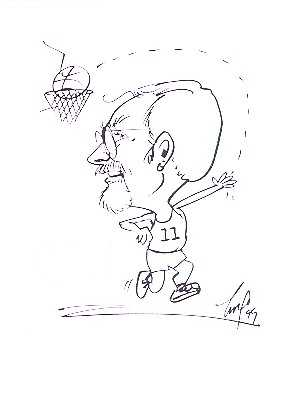
a sermon preached by the Rev. Dr. Tim W. Jensen
at the First Religious Society in Carlisle, Massachusetts
Sunday January 9th, 2005
[extemporaneous introduction]
I've been thinking quite a bit here lately about how much the meaning of the word "Red" has changed just in the course of my own lifetime. Nowadays to be a "Red" apparently means to be a socially-conservative Religious fundamentalist who typically resides in either the South or the Midwest, and for whom "moral values" was the most important consideration in the recent election. Which is, of course, vastly different from what it meant to call someone a "Red" when I was young(er). Back then (as I'm sure all ya'll already know), "Red" was slang for Communist, or perhaps by association, communist sympathizer (or what some today might call a "liberal") -- the radicals who invented Social Security, and not the ones who want to "privatize" it.
And I was delighted to discover (when I got to be of an age when I could appreciate what it meant) that I actually have authentic Reds on both sides of my family tree. The first was my mother's Uncle Al Glotzer, a New York Jew and fiery young Bolshevik back in the days when that actually meant something, who at one point even traveled to Turkey to consult the exiled Leon Trotsky on an obscure point of Marxist ideology, and was pressed into service as one of his bodyguards. And the other was my father's uncle, "Big Bill" Baldwin -- a minor Wobblie in the forests of the Pacific Northwest who was eventually blacklisted by the timber barons, and forced to eek out a living working in the underground economy as a shade-tree mechanic.
Of course, by the time I was old enough to appreciate what they had done, you would never have been able to tell by looking at them. My uncle Al was a semi-retired court stenographer who split his time between his rent-controlled Manhattan apartment and his modest place on Martha's Vineyard; while my uncle Bill turned out not to be my uncle at all: we learned at his death that he and my Auntie Lala had been living together "without benefit of clergy" for nearly half-a-century, not because "Big Bill" was ideologically opposed to the bourgeois institution of marriage, but because Lala knew that her own mother (my great-grandmother) would never have approved of her being married to a Red! And since Bill had apparently not filed an income tax return in all those years either, his estate turned out to be a real mess -- although I did inherit a box of rather interesting books, including a big bundle of Robert Ingersoll tracts and a hardbound copy of Edward Bellamy's utopian classic "Looking Backward."
The start of a New Year is a natural time for people to think about Change. It's part of our culture: this is the season when we gaze back retrospectively at where we've been, or look forward in anticipation of where we are headed, and if we don't like what we see, we resolve to change. Of course, contemplating change is a whole lot easier than actually changing for real, because there's always a price to pay for change, which brings me to the title of today's sermon: "If You Fear Change, Leave It Here." This was the small, hand-written sign taped to the tip jar in the espresso cafe in Eugene, Oregon where I used to go practically every day when I was finishing up my doctoral dissertation. I really liked this sign, because it struck me as just the right combination of subtle tweak to my self-consciousness about being such a strong creature of habit, as well as a clever reminder that there was something tangible I could do to break out of my own little self-absorbed world of dissertation writing and (in a small way at least) contribute toward changing someone else's life for the better. If you fear change, leave it here. Those seven little words were worth an extra twenty cents a day, or about a dollar a week, for the employees of the cafe who made my tall double non-fat latte every morning. Perhaps not a whole lot in and of itself. But when you multiply by the number of people who, life myself, visited that cafe on a near-daily basis, it starts to add up in a hurry.
We all have different reactions to change. Some people are so change resistant that even the slightest disruption of their familiar routine is enough to upset them profoundly, while others routinely like to shake things up just for the excitement of doing things differently for a change. But most of us, I suspect, are somewhere in between -- we appreciate the novelty of an occasional change of scene, while at the same time feeling nostalgic about the familiar things we hope will never change. And of course, not all changes are created equal; there are also various levels of change, some of which feel more disturbing than others.
For example, many so-called "changes" are merely superficial, or on the surface. The appearance changes, but not the real essence of the thing itself. Superficial change is sometimes compared to "rearranging the deck chairs on the Titanic," but I'm not so sure this is really fair. Not every little bump in the night is a collision with an iceberg; sometimes, if all you want to do is get out of the wind, or maybe get a better tan, rearranging deck chairs is a perfectly good response. Furthermore, the notion of the "tipping point" suggests that sometimes small, incremental changes which improve quality in key areas, or a few select new additions which enhance what one is doing already, can often create a ripple effect which extends well beyond their immediate impact. And likewise it is also quite possible to attempt dramatic, sweeping changes which never really get beneath the surface of a problem, and often end up creating more problems than they solve.
The real secret to creating meaningful, effective, substantive change is to focus on changing attitudes as well as behavior. It is so much easier to do things differently when you have also learned how to see them differently, and this improved perspective -- a "changed mind" -- is not only the first step, but also the most important step, in creating truly significant changes in one's life, or in an institution, or even in society itself. Of course, not every new idea is a good one, and not all change is for the better. Yet generally speaking, the more expansive one's perspective, the easier it is to distinguish the good ideas from the bad ones. When we allow meaningless details to distract us from looking at the bigger picture, or a false sense of urgency to prevent us from taking a longer view, we end up running the dual risk of changing things that don't really need to be changed at all, while shortsightedly failing to change the things that will truly make a difference in the long run.
Which brings us at last to the most difficult, most challenging, and perhaps most frightening thing about change, which is the frequent failure to recognize that some form of change is not only necessary, but inevitable. The only thing constant in life is change. And yet, it also so happens that the more things change, the more they remain the same. And between these two truisms is the daunting task of distinguishing between reactive or reactionary change, which typically struggles to resist changes in the larger environment by reinventing the past as a bulwark against the future, and adaptive or progressive change, which attempts to anticipate these larger changes and respond to them in fresh, creative and innovative ways.
I want to change the subject here slightly for just a moment, and say a word or two about some of the changes that are taking place in the Church. And not so much this particular church, but rather "the Church" in general, beginning with the evangelical church, the "Red" church. Evangelical Christianity is no longer just the warm, fuzzy, feel-good religion I remember from when I was a kid. And who knows? -- maybe it never really was that way to begin with. But it seems to me that the Good News about redeeming lost souls through the power of God's love has taken on kind of a hard edge of late, and perhaps even developed a bit of a mean streak to go along with it. It's become more aggressive, and discovered a fondness for throwing its weight around in order to get its own way. The so-called traditional "mainline" churches, on the other hand, at times seem to have lost touch with many of their historically sources of inspiration: the Social Gospel, Liberation theology, the Civil Rights movement. As its membership has grown relatively older, and dwindled in absolute numbers over the past quarter of a century, the Mainline church has started to look inward, attending to the needs of its own remaining members and their children, and to the maintenance and preservation of its property and facilities, rather than attempting to save the world by serving humanity in a spirit of compassion and Social Reform.
In addition to its new-found political agenda, the Evangelical church has continued to explore new and dynamic forms of public worship, to develop strong, innovative teaching ministries, and to pursue its traditional evangelical emphasis on making new converts and "winning souls for Christ," together with more generalized missionary efforts intended to transform society and reshape it along "Christian" lines. Meanwhile the Mainline churches have, for the most part, continued to cling to their traditional forms and methods of worship and education, as if by preserving practices that are in some cases centuries old, they are somehow "keeping the faith" as well; and have often shied away from even the appearance of attempting to impose their own views on others, in the name of religious pluralism and freedom of belief.
These are all just generalizations of course, drawn from the research of those who study this sort of thing for a living. There are plenty of exceptions across the board -- exceptional churches who buck the trends and make their own rules, who embrace change rather than reacting against it, and take advantage of the opportunity to shape their own futures rather than clinging desperately to the past. They know that things are going to change whether they want them to or not, and have decided to change their own attitude about the need for change in order to become part of the cutting edge rather than one of its victims. So I thought I'd wrap up here this morning simply by talking briefly about three of the most common "attitude changes" within exceptional Mainline churches that have helped transform them into vital and dynamic spiritual communities for the 21st century.
The first of these is something I know some of you have heard me talk about on other occasions, and that is transforming an existing spirit of Fellowship to a broader spirit of Hospitality. Most churches see themselves as friendly places, and most of them are...for the people who are already part of the community. But often good intentions go astray: churches put up signs or even run advertisements declaring that "all are welcome," but then when someone new actually shows up at the door they are basically ignored (so as not to put any undo pressure on them), and then if they do decide to stick around anyway, they are quickly assigned to a committee, asked to make a financial contribution, and then carefully monitored by the more "experienced" members of the congregation in order to prevent them from attempting to make any changes to "the way we've always done it here."
It's such a common phenomenon that I could probably take this same sermon into just about any church in the country: Methodist, Baptist, Catholic, Episcopalian, Presbyterian, Unitarian -- it doesn't really matter -- and about half the congregation would be thinking "that's just what happened to me." And of course we never hear anything at all from the ones who decided NOT to stick around. But a Spirit of Hospitality intentionally seeks out newcomers, and invites them in as guests. People are greeted by name, and made to feel welcome just as they are, regardless of whether they really "fit in" or may eventually become active members of the congregation. The subtle distinctions between "insider" and "outsider" are minimized or eliminated; perhaps more importantly, the primary question of the day becomes "what can our church do to make our guests feel more at home?" rather than "what can these newcomers do for us?" A Spirit of Hospitality is not about church growth. Its about making sure that people who are seeking something different in their lives can find what they are looking for.
A second important attitude change is the transformation of an existing culture of Conservation and Stewardship into a Culture of Generosity and Abundance. Conservation and Stewardship are about the responsible use of scarce and precious resources, which are assumed to be limited and therefore need to be strictly and frugally allocated. It's a zero-sum game, which borrows from Peter to pay Paul, and where there is never enough to go around. A culture of generosity and abundance begins with a different set of assumptions. It assumes that "where your treasure is, there shall your heart be also" and then asks people to put their hearts into the things they truly value most. Churches never have enough money to do everything they dream of doing, but they always seem to find the money to do the things they really want to do, or feel that they they must. A culture of generosity and abundance lifts up a vision of possibility rather than one of neediness, and then invites people to become partners to help create it. Which is not to suggest that resources are unlimited, or should be allocated foolishly. But often it is only our own sense of limitation that holds us back, and when we overcome that, we become capable of accomplishing together more than we ever dreamed possible.
The final important attitude change I wanted to mention this morning is the transition from an ethic of Faithfulness to one of Mission and Vocation. The ethic of Faithfulness is about remaining true to one's beliefs, and to the values of one's society or community of faith. And there is certainly nothing wrong with that, just like there is nothing wrong with Fellowship, or Conservation and Stewardship either. But an ethic of Mission and Vocation asks that you go beyond mere faithfulness to a discernment of what you personally have specifically have been called to do in this world, and then offers the encouragement to actually go out and do it. In other words, it's not really enough just to "keep the faith;" one also needs to "spread the faith," to put it to work to make a difference in your own life and in the lives of others. Call to mind again that wonderful verse from the letter of James: "Show me your faith apart from you works, and I by my works will show you my faith." But it's not really a matter of "showing off" -- rather, we bring our faith to life by putting it to work, and thus give our lives larger meaning in the process.
Adopting these kinds of changed attitudes isn't always easy, especially if the other attitudes are working just fine for you, and you don't really see the need to change. But I also hope that as you continue to explore these themes in the weeks and months and years ahead, that you will remain open and receptive to the possibility of real change -- some of it apparently superficial, some of it more difficult and substantial, and some of it quite possibly deeply profound indeed. Because the work of the church -- of this church, and every church -- is to change people's lives for the better. And that is certainly something that none of us need fear.
Sunday, January 9, 2005

Sunday, December 19, 2004
WHEN CHRISTMAS WAS A CRIME
a sermon preached by the Rev. Dr. Tim W. Jensen
at the First Religious Society in Carlisle, Massachusetts
Sunday December 19th, 2004
Early before dawn on the morning of December 26th, 1776, the Continental Army under the command of General George Washington ferried across the partially frozen Delaware river and attacked a garrison of Hessian mercenaries occupying the town of Trenton, New Jersey. Surprise was complete; according to legend at least, most of the Germans were still sleeping off the riotous Christmas celebration they had tied on the night before. One American soldier described the battle in his diary this way: "Hessian population of Trenton at eight am: 1,408 men and 39 officers; Hessian population at nine am: zero." Over 900 of the German troops were killed or captured, at the cost of only two American lives. On the body of Colonel Ralls, the German commander, the Americans found a letter from a British loyalist warning of Washington's imminent attack. The letter was still unopened.
Ralls had been a victim of his own preconceptions: no "Christian" army would launch an attack on Christmas Day! But these were not Catholics, nor Lutherans, nor even Anglicans that the German mercenaries were up against. They were, for the most part, Congregationalists from New England, inheritors of a Puritan legacy which viewed the celebration of Christmas as a "Popish superstition," a "wanton, Bacchanalian feast," and in some jurisdictions here in the Commonwealth of Massachusetts, a criminal offense punishable by a fine of five shillings and confinement in the stocks. These New Englanders had little care for Yule logs and Mistletoe, wassail and Carols and Christmas pudding. Theirs was a tradition of "pure" Christianity, stripped of the trappings of Druidic witchcraft and Roman syncretism. When they wanted to feast, they declared a Day of Thanksgiving and ate Turkey and Cranberries. And there was certainly plenty of thanks being given on the day their captured Hessian prisoners were paraded through the streets of Philadelphia. The dwindling Patriot army had finally won an important victory, and Congress reacted by voting to allow Washington to continue his command.
Although attitudes had certainly moderated somewhat by the time of George Washington, the underlying sentiments of 17th century Puritanism were still quite influential in Revolutionary New England. Puritan religion was based on three simple precepts: a deeply abiding sense of original sin and the total depravity of human kind; a personal awareness of the regenerative power of God's grace through His predestined election of a few unworthy souls for salvation; and a compelling notion of service and religious duty in thanks for God's gift of unconditional election. The Puritans saw themselves as embarked upon an errand into the wilderness, an errand to create a "city upon a hill," a beacon to all the world which would shine as an example of the ideal Christian community, ruled and regulated according to God's Holy Ordinances as revealed in Scripture.
They took themselves and their mission seriously, yet they were also fine scholars, who were well aware of the pagan origins of most Christmas traditions, and who believed that God would turn His back upon their community should they stray from their stern covenant into the festive merriment of the traditional Yuletide holiday. The frivolous actions of just a few might easily bring down God's wrath upon the entire colony. Thus the magistrates were empowered to arrest and punish blasphemers, Sabbath breakers, and anyone else whose ideas or actions might endanger the stability of their perfect Christian community, including those who celebrated Christmas, whether by feasting, or abstaining from labor, or in any other way marking the occasion as something special or out of the ordinary. For the Puritans, Christmas was a day like any other day; to observe otherwise was not only to risk the wrath of God, but to place oneself in danger of criminal prosecution as well.
The Puritan attitude towards Christmas may seem a bit extreme to us today. But then again, the Puritans never did have much of a reputation as a fun-loving bunch. Nowadays, while we might complain about the "commercialization" of Christmas, or the emotional stress of entertaining our friends and families, few of us give much serious thought to the essentially pagan origins of the holiday, nor, I suspect, would we be particularly concerned about them if we did. The evolution of an obscure 4th century Turkish Bishop, St. Nicholas, into a rotund, white bearded "jolly old elf," who dresses in red, owns a herd of flying reindeer, and lives at the North Pole raises few eyebrows; nor are we troubled by the amazing coincidence that December 25th also happens to be the birthday of the Greek God Adonis, the Egyptian God Horus, and the Persian God Mithra, all of whom were well entrenched on the winter solstice long before a virgin gave birth to a savior in a stable in Bethlehem, and laid him in a manger wrapped in swaddling clothes.
Instead, we trim our trees and adorn our homes with holly and mistletoe much as the Celts did centuries ago; we exchange cards and brightly wrapped gifts; bake pies and cookies and cakes; we sing of miracles, of peace on earth, good will to all; and hang our stockings by the chimney with care. We tell ourselves, with a wink, that "Christmas is for Children," all the time knowing that the best parts of Christmas are really for adults, and are often completely lost upon the avaricious little monsters, who scoff at movies like "It's a Wonderful Life," write letters to "Santa" that require extra postage, ransack our closets behind our backs, and just don't seem to quite understand what the whole thing's really all about. Adults tolerate children at Christmas, I think, because we remember that we were once children ourselves. Indeed, if in any sense "Christmas is for Children," it is for the inner children who live within us still, and are now finally old enough to truly understand the message of peace, hope and innocence embodied in this season.
When my kids were younger and still living at home, we had a tradition in our household of only celebrating Christmas every other year. This unorthodox practice dated back to my ex-wife’s first divorce, and an agreement she had with her ex-husband that the kids would spend every other Christmas with him. On those years, Margie simply skipped Christmas at her house altogether, which worked out pretty well for her, since she’s never really been that big of a “Christmas person” anyway; she always associates this time of year with a couple of very unpleasant memories: the untimely death of her mother, when Margie was only 21, and also the death of her own second-born child, Nathan, from Sudden Infant Death Syndrome, a few years after that. So she always kind of appreciated having a built-in excuse to take it easy during the holidays.
And the first year we were married, I think both Jake and Steph kinda assumed that because I was a minister, I HAD to celebrate Christmas every year whether I wanted to or not. So when I announced that we would continue the previous tradition, at first they didn't take me seriously. But after a couple of weeks, when there wasn't any tree, and there weren't any lights, and there weren't any mysterious packages from the Mall hidden in any of our closets, they began to get a little worried. I think they'd both been looking forward to really cleaning up that year, on having two Christmases, with twice the usual amount of candy, and twice the usual number of presents: a real orgy of "ripping," as they so delicately described it, with all the attendant excitement and attention. And I can certainly understand that wish; I suppose in many ways, it's every kid's dream: a Christmas that never ends.
I don't know how many of you have ever had to face this situation of sharing children with a former spouse over the holidays, but it's a fairly common thing these days, and it can be kind of tricky, both logistically and emotionally. There's a real temptation to over-react, to set yourself up in competition with the other person to see who can provide the "better" Christmas, which all too often boils down to who has the deepest pockets. Kids know this, of course, and they play it up for all its worth: not maliciously, I think, but rather because they're not really old enough to know any better. Children have very tangible minds: they like things that they can see and touch. Money is no object with children, because they don't really understand it, although this has its advantages too; the most popular Christmas gift I ever purchased for my children was a 99 cent Nerf ball, which I bought one Christmas Eve as an afterthought while browsing through a local drug store on another last-minute errand.
Yet it is this very quality we find so endearing in children which convinces me that Christmas is wasted upon them. Until one develops the capacity to appreciate the intangibles of Christmas, the holiday remains merely a celebration of consumption: shallow, superficial, and ultimately disappointing. We might as well imitate the Puritans and eliminate it all together, for it adds nothing to the quality of our lives, it simply distracts us from the things that are ultimately important.
The delighted squeal of children on Christmas morning is a transitory thing; it passes away and is soon forgotten: the adults tend to remember it far longer than the kids do. The cries of hungry children who do not have enough to eat are far more persistent, yet even when we pause long enough to hear them cry, it often seems as though there is realistically very little any one of us can hope to do in order to meet that urgent need. Perhaps, if we are conscientious, we try to do our share, and hope that with the help of others, it will be enough. But it never really is enough. Yet it is between these two contrasting extremes that the real meaning of Christmas, the real Spirit of Christmas, can be found. It is found the story of a baby born in a stable because there was no room at the inn, born far from home, on the longest night of the year, to bring a light into the world; incarnating, if you will, the very real possibility that both greed and poverty can be transcended through the simple expedient of profound human relationship, to one another and to the divine, uniting kings and shepherds, animals and angels, in common service to a sovereign mystery, to the appearance of a new star in the sky.
And perhaps it never really happened; perhaps it is nothing but a myth. But the possibility still exists, in the power of the story to help us see beyond the tangible, to reach out to the things we can not touch, and hold them firmly in our hearts all the same.
at the First Religious Society in Carlisle, Massachusetts
Sunday December 19th, 2004
Early before dawn on the morning of December 26th, 1776, the Continental Army under the command of General George Washington ferried across the partially frozen Delaware river and attacked a garrison of Hessian mercenaries occupying the town of Trenton, New Jersey. Surprise was complete; according to legend at least, most of the Germans were still sleeping off the riotous Christmas celebration they had tied on the night before. One American soldier described the battle in his diary this way: "Hessian population of Trenton at eight am: 1,408 men and 39 officers; Hessian population at nine am: zero." Over 900 of the German troops were killed or captured, at the cost of only two American lives. On the body of Colonel Ralls, the German commander, the Americans found a letter from a British loyalist warning of Washington's imminent attack. The letter was still unopened.
Ralls had been a victim of his own preconceptions: no "Christian" army would launch an attack on Christmas Day! But these were not Catholics, nor Lutherans, nor even Anglicans that the German mercenaries were up against. They were, for the most part, Congregationalists from New England, inheritors of a Puritan legacy which viewed the celebration of Christmas as a "Popish superstition," a "wanton, Bacchanalian feast," and in some jurisdictions here in the Commonwealth of Massachusetts, a criminal offense punishable by a fine of five shillings and confinement in the stocks. These New Englanders had little care for Yule logs and Mistletoe, wassail and Carols and Christmas pudding. Theirs was a tradition of "pure" Christianity, stripped of the trappings of Druidic witchcraft and Roman syncretism. When they wanted to feast, they declared a Day of Thanksgiving and ate Turkey and Cranberries. And there was certainly plenty of thanks being given on the day their captured Hessian prisoners were paraded through the streets of Philadelphia. The dwindling Patriot army had finally won an important victory, and Congress reacted by voting to allow Washington to continue his command.
Although attitudes had certainly moderated somewhat by the time of George Washington, the underlying sentiments of 17th century Puritanism were still quite influential in Revolutionary New England. Puritan religion was based on three simple precepts: a deeply abiding sense of original sin and the total depravity of human kind; a personal awareness of the regenerative power of God's grace through His predestined election of a few unworthy souls for salvation; and a compelling notion of service and religious duty in thanks for God's gift of unconditional election. The Puritans saw themselves as embarked upon an errand into the wilderness, an errand to create a "city upon a hill," a beacon to all the world which would shine as an example of the ideal Christian community, ruled and regulated according to God's Holy Ordinances as revealed in Scripture.
They took themselves and their mission seriously, yet they were also fine scholars, who were well aware of the pagan origins of most Christmas traditions, and who believed that God would turn His back upon their community should they stray from their stern covenant into the festive merriment of the traditional Yuletide holiday. The frivolous actions of just a few might easily bring down God's wrath upon the entire colony. Thus the magistrates were empowered to arrest and punish blasphemers, Sabbath breakers, and anyone else whose ideas or actions might endanger the stability of their perfect Christian community, including those who celebrated Christmas, whether by feasting, or abstaining from labor, or in any other way marking the occasion as something special or out of the ordinary. For the Puritans, Christmas was a day like any other day; to observe otherwise was not only to risk the wrath of God, but to place oneself in danger of criminal prosecution as well.
The Puritan attitude towards Christmas may seem a bit extreme to us today. But then again, the Puritans never did have much of a reputation as a fun-loving bunch. Nowadays, while we might complain about the "commercialization" of Christmas, or the emotional stress of entertaining our friends and families, few of us give much serious thought to the essentially pagan origins of the holiday, nor, I suspect, would we be particularly concerned about them if we did. The evolution of an obscure 4th century Turkish Bishop, St. Nicholas, into a rotund, white bearded "jolly old elf," who dresses in red, owns a herd of flying reindeer, and lives at the North Pole raises few eyebrows; nor are we troubled by the amazing coincidence that December 25th also happens to be the birthday of the Greek God Adonis, the Egyptian God Horus, and the Persian God Mithra, all of whom were well entrenched on the winter solstice long before a virgin gave birth to a savior in a stable in Bethlehem, and laid him in a manger wrapped in swaddling clothes.
Instead, we trim our trees and adorn our homes with holly and mistletoe much as the Celts did centuries ago; we exchange cards and brightly wrapped gifts; bake pies and cookies and cakes; we sing of miracles, of peace on earth, good will to all; and hang our stockings by the chimney with care. We tell ourselves, with a wink, that "Christmas is for Children," all the time knowing that the best parts of Christmas are really for adults, and are often completely lost upon the avaricious little monsters, who scoff at movies like "It's a Wonderful Life," write letters to "Santa" that require extra postage, ransack our closets behind our backs, and just don't seem to quite understand what the whole thing's really all about. Adults tolerate children at Christmas, I think, because we remember that we were once children ourselves. Indeed, if in any sense "Christmas is for Children," it is for the inner children who live within us still, and are now finally old enough to truly understand the message of peace, hope and innocence embodied in this season.
When my kids were younger and still living at home, we had a tradition in our household of only celebrating Christmas every other year. This unorthodox practice dated back to my ex-wife’s first divorce, and an agreement she had with her ex-husband that the kids would spend every other Christmas with him. On those years, Margie simply skipped Christmas at her house altogether, which worked out pretty well for her, since she’s never really been that big of a “Christmas person” anyway; she always associates this time of year with a couple of very unpleasant memories: the untimely death of her mother, when Margie was only 21, and also the death of her own second-born child, Nathan, from Sudden Infant Death Syndrome, a few years after that. So she always kind of appreciated having a built-in excuse to take it easy during the holidays.
And the first year we were married, I think both Jake and Steph kinda assumed that because I was a minister, I HAD to celebrate Christmas every year whether I wanted to or not. So when I announced that we would continue the previous tradition, at first they didn't take me seriously. But after a couple of weeks, when there wasn't any tree, and there weren't any lights, and there weren't any mysterious packages from the Mall hidden in any of our closets, they began to get a little worried. I think they'd both been looking forward to really cleaning up that year, on having two Christmases, with twice the usual amount of candy, and twice the usual number of presents: a real orgy of "ripping," as they so delicately described it, with all the attendant excitement and attention. And I can certainly understand that wish; I suppose in many ways, it's every kid's dream: a Christmas that never ends.
I don't know how many of you have ever had to face this situation of sharing children with a former spouse over the holidays, but it's a fairly common thing these days, and it can be kind of tricky, both logistically and emotionally. There's a real temptation to over-react, to set yourself up in competition with the other person to see who can provide the "better" Christmas, which all too often boils down to who has the deepest pockets. Kids know this, of course, and they play it up for all its worth: not maliciously, I think, but rather because they're not really old enough to know any better. Children have very tangible minds: they like things that they can see and touch. Money is no object with children, because they don't really understand it, although this has its advantages too; the most popular Christmas gift I ever purchased for my children was a 99 cent Nerf ball, which I bought one Christmas Eve as an afterthought while browsing through a local drug store on another last-minute errand.
Yet it is this very quality we find so endearing in children which convinces me that Christmas is wasted upon them. Until one develops the capacity to appreciate the intangibles of Christmas, the holiday remains merely a celebration of consumption: shallow, superficial, and ultimately disappointing. We might as well imitate the Puritans and eliminate it all together, for it adds nothing to the quality of our lives, it simply distracts us from the things that are ultimately important.
The delighted squeal of children on Christmas morning is a transitory thing; it passes away and is soon forgotten: the adults tend to remember it far longer than the kids do. The cries of hungry children who do not have enough to eat are far more persistent, yet even when we pause long enough to hear them cry, it often seems as though there is realistically very little any one of us can hope to do in order to meet that urgent need. Perhaps, if we are conscientious, we try to do our share, and hope that with the help of others, it will be enough. But it never really is enough. Yet it is between these two contrasting extremes that the real meaning of Christmas, the real Spirit of Christmas, can be found. It is found the story of a baby born in a stable because there was no room at the inn, born far from home, on the longest night of the year, to bring a light into the world; incarnating, if you will, the very real possibility that both greed and poverty can be transcended through the simple expedient of profound human relationship, to one another and to the divine, uniting kings and shepherds, animals and angels, in common service to a sovereign mystery, to the appearance of a new star in the sky.
And perhaps it never really happened; perhaps it is nothing but a myth. But the possibility still exists, in the power of the story to help us see beyond the tangible, to reach out to the things we can not touch, and hold them firmly in our hearts all the same.
Sunday, December 5, 2004
THE FLAME THAT WOULDN'T DIE
a sermon preached by the Rev. Dr. Tim W. Jensen
at the First Religious Society in Carlisle, Massachusetts
Sunday December 5th, 2004
READING: 1 Maccabees 4: 34-59
When I was a child, growing up in a Unitarian Universalist Sunday School, I always had a lot of fun when we were given the opportunity to celebrate Hanukkah. We lit the candles in the Menorah, we played with Dreidels, we heard the story of the lamp that burned for eight straight days, when there was only a one day supply of oil. In the predominately Catholic neighborhood where we lived, "The Feast of Lights" seemed like our Unitarian-Universalist answer to Advent — not only did it avoid a lot of problematic issues like the Virgin Birth, but it also introduced us to the whole idea of cross-cultural celebrations of the Winter Solstice: the coming of Light into the world, in the season where nights are long and darkness reigns, and it had the added advantage of eight straight days of presents. (In our house that particular tradition only lasted one year, by the way; in subsequent years my parents would only concede to allowing us to open one gift of our choice on Christmas Eve).
I always had a little trouble, though, understanding this business about the lamp that burned for eight days in the temple. After all, a one-day supply of oil is a one-day supply of oil; if the lamp burned for eight days, obviously that was an eight-day supply: someone simply must have made a mistake when they were doing the inventory. I just didn't see what all the fuss was about. Maybe there was a clever priest (or more likely, a building and grounds chair), who was somehow able to adjust the flame and stretch the supply, make the oil last longer than it should have. There was nothing miraculous about that; my mom did that sort of thing all the time. She called them “leftovers.” So I guess I just had a strong humanist streak from a very early age, because it was years before I was able to understand that the flame of the Menorah was only a symbol of the real miracle. The temple had been defiled, but the faith had endured, and triumphed. This is the real miracle of the Feast of Dedication.
Let me share with you a little more of the history behind the the story of Hanukkah. In the year 167 BCE the Selucid emperor Antiochus IV ordered the rededication of the Jewish temple in Jerusalem to the worship of Zeus. The Selucids were one of three dynasties which had emerged from the remnants of Alexander the Great's empire following his death a century and a half earlier. Based primarily in what is now Syria, the Selucids were almost constantly at war with a second post-Alexandrian dynasty, the Ptolemies, who were located in Egypt. Even in that day, there were already significant Jewish communities in both Babylonia (which was controlled by the Selucids) and Alexandria (the capital of the Ptolemies). Life in the diaspora had already begun; while Judaea, the original home of the Jewish people, served as something of a buffer between these two Great Powers of the ancient world, and was constantly buffeted by the ebb and flow of their political and military ambitions.
Controlled by the Ptolemies until the start of the second century BCE, Judea eventually came under the hegemony of the Selucids following their decisive victory over the Ptolemies at the Battle of Banyas, which took place near the headwaters of the Jordan River. To a significant degree, this development was welcomed by many of the Jewish inhabitants of Judaea, because the Ptolemies had been great Hellenizers, which is to say they were fond of introducing Greek customs and practices into the cultures they ruled. The Jewish community in Alexandria, for example, had been deeply influenced by Greek philosophy; and it was their Greek translation of the Hebrew scriptures, the Septuagint, that would eventually become a key factor in the rapid spread of Christianity among the Greek-speaking Gentiles of the Roman Empire.
Selucid rule, on the other hand, appeared to promise the practice of a more authentically Hebrew Judaism, such as existed in Babylonia. But this expectation was not to be borne out. Roman influence in the Eastern Mediterranean was growing; in order to pay for his increasingly expensive military adventures, as well as shield his empire from the threat of Rome, Antiochus IV greatly increased the level of taxation in Judaea, plundering the treasury of the temple in Jerusalem, and also cracking down on dissident Jewish groups who resented the burdens imposed by their Greek-speaking rulers, and who sought the freedom to manage their own affairs. In order to pacify the region, Antiochus IV accelerated the Hellenization of Judaea, siding with those Jews who were sympathetic to Greek ideas and culture, and doing everything within his power to eliminate the practice of Judaism as a distinctive religious faith.
This is the background of the Maccabean revolt. The Maccabees were a guerrilla insurgency who took to the hills in order to resist these changes. Their leader was initially a priest named Mattathias Maccabaeus, who not only refused to offer pagan sacrifice in the Jewish temple where he served, but also reportedly killed the first Jewish apostate who had attempted to do so. When Mattathias himself later died, leadership of the guerrilla army fell upon the shoulders of his oldest son, Judas Maccabaeus, who was eventually able to drive the Selucids out of the city of Jerusalem, and re-dedicate the temple there to the worship of the Hebrew God Yahweh, as we heard in the passage from the First Book of Maccabees I read earlier this morning. This is the origin of Hanukkah — the Festival of Dedication — the only major festival in Judaism not explicitly rooted in the Torah.
There are some major ironies contained within the story of Hanukkah. The Maccabean revolt was a war fought for the purpose of religious liberty — the only such revolt of its kind recorded in ancient history — yet the Maccabees themselves were hardly the religious liberals of their day. They were more akin, perhaps, to modern fundamentalists in their attitudes and practices with respect to their religion; and I suppose if you were Antiochus IV, you might even have called them terrorists. Likewise, the only records of their achievements which have survived were written in Greek, most likely by members of the Jewish community in Alexandria. Although the Maccabees were able to defeat the Selucids at Jerusalem, their position there was anything but secure; thus, a few years later, they entered into a military alliance with the Romans — an act which virtually insured the eventual subjugation of the Jewish people, and the loss of a national Jewish homeland for 2000 years. By the time of Christ, it was Rome who ruled in Judaea; in 70 AD Roman soldiers demolished the temple which Judas Maccabaeus had fought so hard to reconsecrate. Only a portion of a single wall, now known as the "Wailing Wall," was left standing.
Yet the flame of the Maccabees still burns. And the ironies, tragic ironies, still continue. Deep down in my heart of hearts, I have always been something of a closet Zionist. Perhaps this stems, in part, from having had a Jewish grandfather (on my mother’s side), and more recently a brother who has converted to Judaism, and whose wife’s extended family includes Holocaust survivors. But whatever the reason, I’ve always taken pride in the independence of the modern state of Israel, and in the contributions of Judaism in general to Western thought, culture, and civilization. The flame of the Hanukkah Menorah symbolizes the light of that contribution, as well as the persistent struggle of the Jewish people to preserve their religious faith and practice in the face of almost constant anti-semitic persecution and oppression. Zionism reflects the burning aspiration of Jews for a nation of their own, a place to call home. But there is also a shadow cast by Zionism: a shadow which those of us who like to consider ourselves friends of Israel are sometimes reluctant to explore. Hanukkah is a celebration of Light and Hope, Joy and Compassion — in many ways it represents the very best of what religion has to offer us here in this world. Even in the shadow of September 11th and the subsequent war on terror, there are no doubt still many Jews, many people of all faiths the world over, who are deeply troubled by the current “hard line” policies of the Sharon government toward the Palestinians on the West Bank and in Gaza, and who lament the apparent disappearance of hope for a negotiated peace based on principles of mutual tolerance, reasonable accommodation, and sympathetic understanding. It doesn’t matter whether you call it a fence or a wall, trying to confine a “problem” behind concrete and barbed wire in the hopes that it will eventually go away has never really been an effective strategy. Nor does the role of armed oppressor come naturally to the Jewish spirit; and this too, is a lingering irony of the legacy of the Maccabees, whose military victories ultimately brought ruin to their nation.
In his Hanukkah story "The Power of Light," Isaac Bashevis Singer tells of two Jewish children, David and Rebecca, hiding in the ruins of the Warsaw ghetto following its destruction by the Nazis during the Second World War. On the first night of Hanukkah, David finds some matches and a candle while foraging in the rubble, and returns to their hiding place to share his discovery. Singer writes:
Now David pronounced the benediction over the Hanukkah candle, and Rebecca said "Amen." They had both lost their families, and they had good reason to be angry with God for sending them so many afflictions, but the light of the candle brought peace into their souls. That glimmer of light, surrounded by so many shadows, seemed to say without words: Evil has not yet taken complete dominion. A spark of hope is still left.
For some time David and Rebecca had thought about escaping from Warsaw. But how? The ghetto was watched by the Nazis day and night. Each step was dangerous. Rebecca kept delaying their departure. It would be easier in the summer, she often said, but David knew that in their predicament they had little chance of lasting until then. Somewhere in the forest there were young men and women called partisans who fought the Nazi invaders. David wanted to reach them. Now, by the light of the Hanukkah candle, Rebecca suddenly felt renewed courage. She said, "David, let's leave."
"When?" [David asked.]
"When you think it's the right time," she answered.
"The right time is now," David said. "I have a plan."
For a long time David explained the details of his plan to Rebecca. It was more than risky. The Nazis had enclosed the ghetto with barbed wire and posted guards armed with machine guns on the surrounding roofs. At night searchlights lit up all possible exits from the destroyed ghetto. But in his wanderings through the ruins, David had found an opening to a sewer which he thought might lead to the other side. David told Rebecca that their chances of remaining alive were slim. They could drown in the dirty water or freeze to death. Also, the sewers were full of hungry rats. But Rebecca agreed to take the risk; to remain in the cellar for the winter would mean certain death.
When the Hanukkah light began to sputter and flicker before going out, David and Rebecca gathered their few belongings. She packed the remaining food in a kerchief, and David took his matches and a piece of lead pipe for a weapon.
In moments of great danger people become unusually courageous. David and Rebecca were soon on their way through the ruins. They came to passages so narrow they had to crawl on hands and knees. But the food they had eaten, and the joy the Hanukkah candles had awakened in them, gave them the courage to continue. After some time David found the entrance to the sewer. Luckily, the sewage had frozen, and it seemed that the rats had left because of the extreme cold. From time to time David and Rebecca stopped to rest and to listen. After a while they crawled on, slowly and carefully. Suddenly they stopped in their tracks. From above they could hear the clanging of a trolley car. They had reached the other side of the ghetto. All they needed now was to find a way to get out of the sewer and to leave the city as quickly as possible.
Many miracles seemed to happen that Hanukkah night. Because the Nazis were afraid of enemy planes, they had ordered a complete blackout. Because of the bitter cold, there were fewer Gestapo guards. David and Rebecca managed to leave the sewer and steal out of the city without being caught. At dawn they reached a forest where they were able to rest and have a bite to eat.
After a week of traveling by night and hiding by day, David and Rebecca meet up with a group of Jewish partisans hiding in the forest. It is now the final night of Hanukkah, and the children play dreidel on the stump of an oak tree while others keep watch. More and more refugees join them, and they slowly make their way to Israel, assisted by the Haganah: an organization which worked to smuggle Jewish refugees out of Nazi-occupied Europe and into the Holy Land. They finish school, marry, and find a small house with a garden in a suburb of Tel Aviv. Singer concludes his story by writing:
I know all this because David and Rebecca told me their story on a Hanukkah evening in their house in Ramat Gan about eight years later. The Hanukkah candles were burning, and Rebecca was frying potato pancakes served with applesauce for all of us. David and I were playing dreidel with their little son, Menahem Eliezer, named after both of his grandfathers. David told me that this large wooden dreidel was the same one the partisans had played with on that Hanukkah evening in the forest in Poland. Rebecca said to me: "If it had not been for that little candle David brought to our hiding place, we wouldn't be sitting here today. That glimmer of light awakened in us a hope and strength we didn't know we possessed. We'll give the dreidel to Menahem Eliezer when he is old enough to understand what we went through and how miraculously we were saved."
Although it’s not really clear from the story, I like to think that their child, Menahem Eliezer, would be about my age this Hanukkah. OK, maybe a few years older. No doubt he has long since learned the story of his parents' rescue; perhaps by now he even has children or even grandchildren of his own, with whom he has also shared the dreidal, with its four Hebrew letters: nun, gimel, he, shin -- "a great miracle happened there." And this holiday season, may we as well share in the miracle of the Flame that wouldn't die, recalling even in this season of darkness our essential connectedness to the whole of humankind, and our renewed dedication to the timeless principles which allow our faith to endure.
at the First Religious Society in Carlisle, Massachusetts
Sunday December 5th, 2004
READING: 1 Maccabees 4: 34-59
When I was a child, growing up in a Unitarian Universalist Sunday School, I always had a lot of fun when we were given the opportunity to celebrate Hanukkah. We lit the candles in the Menorah, we played with Dreidels, we heard the story of the lamp that burned for eight straight days, when there was only a one day supply of oil. In the predominately Catholic neighborhood where we lived, "The Feast of Lights" seemed like our Unitarian-Universalist answer to Advent — not only did it avoid a lot of problematic issues like the Virgin Birth, but it also introduced us to the whole idea of cross-cultural celebrations of the Winter Solstice: the coming of Light into the world, in the season where nights are long and darkness reigns, and it had the added advantage of eight straight days of presents. (In our house that particular tradition only lasted one year, by the way; in subsequent years my parents would only concede to allowing us to open one gift of our choice on Christmas Eve).
I always had a little trouble, though, understanding this business about the lamp that burned for eight days in the temple. After all, a one-day supply of oil is a one-day supply of oil; if the lamp burned for eight days, obviously that was an eight-day supply: someone simply must have made a mistake when they were doing the inventory. I just didn't see what all the fuss was about. Maybe there was a clever priest (or more likely, a building and grounds chair), who was somehow able to adjust the flame and stretch the supply, make the oil last longer than it should have. There was nothing miraculous about that; my mom did that sort of thing all the time. She called them “leftovers.” So I guess I just had a strong humanist streak from a very early age, because it was years before I was able to understand that the flame of the Menorah was only a symbol of the real miracle. The temple had been defiled, but the faith had endured, and triumphed. This is the real miracle of the Feast of Dedication.
Let me share with you a little more of the history behind the the story of Hanukkah. In the year 167 BCE the Selucid emperor Antiochus IV ordered the rededication of the Jewish temple in Jerusalem to the worship of Zeus. The Selucids were one of three dynasties which had emerged from the remnants of Alexander the Great's empire following his death a century and a half earlier. Based primarily in what is now Syria, the Selucids were almost constantly at war with a second post-Alexandrian dynasty, the Ptolemies, who were located in Egypt. Even in that day, there were already significant Jewish communities in both Babylonia (which was controlled by the Selucids) and Alexandria (the capital of the Ptolemies). Life in the diaspora had already begun; while Judaea, the original home of the Jewish people, served as something of a buffer between these two Great Powers of the ancient world, and was constantly buffeted by the ebb and flow of their political and military ambitions.
Controlled by the Ptolemies until the start of the second century BCE, Judea eventually came under the hegemony of the Selucids following their decisive victory over the Ptolemies at the Battle of Banyas, which took place near the headwaters of the Jordan River. To a significant degree, this development was welcomed by many of the Jewish inhabitants of Judaea, because the Ptolemies had been great Hellenizers, which is to say they were fond of introducing Greek customs and practices into the cultures they ruled. The Jewish community in Alexandria, for example, had been deeply influenced by Greek philosophy; and it was their Greek translation of the Hebrew scriptures, the Septuagint, that would eventually become a key factor in the rapid spread of Christianity among the Greek-speaking Gentiles of the Roman Empire.
Selucid rule, on the other hand, appeared to promise the practice of a more authentically Hebrew Judaism, such as existed in Babylonia. But this expectation was not to be borne out. Roman influence in the Eastern Mediterranean was growing; in order to pay for his increasingly expensive military adventures, as well as shield his empire from the threat of Rome, Antiochus IV greatly increased the level of taxation in Judaea, plundering the treasury of the temple in Jerusalem, and also cracking down on dissident Jewish groups who resented the burdens imposed by their Greek-speaking rulers, and who sought the freedom to manage their own affairs. In order to pacify the region, Antiochus IV accelerated the Hellenization of Judaea, siding with those Jews who were sympathetic to Greek ideas and culture, and doing everything within his power to eliminate the practice of Judaism as a distinctive religious faith.
This is the background of the Maccabean revolt. The Maccabees were a guerrilla insurgency who took to the hills in order to resist these changes. Their leader was initially a priest named Mattathias Maccabaeus, who not only refused to offer pagan sacrifice in the Jewish temple where he served, but also reportedly killed the first Jewish apostate who had attempted to do so. When Mattathias himself later died, leadership of the guerrilla army fell upon the shoulders of his oldest son, Judas Maccabaeus, who was eventually able to drive the Selucids out of the city of Jerusalem, and re-dedicate the temple there to the worship of the Hebrew God Yahweh, as we heard in the passage from the First Book of Maccabees I read earlier this morning. This is the origin of Hanukkah — the Festival of Dedication — the only major festival in Judaism not explicitly rooted in the Torah.
There are some major ironies contained within the story of Hanukkah. The Maccabean revolt was a war fought for the purpose of religious liberty — the only such revolt of its kind recorded in ancient history — yet the Maccabees themselves were hardly the religious liberals of their day. They were more akin, perhaps, to modern fundamentalists in their attitudes and practices with respect to their religion; and I suppose if you were Antiochus IV, you might even have called them terrorists. Likewise, the only records of their achievements which have survived were written in Greek, most likely by members of the Jewish community in Alexandria. Although the Maccabees were able to defeat the Selucids at Jerusalem, their position there was anything but secure; thus, a few years later, they entered into a military alliance with the Romans — an act which virtually insured the eventual subjugation of the Jewish people, and the loss of a national Jewish homeland for 2000 years. By the time of Christ, it was Rome who ruled in Judaea; in 70 AD Roman soldiers demolished the temple which Judas Maccabaeus had fought so hard to reconsecrate. Only a portion of a single wall, now known as the "Wailing Wall," was left standing.
Yet the flame of the Maccabees still burns. And the ironies, tragic ironies, still continue. Deep down in my heart of hearts, I have always been something of a closet Zionist. Perhaps this stems, in part, from having had a Jewish grandfather (on my mother’s side), and more recently a brother who has converted to Judaism, and whose wife’s extended family includes Holocaust survivors. But whatever the reason, I’ve always taken pride in the independence of the modern state of Israel, and in the contributions of Judaism in general to Western thought, culture, and civilization. The flame of the Hanukkah Menorah symbolizes the light of that contribution, as well as the persistent struggle of the Jewish people to preserve their religious faith and practice in the face of almost constant anti-semitic persecution and oppression. Zionism reflects the burning aspiration of Jews for a nation of their own, a place to call home. But there is also a shadow cast by Zionism: a shadow which those of us who like to consider ourselves friends of Israel are sometimes reluctant to explore. Hanukkah is a celebration of Light and Hope, Joy and Compassion — in many ways it represents the very best of what religion has to offer us here in this world. Even in the shadow of September 11th and the subsequent war on terror, there are no doubt still many Jews, many people of all faiths the world over, who are deeply troubled by the current “hard line” policies of the Sharon government toward the Palestinians on the West Bank and in Gaza, and who lament the apparent disappearance of hope for a negotiated peace based on principles of mutual tolerance, reasonable accommodation, and sympathetic understanding. It doesn’t matter whether you call it a fence or a wall, trying to confine a “problem” behind concrete and barbed wire in the hopes that it will eventually go away has never really been an effective strategy. Nor does the role of armed oppressor come naturally to the Jewish spirit; and this too, is a lingering irony of the legacy of the Maccabees, whose military victories ultimately brought ruin to their nation.
In his Hanukkah story "The Power of Light," Isaac Bashevis Singer tells of two Jewish children, David and Rebecca, hiding in the ruins of the Warsaw ghetto following its destruction by the Nazis during the Second World War. On the first night of Hanukkah, David finds some matches and a candle while foraging in the rubble, and returns to their hiding place to share his discovery. Singer writes:
Now David pronounced the benediction over the Hanukkah candle, and Rebecca said "Amen." They had both lost their families, and they had good reason to be angry with God for sending them so many afflictions, but the light of the candle brought peace into their souls. That glimmer of light, surrounded by so many shadows, seemed to say without words: Evil has not yet taken complete dominion. A spark of hope is still left.
For some time David and Rebecca had thought about escaping from Warsaw. But how? The ghetto was watched by the Nazis day and night. Each step was dangerous. Rebecca kept delaying their departure. It would be easier in the summer, she often said, but David knew that in their predicament they had little chance of lasting until then. Somewhere in the forest there were young men and women called partisans who fought the Nazi invaders. David wanted to reach them. Now, by the light of the Hanukkah candle, Rebecca suddenly felt renewed courage. She said, "David, let's leave."
"When?" [David asked.]
"When you think it's the right time," she answered.
"The right time is now," David said. "I have a plan."
For a long time David explained the details of his plan to Rebecca. It was more than risky. The Nazis had enclosed the ghetto with barbed wire and posted guards armed with machine guns on the surrounding roofs. At night searchlights lit up all possible exits from the destroyed ghetto. But in his wanderings through the ruins, David had found an opening to a sewer which he thought might lead to the other side. David told Rebecca that their chances of remaining alive were slim. They could drown in the dirty water or freeze to death. Also, the sewers were full of hungry rats. But Rebecca agreed to take the risk; to remain in the cellar for the winter would mean certain death.
When the Hanukkah light began to sputter and flicker before going out, David and Rebecca gathered their few belongings. She packed the remaining food in a kerchief, and David took his matches and a piece of lead pipe for a weapon.
In moments of great danger people become unusually courageous. David and Rebecca were soon on their way through the ruins. They came to passages so narrow they had to crawl on hands and knees. But the food they had eaten, and the joy the Hanukkah candles had awakened in them, gave them the courage to continue. After some time David found the entrance to the sewer. Luckily, the sewage had frozen, and it seemed that the rats had left because of the extreme cold. From time to time David and Rebecca stopped to rest and to listen. After a while they crawled on, slowly and carefully. Suddenly they stopped in their tracks. From above they could hear the clanging of a trolley car. They had reached the other side of the ghetto. All they needed now was to find a way to get out of the sewer and to leave the city as quickly as possible.
Many miracles seemed to happen that Hanukkah night. Because the Nazis were afraid of enemy planes, they had ordered a complete blackout. Because of the bitter cold, there were fewer Gestapo guards. David and Rebecca managed to leave the sewer and steal out of the city without being caught. At dawn they reached a forest where they were able to rest and have a bite to eat.
After a week of traveling by night and hiding by day, David and Rebecca meet up with a group of Jewish partisans hiding in the forest. It is now the final night of Hanukkah, and the children play dreidel on the stump of an oak tree while others keep watch. More and more refugees join them, and they slowly make their way to Israel, assisted by the Haganah: an organization which worked to smuggle Jewish refugees out of Nazi-occupied Europe and into the Holy Land. They finish school, marry, and find a small house with a garden in a suburb of Tel Aviv. Singer concludes his story by writing:
I know all this because David and Rebecca told me their story on a Hanukkah evening in their house in Ramat Gan about eight years later. The Hanukkah candles were burning, and Rebecca was frying potato pancakes served with applesauce for all of us. David and I were playing dreidel with their little son, Menahem Eliezer, named after both of his grandfathers. David told me that this large wooden dreidel was the same one the partisans had played with on that Hanukkah evening in the forest in Poland. Rebecca said to me: "If it had not been for that little candle David brought to our hiding place, we wouldn't be sitting here today. That glimmer of light awakened in us a hope and strength we didn't know we possessed. We'll give the dreidel to Menahem Eliezer when he is old enough to understand what we went through and how miraculously we were saved."
Although it’s not really clear from the story, I like to think that their child, Menahem Eliezer, would be about my age this Hanukkah. OK, maybe a few years older. No doubt he has long since learned the story of his parents' rescue; perhaps by now he even has children or even grandchildren of his own, with whom he has also shared the dreidal, with its four Hebrew letters: nun, gimel, he, shin -- "a great miracle happened there." And this holiday season, may we as well share in the miracle of the Flame that wouldn't die, recalling even in this season of darkness our essential connectedness to the whole of humankind, and our renewed dedication to the timeless principles which allow our faith to endure.
Sunday, November 28, 2004
ANOTHER ADVENTURE
a sermon preached by the Rev. Dr. Tim W. Jensen
at the First Religious Society in Carlisle, Massachusetts
Sunday November 28th, 2004
I've been thinking a lot about Time this past week: what it is, where it goes, what it means (none of which I particularly understand); and also about the difference between Chronological Time, which appears to move in a line -- past, present, future -- and Seasonal Time, which seems to move circularly -- winter, spring, summer, fall, and then back to winter again. We live our lives chronologically: we are born, we live (mostly in the present, although sometimes in the past...or future) and then we die, and after that who knows. But the world itself is a seasonal place, in which time moves on and repeats itself endlessly, essentially oblivious to our presence here, except for the history that we impose upon it.
I've thought about these things before, of course; but I was reminded of them again last Wednesday while preaching at the ecumenical Thanksgiving service at St. Irenes. The Catholic Church has something called a missal, which is essentially a liturgical almanac -- they publish a new one several times a year, and in it are all the readings, and the prayers, and even the music appropriate for every occasion on the liturgical calendar. Advent, Christmas, Epiphany, Lent, Easter, Pentecost....and in between times, something called "ordinary time" (which is where a lot of us live all or most the time anyway). But it all begins again with Advent -- the start of Another Adventure -- a new birth, in anticipation of another death, and a rebirth in the spirit, world without end.
I’ve also been thinking an awful lot this past week about the traditional Christmas story, and especially about how well the story works AS a story, on so many different levels, despite the fact that (most of it, at least) probably didn’t really happen at all. But why let the facts interfere with the truth? There’s a mythological quality to the Nativity narratives which is meaningful in its own right, notwithstanding even the fact that Matthew and Luke contradict one another, not only on the minor details, but also regarding some of the major points as well. How, for example, can Jesus be descended from David, through Joseph, thus fulfilling the prophecy that the Messiah shall be a "shoot from the stump of the House of Jesse," and at the same time be "born of a Virgin" and "conceived by the Holy Ghost," not just the Savior, but the Son of God Incarnate?
Not that any of this really matters to Unitarians, who for centuries have been saying that the real miracle of Christmas is the miracle of birth itself, and the coming of new life and new light into the world -- that "Every Night a Child is Born is a Holy Night," and that we are all the sons and the daughters of the Creator. But even this "demythologizing" of the Christmas Story tends to ignore what is , to my mind, the most important aspect of the tale. What kind of Universe do we inhabit, where the King of Kings and Lord of Lords, the Prince of Peace, the Messiah and God’s Anointed Son Incarnate, God’s Word Made Flesh, Christ the Savior is born, not in some palace someplace, like Pharaoh or Caesar (or the Buddha, for that matter), but in a barn, to an unwed mother, the illegitimate offspring of a landless, peasant day laborer who ekes out a meager existence from the sweat of his brow and by the work of his hands, and who may or may not actually be the child’s biological father? Homeless people, for whom there was no room at the inn; refugees, who fled to Egypt following the child’s birth, in order to escape Herod’s murderous persecution.
Can you imagine what it might be like to be a child born in those circumstances? Is it any wonder that you would grow up to proclaim a message of radical egalitarianism, or that you should meet your end before attaining your 34th birthday, publicly executed as a religious fanatic and potential terrorist by the foreign hegemonic power whose military occupation and civil governance of your homeland helps preserve the global peace? Just a little something to think about, here at the start of this holiday season.
For my own part, I’m always a little surprised to realize just how few vivid memories I actually have of Christmas from my own childhood. I can recall one Christmas gathering at my great-grandmother’s home south of Seattle...snow on the ground, a house crowded with strangers, all of whom were in some way related to me, and a table covered with the most extraordinary homemade confections, including something called "Divinity," which was no doubt the first time in my life I had ever heard that word. And look how I ended up. And I can remember another Christmas traveling by train in the company of my grandmother over the Cascade mountains, in a blizzard, from Seattle to Spokane, to spend Christmas with my older cousins, one of whom subsequently hit me in the side of the head with a snowball so hard it made me cry. And that’s really about it for childhood memories (up until maybe the age of ten or eleven). My best memories of Christmas are all as a grown-up: shopping at the last minute on Christmas Eve for inexpensive and unusual stocking stuffers with my daughter (something we did together every year); delicious meals of Standing Rib Roast and Yorkshire pudding, shared with family and friends; and lots and LOTS of Christmas Eve Candlelight services, which kind of come with the territory in my line of work.
But I honestly think that my "best Christmas ever" was just a few years ago, in 1999, which was the year that my youngest brother Erik converted to Judaism, and was married under a canopy in a very elaborate ceremony and reception at New York City’s Union Club. And then immediately afterwards he took off (with his bride) for a month-long honeymoon in Paris and Africa, leaving me the keys to his midtown Manhattan apartment. Of course, my entire family was there as well, at least for awhile, and we had a wonderful time exploring the city together: ice skating at Rockefeller Center, shopping for toys at FAO Schwartz, visiting the top of the Empire State Building, and two Christmas Eve services: the first at Saint Patrick’s Cathedral, and then the midnight candlelight service at All Souls Unitarian Church on Lexington Avenue.
And then on Christmas Day, after everyone else had gone home but my then-wife Margaret, our grown daughter Stephenie, and me, we took the subway down to the Lower East Side and had hot pastrami sandwiches at Katz’s delicatessen, then walked across the Brooklyn Bridge and saw the statue of Henry Ward Beecher outside of Plymouth Congregational Church, and finally caught the train back uptown and ordered Chinese take-out for dinner, in celebration of my baby brother's new religion.
Not exactly the most traditional family Christmas, I know. But the Christmas Spirit has an extraordinary habit of surprising people when they least expect it. As you may remember, 1999 had the added attraction of being New Year Y2K -- the millennium that never happened -- although at the time it certainly added plenty of spice and excitement to the festivities in Times Square. A mere two years later, Christmas felt very different, with the World Trade Center in rubble, and Margaret and I living on opposite coasts and in the process of divorcing. As adults it often seems as though every Christmas there is some potential catastrophe lingering just in the background of the holiday season: sometimes something global, sometimes something very personal. But children don't generally notice these things, unless they've first noticed something about us. Children lack the imagination of adults; their world is so much more concrete...and so we try to shield them as best we can with fantasies more appropriate to their young minds: elves and toys and flying reindeer, while attempting to keep our own present anxieties in check. And sometimes the past can teach us a lesson about how to to get a grip on our fears of what the future may bring.
In 1914 it seemed to many as though the entire civilized world had gone insane. [This is, by the way, my favorite Christmas story of all time]. Hundreds of thousands of British, French and German soldiers confronting one another across a muddy, frozen battlefield which stretched from the Swiss frontier to the North Sea: six hundred miles of trenches and barbed wire, artillery craters and unburied corpses. And then, on Christmas Day, a seemingly miraculous event took place again and again all along the line. Here is a first-hand description of the experience by a British Second Lieutenant named Dougan Chater, from letter to his mother dated December 25th, 1914:
" I think I have seen one of the most extraordinary sights today that anyone has ever seen. About 10 o'clock this morning I was peeping over the parapet when I saw a German, waving his arms, and presently two of them got out of their trenches and some came towards ours. We were just going to fire on them when we saw they had no rifles so one of our men went out to meet them and in about two minutes the ground between the two lines of trenches was swarming with men and officers of both sides, shaking hands and wishing each other a happy Christmas."
Here is another account of what happened, this time from a German officer, Lieutenant Johannes Niemann, of the 133rd Saxon Regiment:
"The mist was slow to clear and suddenly my orderly threw himself into my dugout to say that both German and Scottish soldiers had come out of their trenches and were fraternizing… exchanging cigarettes, schnapps and chocolate…. Later a Scottish soldier appeared with a football which seemed to come from nowhere and a few minutes later a real football match got underway. The Scots marked their goalmouth with their strange caps and we did the same. It was far from easy to play on the frozen ground, but we continued, keeping rigorously to the rules, despite the fact that it only lasted an hour and that we had no referee…. Us Germans really roared when a gust of wind revealed that the Scots wore nothing under their kilts…. The game finished with a score of 3 goals to 2 in favor of Fritz against Tommy."
The spontaneous Christmas cease-fire of 1914 was hardly universal along the Western front. In many places it didn’t take place at all, and in some it only lasted a few hours, while in others it persisted for days. But the phenomenon was common enough to cause great concern among the High Commands of both sides, who issued strict orders intended to prevent such an event from ever happening again. But the following year, on at least one occasion, it did happen again...this time near the village of Laventie, France, just west of the city of Lille. Private Bertie Felstead, who (until his death at the age of 106 on July 22, 2001) was the last surviving eyewitness to the 1915 truce, recounted that it began on Christmas Eve, when the Germans began singing Christmas Carols from their trenches 100 yards across no-man’s land. "It wasn’t long before we were singing as well, ‘Good King Wenceslas,’ I think it was.... You couldn’t hear each other sing like that without it affecting your feelings for the other side." Then, on Christmas Day "there was shouting between the trenches, ‘Hello Tommy, Hello Fritz,’ and that broke a lot more ice. A few of the Germans came out first and started walking over. A whole mass of us went out to meet them. Nothing was planned.... Some of them were smoking cigars and offered us cigarettes. We offered them some of ours and we chatted.... We weren’t afraid.... We just sheltered each other. Nobody would shoot at us when we were all mixed up" Before too long, someone naturally produced another soccer ball. "It wasn’t a game as such. More of a kick around and a free-for-all. I remember scrambling around in the snow. There could have been 50 on each side. No one was keeping score." After about half an hour, a British major showed up and ordered the men back into the trenches, telling them "You came out to fight the Huns, not to make friends with them." And moments later this command was punctuated by a salvo of British artillery. But Private Bertie Felstead, of the Royal Welch Fusiliers, had already learned a far different lesson. "The Germans were all right," he recalled, shortly before his death. "There wouldn’t have been a war if it had been left to the public."
The Great War of 1914-1918, then commonly thought of as "the war to end all wars," is now routinely referred to simply as "the First World War" or "WWI." Within a generation, the world would once more be plunged into a Second World War, which would in turn be followed by a half-century of "Cold War" between the surviving victors of that conflict, and now a "War on Terror," in which the entire world sometimes seems like a battlefield, and friends and enemies are often difficult to distinguish. This year once again the "Little Town of Bethlehem" will resemble more an armed military camp than it does a sacred and holy shrine, a landscape occupied by soldiers and tanks and barbed wire checkpoints instead of shepherds and angels and wise men from afar. This year once again many of our own neighbors will spend Christmas worrying about the safety of their own sons and daughters in uniform, far from home and in harm's way in a foreign land.
And yet by now one would think that we should have learned that a peace imposed by force of arms is rarely a just and lasting peace; that true peace comes, not from the barrel of a gun, but rather from the birth of a child... and the smiles of loving parents, from gifts from strangers, and the realization that "goodwill toward all" begins with each of us, with the innocent child that still lives within us all, and the songs we sing to one another in the darkness....
at the First Religious Society in Carlisle, Massachusetts
Sunday November 28th, 2004
I've been thinking a lot about Time this past week: what it is, where it goes, what it means (none of which I particularly understand); and also about the difference between Chronological Time, which appears to move in a line -- past, present, future -- and Seasonal Time, which seems to move circularly -- winter, spring, summer, fall, and then back to winter again. We live our lives chronologically: we are born, we live (mostly in the present, although sometimes in the past...or future) and then we die, and after that who knows. But the world itself is a seasonal place, in which time moves on and repeats itself endlessly, essentially oblivious to our presence here, except for the history that we impose upon it.
I've thought about these things before, of course; but I was reminded of them again last Wednesday while preaching at the ecumenical Thanksgiving service at St. Irenes. The Catholic Church has something called a missal, which is essentially a liturgical almanac -- they publish a new one several times a year, and in it are all the readings, and the prayers, and even the music appropriate for every occasion on the liturgical calendar. Advent, Christmas, Epiphany, Lent, Easter, Pentecost....and in between times, something called "ordinary time" (which is where a lot of us live all or most the time anyway). But it all begins again with Advent -- the start of Another Adventure -- a new birth, in anticipation of another death, and a rebirth in the spirit, world without end.
I’ve also been thinking an awful lot this past week about the traditional Christmas story, and especially about how well the story works AS a story, on so many different levels, despite the fact that (most of it, at least) probably didn’t really happen at all. But why let the facts interfere with the truth? There’s a mythological quality to the Nativity narratives which is meaningful in its own right, notwithstanding even the fact that Matthew and Luke contradict one another, not only on the minor details, but also regarding some of the major points as well. How, for example, can Jesus be descended from David, through Joseph, thus fulfilling the prophecy that the Messiah shall be a "shoot from the stump of the House of Jesse," and at the same time be "born of a Virgin" and "conceived by the Holy Ghost," not just the Savior, but the Son of God Incarnate?
Not that any of this really matters to Unitarians, who for centuries have been saying that the real miracle of Christmas is the miracle of birth itself, and the coming of new life and new light into the world -- that "Every Night a Child is Born is a Holy Night," and that we are all the sons and the daughters of the Creator. But even this "demythologizing" of the Christmas Story tends to ignore what is , to my mind, the most important aspect of the tale. What kind of Universe do we inhabit, where the King of Kings and Lord of Lords, the Prince of Peace, the Messiah and God’s Anointed Son Incarnate, God’s Word Made Flesh, Christ the Savior is born, not in some palace someplace, like Pharaoh or Caesar (or the Buddha, for that matter), but in a barn, to an unwed mother, the illegitimate offspring of a landless, peasant day laborer who ekes out a meager existence from the sweat of his brow and by the work of his hands, and who may or may not actually be the child’s biological father? Homeless people, for whom there was no room at the inn; refugees, who fled to Egypt following the child’s birth, in order to escape Herod’s murderous persecution.
Can you imagine what it might be like to be a child born in those circumstances? Is it any wonder that you would grow up to proclaim a message of radical egalitarianism, or that you should meet your end before attaining your 34th birthday, publicly executed as a religious fanatic and potential terrorist by the foreign hegemonic power whose military occupation and civil governance of your homeland helps preserve the global peace? Just a little something to think about, here at the start of this holiday season.
For my own part, I’m always a little surprised to realize just how few vivid memories I actually have of Christmas from my own childhood. I can recall one Christmas gathering at my great-grandmother’s home south of Seattle...snow on the ground, a house crowded with strangers, all of whom were in some way related to me, and a table covered with the most extraordinary homemade confections, including something called "Divinity," which was no doubt the first time in my life I had ever heard that word. And look how I ended up. And I can remember another Christmas traveling by train in the company of my grandmother over the Cascade mountains, in a blizzard, from Seattle to Spokane, to spend Christmas with my older cousins, one of whom subsequently hit me in the side of the head with a snowball so hard it made me cry. And that’s really about it for childhood memories (up until maybe the age of ten or eleven). My best memories of Christmas are all as a grown-up: shopping at the last minute on Christmas Eve for inexpensive and unusual stocking stuffers with my daughter (something we did together every year); delicious meals of Standing Rib Roast and Yorkshire pudding, shared with family and friends; and lots and LOTS of Christmas Eve Candlelight services, which kind of come with the territory in my line of work.
But I honestly think that my "best Christmas ever" was just a few years ago, in 1999, which was the year that my youngest brother Erik converted to Judaism, and was married under a canopy in a very elaborate ceremony and reception at New York City’s Union Club. And then immediately afterwards he took off (with his bride) for a month-long honeymoon in Paris and Africa, leaving me the keys to his midtown Manhattan apartment. Of course, my entire family was there as well, at least for awhile, and we had a wonderful time exploring the city together: ice skating at Rockefeller Center, shopping for toys at FAO Schwartz, visiting the top of the Empire State Building, and two Christmas Eve services: the first at Saint Patrick’s Cathedral, and then the midnight candlelight service at All Souls Unitarian Church on Lexington Avenue.
And then on Christmas Day, after everyone else had gone home but my then-wife Margaret, our grown daughter Stephenie, and me, we took the subway down to the Lower East Side and had hot pastrami sandwiches at Katz’s delicatessen, then walked across the Brooklyn Bridge and saw the statue of Henry Ward Beecher outside of Plymouth Congregational Church, and finally caught the train back uptown and ordered Chinese take-out for dinner, in celebration of my baby brother's new religion.
Not exactly the most traditional family Christmas, I know. But the Christmas Spirit has an extraordinary habit of surprising people when they least expect it. As you may remember, 1999 had the added attraction of being New Year Y2K -- the millennium that never happened -- although at the time it certainly added plenty of spice and excitement to the festivities in Times Square. A mere two years later, Christmas felt very different, with the World Trade Center in rubble, and Margaret and I living on opposite coasts and in the process of divorcing. As adults it often seems as though every Christmas there is some potential catastrophe lingering just in the background of the holiday season: sometimes something global, sometimes something very personal. But children don't generally notice these things, unless they've first noticed something about us. Children lack the imagination of adults; their world is so much more concrete...and so we try to shield them as best we can with fantasies more appropriate to their young minds: elves and toys and flying reindeer, while attempting to keep our own present anxieties in check. And sometimes the past can teach us a lesson about how to to get a grip on our fears of what the future may bring.
In 1914 it seemed to many as though the entire civilized world had gone insane. [This is, by the way, my favorite Christmas story of all time]. Hundreds of thousands of British, French and German soldiers confronting one another across a muddy, frozen battlefield which stretched from the Swiss frontier to the North Sea: six hundred miles of trenches and barbed wire, artillery craters and unburied corpses. And then, on Christmas Day, a seemingly miraculous event took place again and again all along the line. Here is a first-hand description of the experience by a British Second Lieutenant named Dougan Chater, from letter to his mother dated December 25th, 1914:
" I think I have seen one of the most extraordinary sights today that anyone has ever seen. About 10 o'clock this morning I was peeping over the parapet when I saw a German, waving his arms, and presently two of them got out of their trenches and some came towards ours. We were just going to fire on them when we saw they had no rifles so one of our men went out to meet them and in about two minutes the ground between the two lines of trenches was swarming with men and officers of both sides, shaking hands and wishing each other a happy Christmas."
Here is another account of what happened, this time from a German officer, Lieutenant Johannes Niemann, of the 133rd Saxon Regiment:
"The mist was slow to clear and suddenly my orderly threw himself into my dugout to say that both German and Scottish soldiers had come out of their trenches and were fraternizing… exchanging cigarettes, schnapps and chocolate…. Later a Scottish soldier appeared with a football which seemed to come from nowhere and a few minutes later a real football match got underway. The Scots marked their goalmouth with their strange caps and we did the same. It was far from easy to play on the frozen ground, but we continued, keeping rigorously to the rules, despite the fact that it only lasted an hour and that we had no referee…. Us Germans really roared when a gust of wind revealed that the Scots wore nothing under their kilts…. The game finished with a score of 3 goals to 2 in favor of Fritz against Tommy."
The spontaneous Christmas cease-fire of 1914 was hardly universal along the Western front. In many places it didn’t take place at all, and in some it only lasted a few hours, while in others it persisted for days. But the phenomenon was common enough to cause great concern among the High Commands of both sides, who issued strict orders intended to prevent such an event from ever happening again. But the following year, on at least one occasion, it did happen again...this time near the village of Laventie, France, just west of the city of Lille. Private Bertie Felstead, who (until his death at the age of 106 on July 22, 2001) was the last surviving eyewitness to the 1915 truce, recounted that it began on Christmas Eve, when the Germans began singing Christmas Carols from their trenches 100 yards across no-man’s land. "It wasn’t long before we were singing as well, ‘Good King Wenceslas,’ I think it was.... You couldn’t hear each other sing like that without it affecting your feelings for the other side." Then, on Christmas Day "there was shouting between the trenches, ‘Hello Tommy, Hello Fritz,’ and that broke a lot more ice. A few of the Germans came out first and started walking over. A whole mass of us went out to meet them. Nothing was planned.... Some of them were smoking cigars and offered us cigarettes. We offered them some of ours and we chatted.... We weren’t afraid.... We just sheltered each other. Nobody would shoot at us when we were all mixed up" Before too long, someone naturally produced another soccer ball. "It wasn’t a game as such. More of a kick around and a free-for-all. I remember scrambling around in the snow. There could have been 50 on each side. No one was keeping score." After about half an hour, a British major showed up and ordered the men back into the trenches, telling them "You came out to fight the Huns, not to make friends with them." And moments later this command was punctuated by a salvo of British artillery. But Private Bertie Felstead, of the Royal Welch Fusiliers, had already learned a far different lesson. "The Germans were all right," he recalled, shortly before his death. "There wouldn’t have been a war if it had been left to the public."
The Great War of 1914-1918, then commonly thought of as "the war to end all wars," is now routinely referred to simply as "the First World War" or "WWI." Within a generation, the world would once more be plunged into a Second World War, which would in turn be followed by a half-century of "Cold War" between the surviving victors of that conflict, and now a "War on Terror," in which the entire world sometimes seems like a battlefield, and friends and enemies are often difficult to distinguish. This year once again the "Little Town of Bethlehem" will resemble more an armed military camp than it does a sacred and holy shrine, a landscape occupied by soldiers and tanks and barbed wire checkpoints instead of shepherds and angels and wise men from afar. This year once again many of our own neighbors will spend Christmas worrying about the safety of their own sons and daughters in uniform, far from home and in harm's way in a foreign land.
And yet by now one would think that we should have learned that a peace imposed by force of arms is rarely a just and lasting peace; that true peace comes, not from the barrel of a gun, but rather from the birth of a child... and the smiles of loving parents, from gifts from strangers, and the realization that "goodwill toward all" begins with each of us, with the innocent child that still lives within us all, and the songs we sing to one another in the darkness....
Sunday, November 21, 2004
THE HOSPITALITY OF PILGRIMS
a sermon preached by the Rev. Dr. Tim W. Jensen
at the First Religious Society in Carlisle, Massachusetts
Sunday November 21st, 2004
I thought I'd start out today by telling you all just one more story about Theodore Parker. As I mentioned last week, Parker was ordained to the Unitarian ministry at the age of 26 by the Spring Street Church in the village of West Roxbury, on June 21st, 1837, Midsummer night's Eve, the longest day of the year. And as was common both then and now, the members of the congregation had organized a reception for their newly-ordained minister following the service at the luxurious Taft hotel, which was located a mile or so away from the church. Unfortunately, as often happens in the midst of so much excitement and confusion, one important detail had been overlooked: no one had thought to arrange transportation for the guest of honor. So as his affluent congregation departed from the meeting house in their carriages or on horseback, Parker himself was left alone to walk to the hotel, and by the time he finally arrived, all the food had already been eaten! Some time later he would describe this experience as an "omen" of what awaited him in his career in parish ministry.
This is one of my favorite anecdotes about Theodore Parker, and I've thought quite a bit over the years about the nature of Parker's "omen," and why he saw things the way he did. One of the great occupational hazards (or perhaps great fringe benefits, depending on you point of view) of being a parish minister is that you tend to eat a lot of free food. And it's not just coffee hour and covered dish potlucks. Ordinations, funerals, christenings, and especially weddings -- there's always something delicious to nosh on close at hand, as well as an unspoken expectation that, as a leader and role model, the minister is supposed to taste and praise every single item.
I have plenty of colleagues (skinny ones, mostly) who really don't care for occasions like this, weddings in particular, and who will often go to great lengths to avoid doing any more than they absolutely have to. But to my way of thinking officiating at a wedding is one of the best parts of my job, and I'm always happy to schedule as many as I can realistically manage. To be sure, officiating at a wedding is a little extra work (although not nearly so much work as catering the wedding) but in exchange for your modest labors you get a chance to earn a little extra cash (which I can almost always find a way to put to good use), you get to meet some wonderful people you might not have had a chance to meet otherwise, and you get invited to attend a terrific party on what is typically (at least for the moment) the happiest day of these two person's lives.
There's only one catch, which is that more often than not, couples chose to celebrate their weddings on a Saturday, which means that if you are a preacher like myself (who no matter how early in the week I start am still working on my sermon pretty much right up until the last second), just about the time the happy couple is cutting the cake and uncorking the champagne, you're getting back in your car and heading home to the word processor, which has been waiting for you with the screen saver running the entire time you've been gone.
It's not just a question of better time management (although good time management certainly helps). The problem is that parish ministry as we know it today is still basically a job that was last redesigned in the 17th century, and has only hesitantly been adapted and upgraded for our own. It's natural rhythms are those of a rural, agrarian New England village — quill pens and lingering conversations, not Palm Pilots and Cellular Phones. It is a contemplative vocation, rooted in living tradition and the cultivation of profound interpersonal relationships intended to last a lifetime, literally from cradle to grave. It survives because we need it: because we crave the kind of comfortable, spiritual intimacy that the covenant of ministry promises, and because, like a couple on their wedding day, we are willing to overlook potential pitfalls along the way in exchange for the opportunity of having those promises fulfilled.
The life of Theodore Parker is interesting in this regard because his career comes at precisely the point in American history when the tensions between the old way of doing ministry and the demands of the way we do it now were first beginning to reveal themselves. As the United States (and New England in particular) started to change from a predominately rural, agrarian society to one with an urban economy based heavily on manufacture and commerce, the church as an institution was forced to adjust as well, often under protest, and with only moderate success. In Unitarian circles in particular, as we heard last week, the ministry of Theodore Parker helped to define the parameters of that adjustment, both as an exemplary paradigm of success, and also as a cautionary tale for those who would attempt too much.
Parker took advantage of new technologies like the railroad, the telegraph, inexpensive newsprint and high speed printing presses to create a sphere of influence far beyond the traditional geographical boundaries of a New England "parish." Yet for all his achievements and innovations, when he compared his own experiences as a minister to what his expectations had been, he felt that something was missing. And just as we look retrospectively to Parker's experience for inspiration and insight into our own times, Parker also looked nostalgically at his own New England past for inspiration: to Revolutionary preachers like William Emerson and Jonathan Mayhew, whose influence had helped to rally New England to the Patriot cause; to the 17th-century jeremiads of Increase and Cotton Mather; and, of course, to the Pilgrims of Plymouth Plantation, who had left their homes and crossed a stormy ocean seeking religious liberty in the wilderness of a New World.
Thanksgiving is the holiday when we celebrate this heritage, but the holiday of Thanksgiving has a history all its own, which in many ways is even more interesting. A century ago humorist Finley Peter Dunne [writing in the voice of his Irish-American character, Mr Dooley} observed that Thanksgiving "was founded be th' Puritan to give thanks f'r being presarved fr'm th' Indyans, an'...we keep it to give thanks f'r bein' presarved fr'm th' Puritans." But it was Abraham Lincoln who officially designated the fourth Thursday in November as a National Day of Thanksgiving in 1863, and whose proclamation in the midst of the Civil War did "fervently implore the interposition of the Almighty Hand to heal the wounds of the nation and to restore it as soon as may be consistent with Divine purposes to full enjoyment of peace, harmony, tranquility and Union."
The periodic declaration of a public Day of Thanksgiving had indeed been common in Puritan times, but the more relevant precedent to the annual holiday as we have known it since Lincoln's time was the celebration here in New England of something variously known as "Founders Day," "Landing Day," or "Forefathers Day," which commemorated, not the legendary feast we think of as the "first Thanksgiving," but rather the arrival of the Mayflower at Plymouth Rock on December 21st of the previous year. At the bicentennial of that event in 1820, Daniel Webster stood in the First Parish Meetinghouse at Plymouth and praised the founders of that (now Unitarian-Universalist) congregation not only for their steadfast faith in Religious Liberty, but also as the inspiration for 19th-century New England's cherished beliefs in representative government and free public education, and then went on in no uncertain terms to excoriate the continued existence of slavery in less-enlightened regions of the United States, proclaiming that "it is not fit that the land of the Pilgrims should bear the shame longer." Nearly a quarter-century later, in 1844, Transcendentalist author Margaret Fuller wrote in the New-York Daily Tribune that "Thanksgiving is peculiarly the festival day of New England," a time when friends and family gather together "for the enjoyment of a good dinner," and expressed her wish that this "spirit of kindness" and "instinct of family love" might express itself more widely. "If charity begin[s] at home," she asserted, "it must not end there."
Yet despite these strong associations with New England, Abolition, and Social Reform, the periodic observance of a Thanksgiving holiday as some combination of public religious celebration and private family dinner gradually spread throughout the United States. In 1876 yet another component was added to the holiday, when Harvard, Yale, Princeton and Columbia formed the Intercollegiate Football Association, whose annual championship game was held in New York City on Thanksgiving Day. In an era which knew neither the World Series nor the Super Bowl, this game quickly became both the nation's premier sporting event, and the unofficial beginning of the New York winter social season for a certain class of America's Ivy league educated social elites. An 1893 editorial in the New York Herald complained that "Thanksgiving Day is no longer a solemn festival to God for mercies given.... It is a holiday granted by the State and the Nation to see a game of football."
Yet it was also becoming a season of reunion and homecoming in a larger sense, a time when members of widely-scattered extended families could travel back to their birthplaces or childhood homes, and once more sit together under the same roof around the family table. The emergence of Turkey as the principal dish of this traditional meal was the result of an intensive marketing effort on the part of a consortium of Northeastern poultry producers; the original Pilgrims had eaten venison provided by their Indian guests, as well as a variety of unspecified wild fowl...most likely duck and goose as well as possibly turkey (although wild turkeys are notoriously difficult to hunt, even with reliable and highly accurate modern firearms. Ten years worth of archeological excavations at the site of the original Plymouth Colony have uncovered just one Turkey bone).
Yet beneath these many layers of tradition, some historical and some invented, Thanksgiving remains at bottom an occasion for giving thanks. Yes of course it's a time for family, and football, and feasting -- a time when second helpings are obligatory, and we continue to eat the leftovers for days. But it is also a time when we express our gratitude for what we have received through our generosity to others, by acts of hospitality...a time when we often invite into our own homes those who are far from home themselves. And in this regard, Thanksgiving is connected to a much larger spiritual tradition of feasts and banquets which not only celebrate the virtues of gratitude, generosity and hospitality, reminding us of Creation's great generosity toward us, beginning with the gift of life itself...but also provide a warning against the consequences of their opposites: of selfishness, ingratitude, and hostility rather than hospitality toward those who are strangers or different from ourselves, and distant from their own friends and family.
This brings me to the last thing that I want to talk about today, and that is what it means to be a pilgrim. Just as our sense of spiritual gratitude calls on us to show hospitality to others, sometimes our spiritual hunger also calls us to become pilgrims ourselves -- to leave our homes, and our families, and our relatively comfortable lives, and to set out upon an excursion into the unknown, seeking something that was missing in that former place, and relying upon the hospitality of others in order to successfully complete our journey. A pilgrimage is a journey of spiritual exploration, a path by which we come to discover that part of ourselves which is created in the image of God, and which we share with all of God's creatures. Pilgrims leave behind the comfortable and the familiar in order to become more comfortable and more familiar with that which is uncomfortable and unfamiliar. And pilgrims unavoidably depend upon the kindness of strangers as they travel along this pathway of self-discovery -- strangers whose welcome hospitality dissolves the strangeness of the unfamiliar with the comfortable reciprocity of mutual generosity and mutual gratitude.
The Dutch theologian Henri Nouwen once wrote: "In our world full of strangers, estranged from their own past, culture and country, from their neighbors, friends and family, from their deepest self and their [Creator], we witness a painful search for a hospitable place where life can be lived without fear and where community can be found.... [I]t is...obligatory for [people of faith] to offer an open and hospitable space where strangers can cast off their strangeness and become our fellow human beings." This journey from estrangement to "a hospitable place where life can be lived without fear and community can be found" is the pilgrimage which continuously awaits us all. And part of our mission, our "ministry" as a people of faith, is both the responsibility and the obligation to work to create that space, not only for ourselves, but for other pilgrims, both strangers and friends, who follow the same path and desire to walk together with us. And waiting for us along the road, often when we least expect it, there are feasts: sumptuous banquets where everyone gets fed, and no one need go hungry, no matter how far they have had to walk, or what time they arrived at the party.
at the First Religious Society in Carlisle, Massachusetts
Sunday November 21st, 2004
I thought I'd start out today by telling you all just one more story about Theodore Parker. As I mentioned last week, Parker was ordained to the Unitarian ministry at the age of 26 by the Spring Street Church in the village of West Roxbury, on June 21st, 1837, Midsummer night's Eve, the longest day of the year. And as was common both then and now, the members of the congregation had organized a reception for their newly-ordained minister following the service at the luxurious Taft hotel, which was located a mile or so away from the church. Unfortunately, as often happens in the midst of so much excitement and confusion, one important detail had been overlooked: no one had thought to arrange transportation for the guest of honor. So as his affluent congregation departed from the meeting house in their carriages or on horseback, Parker himself was left alone to walk to the hotel, and by the time he finally arrived, all the food had already been eaten! Some time later he would describe this experience as an "omen" of what awaited him in his career in parish ministry.
This is one of my favorite anecdotes about Theodore Parker, and I've thought quite a bit over the years about the nature of Parker's "omen," and why he saw things the way he did. One of the great occupational hazards (or perhaps great fringe benefits, depending on you point of view) of being a parish minister is that you tend to eat a lot of free food. And it's not just coffee hour and covered dish potlucks. Ordinations, funerals, christenings, and especially weddings -- there's always something delicious to nosh on close at hand, as well as an unspoken expectation that, as a leader and role model, the minister is supposed to taste and praise every single item.
I have plenty of colleagues (skinny ones, mostly) who really don't care for occasions like this, weddings in particular, and who will often go to great lengths to avoid doing any more than they absolutely have to. But to my way of thinking officiating at a wedding is one of the best parts of my job, and I'm always happy to schedule as many as I can realistically manage. To be sure, officiating at a wedding is a little extra work (although not nearly so much work as catering the wedding) but in exchange for your modest labors you get a chance to earn a little extra cash (which I can almost always find a way to put to good use), you get to meet some wonderful people you might not have had a chance to meet otherwise, and you get invited to attend a terrific party on what is typically (at least for the moment) the happiest day of these two person's lives.
There's only one catch, which is that more often than not, couples chose to celebrate their weddings on a Saturday, which means that if you are a preacher like myself (who no matter how early in the week I start am still working on my sermon pretty much right up until the last second), just about the time the happy couple is cutting the cake and uncorking the champagne, you're getting back in your car and heading home to the word processor, which has been waiting for you with the screen saver running the entire time you've been gone.
It's not just a question of better time management (although good time management certainly helps). The problem is that parish ministry as we know it today is still basically a job that was last redesigned in the 17th century, and has only hesitantly been adapted and upgraded for our own. It's natural rhythms are those of a rural, agrarian New England village — quill pens and lingering conversations, not Palm Pilots and Cellular Phones. It is a contemplative vocation, rooted in living tradition and the cultivation of profound interpersonal relationships intended to last a lifetime, literally from cradle to grave. It survives because we need it: because we crave the kind of comfortable, spiritual intimacy that the covenant of ministry promises, and because, like a couple on their wedding day, we are willing to overlook potential pitfalls along the way in exchange for the opportunity of having those promises fulfilled.
The life of Theodore Parker is interesting in this regard because his career comes at precisely the point in American history when the tensions between the old way of doing ministry and the demands of the way we do it now were first beginning to reveal themselves. As the United States (and New England in particular) started to change from a predominately rural, agrarian society to one with an urban economy based heavily on manufacture and commerce, the church as an institution was forced to adjust as well, often under protest, and with only moderate success. In Unitarian circles in particular, as we heard last week, the ministry of Theodore Parker helped to define the parameters of that adjustment, both as an exemplary paradigm of success, and also as a cautionary tale for those who would attempt too much.
Parker took advantage of new technologies like the railroad, the telegraph, inexpensive newsprint and high speed printing presses to create a sphere of influence far beyond the traditional geographical boundaries of a New England "parish." Yet for all his achievements and innovations, when he compared his own experiences as a minister to what his expectations had been, he felt that something was missing. And just as we look retrospectively to Parker's experience for inspiration and insight into our own times, Parker also looked nostalgically at his own New England past for inspiration: to Revolutionary preachers like William Emerson and Jonathan Mayhew, whose influence had helped to rally New England to the Patriot cause; to the 17th-century jeremiads of Increase and Cotton Mather; and, of course, to the Pilgrims of Plymouth Plantation, who had left their homes and crossed a stormy ocean seeking religious liberty in the wilderness of a New World.
Thanksgiving is the holiday when we celebrate this heritage, but the holiday of Thanksgiving has a history all its own, which in many ways is even more interesting. A century ago humorist Finley Peter Dunne [writing in the voice of his Irish-American character, Mr Dooley} observed that Thanksgiving "was founded be th' Puritan to give thanks f'r being presarved fr'm th' Indyans, an'...we keep it to give thanks f'r bein' presarved fr'm th' Puritans." But it was Abraham Lincoln who officially designated the fourth Thursday in November as a National Day of Thanksgiving in 1863, and whose proclamation in the midst of the Civil War did "fervently implore the interposition of the Almighty Hand to heal the wounds of the nation and to restore it as soon as may be consistent with Divine purposes to full enjoyment of peace, harmony, tranquility and Union."
The periodic declaration of a public Day of Thanksgiving had indeed been common in Puritan times, but the more relevant precedent to the annual holiday as we have known it since Lincoln's time was the celebration here in New England of something variously known as "Founders Day," "Landing Day," or "Forefathers Day," which commemorated, not the legendary feast we think of as the "first Thanksgiving," but rather the arrival of the Mayflower at Plymouth Rock on December 21st of the previous year. At the bicentennial of that event in 1820, Daniel Webster stood in the First Parish Meetinghouse at Plymouth and praised the founders of that (now Unitarian-Universalist) congregation not only for their steadfast faith in Religious Liberty, but also as the inspiration for 19th-century New England's cherished beliefs in representative government and free public education, and then went on in no uncertain terms to excoriate the continued existence of slavery in less-enlightened regions of the United States, proclaiming that "it is not fit that the land of the Pilgrims should bear the shame longer." Nearly a quarter-century later, in 1844, Transcendentalist author Margaret Fuller wrote in the New-York Daily Tribune that "Thanksgiving is peculiarly the festival day of New England," a time when friends and family gather together "for the enjoyment of a good dinner," and expressed her wish that this "spirit of kindness" and "instinct of family love" might express itself more widely. "If charity begin[s] at home," she asserted, "it must not end there."
Yet despite these strong associations with New England, Abolition, and Social Reform, the periodic observance of a Thanksgiving holiday as some combination of public religious celebration and private family dinner gradually spread throughout the United States. In 1876 yet another component was added to the holiday, when Harvard, Yale, Princeton and Columbia formed the Intercollegiate Football Association, whose annual championship game was held in New York City on Thanksgiving Day. In an era which knew neither the World Series nor the Super Bowl, this game quickly became both the nation's premier sporting event, and the unofficial beginning of the New York winter social season for a certain class of America's Ivy league educated social elites. An 1893 editorial in the New York Herald complained that "Thanksgiving Day is no longer a solemn festival to God for mercies given.... It is a holiday granted by the State and the Nation to see a game of football."
Yet it was also becoming a season of reunion and homecoming in a larger sense, a time when members of widely-scattered extended families could travel back to their birthplaces or childhood homes, and once more sit together under the same roof around the family table. The emergence of Turkey as the principal dish of this traditional meal was the result of an intensive marketing effort on the part of a consortium of Northeastern poultry producers; the original Pilgrims had eaten venison provided by their Indian guests, as well as a variety of unspecified wild fowl...most likely duck and goose as well as possibly turkey (although wild turkeys are notoriously difficult to hunt, even with reliable and highly accurate modern firearms. Ten years worth of archeological excavations at the site of the original Plymouth Colony have uncovered just one Turkey bone).
Yet beneath these many layers of tradition, some historical and some invented, Thanksgiving remains at bottom an occasion for giving thanks. Yes of course it's a time for family, and football, and feasting -- a time when second helpings are obligatory, and we continue to eat the leftovers for days. But it is also a time when we express our gratitude for what we have received through our generosity to others, by acts of hospitality...a time when we often invite into our own homes those who are far from home themselves. And in this regard, Thanksgiving is connected to a much larger spiritual tradition of feasts and banquets which not only celebrate the virtues of gratitude, generosity and hospitality, reminding us of Creation's great generosity toward us, beginning with the gift of life itself...but also provide a warning against the consequences of their opposites: of selfishness, ingratitude, and hostility rather than hospitality toward those who are strangers or different from ourselves, and distant from their own friends and family.
This brings me to the last thing that I want to talk about today, and that is what it means to be a pilgrim. Just as our sense of spiritual gratitude calls on us to show hospitality to others, sometimes our spiritual hunger also calls us to become pilgrims ourselves -- to leave our homes, and our families, and our relatively comfortable lives, and to set out upon an excursion into the unknown, seeking something that was missing in that former place, and relying upon the hospitality of others in order to successfully complete our journey. A pilgrimage is a journey of spiritual exploration, a path by which we come to discover that part of ourselves which is created in the image of God, and which we share with all of God's creatures. Pilgrims leave behind the comfortable and the familiar in order to become more comfortable and more familiar with that which is uncomfortable and unfamiliar. And pilgrims unavoidably depend upon the kindness of strangers as they travel along this pathway of self-discovery -- strangers whose welcome hospitality dissolves the strangeness of the unfamiliar with the comfortable reciprocity of mutual generosity and mutual gratitude.
The Dutch theologian Henri Nouwen once wrote: "In our world full of strangers, estranged from their own past, culture and country, from their neighbors, friends and family, from their deepest self and their [Creator], we witness a painful search for a hospitable place where life can be lived without fear and where community can be found.... [I]t is...obligatory for [people of faith] to offer an open and hospitable space where strangers can cast off their strangeness and become our fellow human beings." This journey from estrangement to "a hospitable place where life can be lived without fear and community can be found" is the pilgrimage which continuously awaits us all. And part of our mission, our "ministry" as a people of faith, is both the responsibility and the obligation to work to create that space, not only for ourselves, but for other pilgrims, both strangers and friends, who follow the same path and desire to walk together with us. And waiting for us along the road, often when we least expect it, there are feasts: sumptuous banquets where everyone gets fed, and no one need go hungry, no matter how far they have had to walk, or what time they arrived at the party.
Sunday, November 14, 2004
A MINISTER OF THE PEOPLE, BY THE PEOPLE, AND FOR THE PEOPLE
a sermon preached by the Rev. Dr. Tim W. Jensen
at the First Religious Society in Carlisle, Massachusetts
Sunday November 14th, 2004
[Extemporaneous Introduction: Veteran’s Day]
At the conclusion of my sermon last week, I talked a little bit about Abraham Lincoln, and quoted a small portion of his Gettysburg Address. In many ways, the 272 words of President Lincoln's "Dedicatory Remarks" at the consecration of the military cemetery there at that famous battlefield are as familiar to our ears as scripture -- indeed, in the case of many Unitarian Universalists, probably more familiar. "Conceived in liberty and dedicated to the proposition that all men are created equal." "Testing whether that nation, or any nation so conceived and so dedicated, can long endure." "The last full measure of devotion." "A new birth of freedom." And most especially: "A government of the people, by the people, and for the people." These phrases are indelibly engraved in our national consciousness, a key component of our national identity. And contrary to his own prediction, the world has long remembered what Lincoln said at Gettysburg; indeed, without his speech the battle itself might easily have been all but forgotten now, like so many battles of that bitter and bloody conflict. On July the Fourth, 1863, as Robert E. Lee's shattered Army of Northern Virginia retreated from the site of its defeat, it was apparent that a great battle had been fought and lost, but the significance of the victory was still not clear. It fell to Lincoln to define with words the larger meaning of the battle that had been fought at Gettysburg, the enduring principles for which so much blood and so much treasure had been brutally sacrificed.
"We hold these truths to be self-evident: that all men are created equal; that they are endowed by their Creator with certain unalienable rights; that among these are life, liberty, and the pursuit of happiness." Exactly four score and seven years (to the day) prior to the Confederate retreat from the battlefield at Gettysburg, the Continental Congress meeting in Philadelphia voted to approve a revolutionary document drafted by a 33-year-old delegate from Virginia named Thomas Jefferson. As many noted even in his own era, Jefferson's Declaration of Independence announced an ideal of equality far beyond anything that actually existed in America at the time. Yet in composing the Declaration, Jefferson had intentionally written a blank check of freedom to future generations. And it was to this "unfinished work" that Lincoln wished to draw the attention of the nation at Gettysberg, and to which his words continue to draw our attention to this day.
As one might expect with respect to something which has proven so important to our national character, there is a great deal of mythology that has grown up around the Gettysburg Address. It is said, for example, that Lincoln wrote his speech on the back of an envelope while traveling on the train from Washington, DC. The brevity of his remarks is often contrasted with the two-hour oration delivered by the Unitarian minister Edward Everett on the same occasion, often with the not-so-subtle insinuation that Lincoln said more in two-and-a-half minutes than Everett could say in half the afternoon.
These "myths" obscure the very deliberate way in which Lincoln took advantage of the opportunity provided by Gettysburg to raise the stakes in the war between the States. It was no longer a struggle for the abolition of slavery, nor even for the preservation of the Union in preference to "states' rights." Rather, the important issue for Lincoln becomes the MEANING of that Union, and the values which it embodies that make the continuation of slavery inconceivable. Liberty and Slavery are intellectually irreconcilable. Lincoln's plea for "a new birth of freedom," rooted in Jefferson's self-evident truth that "all men are created equal," washes away three generations of political compromise, in which human beings were treated as the equivalent of chattel property and counted as three-fifths of a person for purposes of congressional representation.
In its place he substitutes an ideal, not of compromise, but of democracy: a government "of the people, by the people, and for the people" in which Jefferson's promise of political equality becomes a viable basis of political community. What is most interesting to me, however, is that Lincoln's famously memorable definition of democracy was actually written by another Unitarian minister, Theodore Parker, whose printed sermons provided a steady spiritual diet of Abolitionist Transcendentalism for Lincoln's Springfield law partner William Herndon. Herndon often shared Parker's pamphlets with his senior partner, and they evidently made some impact, since Parker’s phrase "government of all the people, by all the people, for all the people," is underlined in the printed copy of Parker's 1850 lecture on “The American Idea” which Herndon shared with his boss.
Theodore Parker was born in the village of Lexington, Massachusetts on August 24th, 1810, the eleventh child of John and Hannah Parker, who had long before run out of the Biblical names they preferred for their children, and thus named their new baby Theodore --"gift of God." (And yes, it’s true, my dog Parker is named after him). The Parker family were long-time inhabitants of Lexington; Theodore's grandfather, Captain John Parker, had commanded the Minutemen on Lexington Common in 1774, where the first shots were fired of the American Revolution, and is remembered by history as the man who uttered those immortal words you may still recall from our annual celebration of that battle: "If they mean to have a war, let it begin here." There was more than a little of the grandfather to be found in the fiery grandson, who throughout his adult life kept the old "Firelock" musket which Captain Parker had captured from the British that day hanging in his study; and on more than one occasion during the fugitive slave law controversy of the 1850's, Reverend Parker threatened to use it again himself in defense of those same principles of human liberty his grandfather had defended in the days of the American Revolution.
Outside of Unitarian Universalist circles, Parker is best known to history as an uncompromising abolitionist, who frequently expressed his outrage at the moral hypocrisy of the existence of slavery in a so-called "free" society. In addition to his regular preaching, he lectured as often as a hundred times a year, generally on the topic of abolition; and his sermons and lectures were regularly printed for distribution to an even wider audience. Yet Parker did far more than merely talk about Abolition. He also believed that even for a Christian (and he considered himself such), violence was at times an appropriate means for opposing a great evil. Thus Parker was active in the Underground Railroad; and, in 1854, when runaway slave Anthony Burns was arrested in Boston under the new Fugitive Slave Act (which Parker habitually referred to as the "Government Kidnapping Act"), he helped to organize a riot in a failed attempt to break Burns out of jail. Parker was eventually indicted in connection with that riot, although later the charges were dismissed on a technicality, out of fear, some say, of the publicity Parker would have received from such a trial. Not long afterwards, he was at it again, this time raising money for the "free soil" forces in "Bleeding Kansas." Indeed, Parker has the dubious historical distinction of having been one of the six outsiders privy in advance to John Brown's plans to mount a guerilla raid on the Federal Arsenal at Harpers Ferry. For Theodore Parker, religion's "higher moral laws" were not just vague abstractions for another world. They were militant ethical imperatives for the here and now.
Yet Parker’s heroic genealogy and outspoken political views are only part of his story. Despite the prestige of his grandfather’s reputation as a patriot, during Theodore’s childhood the Parker family had fallen on hard times. Growing up with ten older brothers and sisters, some of whom were already adults by the time he was born, was not easy for a sensitive and intelligent little boy. There was never enough money to go around, and no one his own age to play with; the older children were all needed to help run the farm, a responsibly which Theodore also quickly had thrust upon him. His mother died when he was only 13. Yet his boundless curiosity drove him to read whatever he could get his hands on, and eventually he was able to pass the entrance examination for Harvard College and was accepted as a student there, even though he couldn't afford to pay the tuition. He completed the entire four-year curriculum in a single year, then took a job as a schoolmaster in Boston, where he hoped to earn enough money to pay his fees and be awarded his bachelors degree. As it turned out, Parker never did receive that diploma; instead, with the money he was able to save from teaching and the help of a supportive Unitarian clergyman from Watertown, Convers Francis, he chose to enroll at the Harvard Divinity School, where he graduated in 1836 (a year ahead of schedule) wearing a borrowed robe. That following spring, after a year of candidating at various churches throughout New England, he accepted a call to the pulpit in West Roxbury, where he and his new wife, the former Lydia Cabot, looked forward to sharing the challenging responsibility of ministering to this congregation of fifty-some souls.
West Roxbury in those days was a community in transition. Although it still retained much of its rural character, and was not yet served by the railroad, a daily commuter stage-coach connected it to "the Neighborhood of Boston," and thus it was also developing something of a suburban quality, particularly for the more affluent, who could afford the luxury of living in the country and working in the city. For a farm boy like Parker, accustomed to traveling by foot, it was also realistic simply to spend a day walking into the city, where he could enjoy the bookstores and the intellectual stimulation of visiting with older and more experienced ministerial colleagues like William Ellery Channing, before strolling back home in time for supper.
As the minister of the West Roxbury Church, Parker was even considered a member of the Boston Ministerial Association, a professional organization of Unitarian ministers who shared responsibility for delivering "the Great and Thursday Lecture" at the First Church in Boston. It was a good life for a young, intellectually-gifted minister like Parker, since it combined the professional visibility and intellectual stimulation of an urban environment with the slower, contemplative rhythms of a rural, village parish. In fact, these same characteristics eventually inspired George Ripley to select West Roxbury as the site for his own Transcendentalist Utopian experiment at Brook Farm. The Transcendentalist Controversy of the late 1830's and early 1840's dramatically transformed Theodore Parker's life and career. It is difficult to characterize Transcendentalism in a nutshell; I think the best definition I've ever seen is that the Transcendentalist movement consisted of the friends of Margaret Fuller, but unless you already know something about Margaret Fuller, that definition hardly tells you very much. On an intellectual level, Transcendentalism represented a more intuitive way of relating to the world, inspired at least in part by the Philosophical Idealism of German intellectuals like Kant and Goethe. As a religious movement, it reflected a desire for a more emotionally-satisfying, "spiritual" faith vis-a-vis the highly rational "old school" Unitarianism of the day. And as a sociological phenomenon, Transcendentalism was part of the much larger critique of industrial, urban society embodied in the Romantic movement, which idealized the wisdom of nature and the simple values of country living over and against the striving, competitive value system of the mercantile economy.
The idealistic young minister's embracing of the Transcendentalist manifesto soon served to isolate him from the support of many of his older, more conservative colleagues, who often served churches whose parishioners were shocked by these radical new ideas, especially since many of them had made their fortunes in the same slave-dependent cotton and textile-based commercial economy that Transcendentalism so eloquently condemned. Yet while many ministers with Transcendentalist leanings chose to leave the church in order to pursue other careers, Parker stubbornly remained a parish minister, much to the discomfort of the conservatives. At one point the Boston Association of Ministers even met with Parker and politely asked him to resign from their fellowship. Parker refused, leaving his colleagues with the uncomfortable choice between kicking him out, and admitting to themselves that there were indeed doctrinal limitations to the "free and disciplined search for truth and meaning." Fortunately for the future of pluralism within our movement, the Boston ministers chose freedom and fellowship over doctrinal conformity, and Parker remained a member of the Association. But few of his remaining colleagues were willing to allow him to preach in their churches, in the long-established tradition of pulpit exchange then common in our denomination. So in 1845 some friends of Parker's undertook to organize the 28th Congregational Society, for the sole purpose "That the Rev. Theodore Parker shall have a chance to be heard in Boston."
Parker's resignation from West Roxbury and subsequent move to Boston created a great many changes in his lifestyle. In its heyday, the parish register of the 28th Congregational Society contained over seven thousand names. It was without a doubt the largest church of any denomination in Boston at that time, and perhaps the second-largest congregation in the entire United States, trailing only that of fellow abolitionist Henry Ward Beecher’s Plymouth Congregational Church in Brooklyn. It met for Sunday worship in the Boston Music Hall, the only building in the city large enough to contain the huge number of people Parker's preaching could attract. Parker often found himself preaching to audiences of three thousand or more on a given Sunday, while during the week he was actively involved in the numerous movements for social reform which were likewise springing up in and around the Transcendentalist community. Parker was an early supporter of the Women's movement. The Boston area Peace Society was organized in his home. He was an advocate of judicial reform, an opponent of capital punishment, active in programs to aid the poor of Boston.
But above all, he was that uncompromising abolitionist I spoke of earlier,
whose moral outrage at the hypocrisy of the existence of slavery in a "free" society knew no rest, and whose opinions on that subject eventually found their way word for word into America’s most eloquent expression of the meaning of Democracy. And perhaps this is emblematic of Parker's true historical legacy, that when he speaks to us today it is through the mouth of someone else. Parker himself left almost nothing in the way of an institutional legacy, despite the fact his congregation was the largest of his time, and located at the very hub of the Unitarian universe. Thirty years after Parker's death the 28th Congregational Society was out of business — its membership had dwindled to next to nothing, and its meager assets distributed to the Benevolent Fraternity.
What happened? To make a long story short, nothing happened — and that was the problem. Parker never took the time to develop an institutional infrastructure to support the huge number of people he was capable of attracting through his preaching. Rather than sharing the burdens of his ministry with an associate, or even developing an effective network of permanent church workers who could assist him in creating programs like a Sunday School, Parker tended instead to draw upon his own prodigious energy and do it all himself, a habit which likewise tended to leave many things undone, and which many of his friends felt contributed to his early death. Rather than developing a strong and reliable base of financial support for the church, when funds got tight Parker typically "solved" the problem by volunteering to take a cut in pay -- something he could easily afford to do given the huge income he generated through his writing and lecturing. But the net effect of his supposed generosity was to cripple the long-term viability of the faith community he faithfully presumed to serve.
The bonds of community in a typical 19th-century small rural parish were dictated by geography. You belonged because you had no choice; everybody knew who you are, and there wasn’t really anywhere else to go anyway. But in a more sophisticated, pluralistic, and mobile environment, the bonds of community must likewise become more intentional: they have to be created, and supported, and maintained. Leadership is important, but "followership" is just as important. It's not enough just to see the goal or even to share the "vision;" it is also essential to pursue the goal: to plan, to organize, and to move forward to achieve it.
It can be tempting sometimes to overstate the “lessons of history.” No two times are identical, and drawing rigid analogies from historical periods other than our own is often just an exercise in finding whatever you’re looking for. Within Unitarian Universalism, Theodore Parker has traditionally been characterized as both a role-model and a saint. His influence on subsequent generations of UU ministers has been profound; Parker’s protégé Thomas Wentworth Higginson once described it by observing that in his day every young minister felt they needed to at least attempt what Theodore Parker had accomplished. Yet today Parker is also often an object of criticism, especially for his inability to compromise, and his failure to be more attentive to the institutional duties of a parish minister. Parker himself died while traveling in Florence, Italy in 1860, just in time to avoid witnessing the conflagration over States rights, slavery, and succession from the Union brought about by Lincoln's Inauguration, and the subsequent attack on Fort Sumter in 1861. Who knows how the founder of the Boston Peace Society would have responded to the unimaginable carnage and fratricide of the American Civil War? His literary legacy endures as an intrinsic part of what is perhaps America's most important and well-known piece of political oratory. Yet for good or ill, Parker's radical religious individualism, which in his mind was inseparable from the moral imperative to engage evil in the world wherever you may find it, whatever the sacrifice, whatever the consequences, is also now a permanent part of America's political landscape.
at the First Religious Society in Carlisle, Massachusetts
Sunday November 14th, 2004
[Extemporaneous Introduction: Veteran’s Day]
At the conclusion of my sermon last week, I talked a little bit about Abraham Lincoln, and quoted a small portion of his Gettysburg Address. In many ways, the 272 words of President Lincoln's "Dedicatory Remarks" at the consecration of the military cemetery there at that famous battlefield are as familiar to our ears as scripture -- indeed, in the case of many Unitarian Universalists, probably more familiar. "Conceived in liberty and dedicated to the proposition that all men are created equal." "Testing whether that nation, or any nation so conceived and so dedicated, can long endure." "The last full measure of devotion." "A new birth of freedom." And most especially: "A government of the people, by the people, and for the people." These phrases are indelibly engraved in our national consciousness, a key component of our national identity. And contrary to his own prediction, the world has long remembered what Lincoln said at Gettysburg; indeed, without his speech the battle itself might easily have been all but forgotten now, like so many battles of that bitter and bloody conflict. On July the Fourth, 1863, as Robert E. Lee's shattered Army of Northern Virginia retreated from the site of its defeat, it was apparent that a great battle had been fought and lost, but the significance of the victory was still not clear. It fell to Lincoln to define with words the larger meaning of the battle that had been fought at Gettysburg, the enduring principles for which so much blood and so much treasure had been brutally sacrificed.
"We hold these truths to be self-evident: that all men are created equal; that they are endowed by their Creator with certain unalienable rights; that among these are life, liberty, and the pursuit of happiness." Exactly four score and seven years (to the day) prior to the Confederate retreat from the battlefield at Gettysburg, the Continental Congress meeting in Philadelphia voted to approve a revolutionary document drafted by a 33-year-old delegate from Virginia named Thomas Jefferson. As many noted even in his own era, Jefferson's Declaration of Independence announced an ideal of equality far beyond anything that actually existed in America at the time. Yet in composing the Declaration, Jefferson had intentionally written a blank check of freedom to future generations. And it was to this "unfinished work" that Lincoln wished to draw the attention of the nation at Gettysberg, and to which his words continue to draw our attention to this day.
As one might expect with respect to something which has proven so important to our national character, there is a great deal of mythology that has grown up around the Gettysburg Address. It is said, for example, that Lincoln wrote his speech on the back of an envelope while traveling on the train from Washington, DC. The brevity of his remarks is often contrasted with the two-hour oration delivered by the Unitarian minister Edward Everett on the same occasion, often with the not-so-subtle insinuation that Lincoln said more in two-and-a-half minutes than Everett could say in half the afternoon.
These "myths" obscure the very deliberate way in which Lincoln took advantage of the opportunity provided by Gettysburg to raise the stakes in the war between the States. It was no longer a struggle for the abolition of slavery, nor even for the preservation of the Union in preference to "states' rights." Rather, the important issue for Lincoln becomes the MEANING of that Union, and the values which it embodies that make the continuation of slavery inconceivable. Liberty and Slavery are intellectually irreconcilable. Lincoln's plea for "a new birth of freedom," rooted in Jefferson's self-evident truth that "all men are created equal," washes away three generations of political compromise, in which human beings were treated as the equivalent of chattel property and counted as three-fifths of a person for purposes of congressional representation.
In its place he substitutes an ideal, not of compromise, but of democracy: a government "of the people, by the people, and for the people" in which Jefferson's promise of political equality becomes a viable basis of political community. What is most interesting to me, however, is that Lincoln's famously memorable definition of democracy was actually written by another Unitarian minister, Theodore Parker, whose printed sermons provided a steady spiritual diet of Abolitionist Transcendentalism for Lincoln's Springfield law partner William Herndon. Herndon often shared Parker's pamphlets with his senior partner, and they evidently made some impact, since Parker’s phrase "government of all the people, by all the people, for all the people," is underlined in the printed copy of Parker's 1850 lecture on “The American Idea” which Herndon shared with his boss.
Theodore Parker was born in the village of Lexington, Massachusetts on August 24th, 1810, the eleventh child of John and Hannah Parker, who had long before run out of the Biblical names they preferred for their children, and thus named their new baby Theodore --"gift of God." (And yes, it’s true, my dog Parker is named after him). The Parker family were long-time inhabitants of Lexington; Theodore's grandfather, Captain John Parker, had commanded the Minutemen on Lexington Common in 1774, where the first shots were fired of the American Revolution, and is remembered by history as the man who uttered those immortal words you may still recall from our annual celebration of that battle: "If they mean to have a war, let it begin here." There was more than a little of the grandfather to be found in the fiery grandson, who throughout his adult life kept the old "Firelock" musket which Captain Parker had captured from the British that day hanging in his study; and on more than one occasion during the fugitive slave law controversy of the 1850's, Reverend Parker threatened to use it again himself in defense of those same principles of human liberty his grandfather had defended in the days of the American Revolution.
Outside of Unitarian Universalist circles, Parker is best known to history as an uncompromising abolitionist, who frequently expressed his outrage at the moral hypocrisy of the existence of slavery in a so-called "free" society. In addition to his regular preaching, he lectured as often as a hundred times a year, generally on the topic of abolition; and his sermons and lectures were regularly printed for distribution to an even wider audience. Yet Parker did far more than merely talk about Abolition. He also believed that even for a Christian (and he considered himself such), violence was at times an appropriate means for opposing a great evil. Thus Parker was active in the Underground Railroad; and, in 1854, when runaway slave Anthony Burns was arrested in Boston under the new Fugitive Slave Act (which Parker habitually referred to as the "Government Kidnapping Act"), he helped to organize a riot in a failed attempt to break Burns out of jail. Parker was eventually indicted in connection with that riot, although later the charges were dismissed on a technicality, out of fear, some say, of the publicity Parker would have received from such a trial. Not long afterwards, he was at it again, this time raising money for the "free soil" forces in "Bleeding Kansas." Indeed, Parker has the dubious historical distinction of having been one of the six outsiders privy in advance to John Brown's plans to mount a guerilla raid on the Federal Arsenal at Harpers Ferry. For Theodore Parker, religion's "higher moral laws" were not just vague abstractions for another world. They were militant ethical imperatives for the here and now.
Yet Parker’s heroic genealogy and outspoken political views are only part of his story. Despite the prestige of his grandfather’s reputation as a patriot, during Theodore’s childhood the Parker family had fallen on hard times. Growing up with ten older brothers and sisters, some of whom were already adults by the time he was born, was not easy for a sensitive and intelligent little boy. There was never enough money to go around, and no one his own age to play with; the older children were all needed to help run the farm, a responsibly which Theodore also quickly had thrust upon him. His mother died when he was only 13. Yet his boundless curiosity drove him to read whatever he could get his hands on, and eventually he was able to pass the entrance examination for Harvard College and was accepted as a student there, even though he couldn't afford to pay the tuition. He completed the entire four-year curriculum in a single year, then took a job as a schoolmaster in Boston, where he hoped to earn enough money to pay his fees and be awarded his bachelors degree. As it turned out, Parker never did receive that diploma; instead, with the money he was able to save from teaching and the help of a supportive Unitarian clergyman from Watertown, Convers Francis, he chose to enroll at the Harvard Divinity School, where he graduated in 1836 (a year ahead of schedule) wearing a borrowed robe. That following spring, after a year of candidating at various churches throughout New England, he accepted a call to the pulpit in West Roxbury, where he and his new wife, the former Lydia Cabot, looked forward to sharing the challenging responsibility of ministering to this congregation of fifty-some souls.
West Roxbury in those days was a community in transition. Although it still retained much of its rural character, and was not yet served by the railroad, a daily commuter stage-coach connected it to "the Neighborhood of Boston," and thus it was also developing something of a suburban quality, particularly for the more affluent, who could afford the luxury of living in the country and working in the city. For a farm boy like Parker, accustomed to traveling by foot, it was also realistic simply to spend a day walking into the city, where he could enjoy the bookstores and the intellectual stimulation of visiting with older and more experienced ministerial colleagues like William Ellery Channing, before strolling back home in time for supper.
As the minister of the West Roxbury Church, Parker was even considered a member of the Boston Ministerial Association, a professional organization of Unitarian ministers who shared responsibility for delivering "the Great and Thursday Lecture" at the First Church in Boston. It was a good life for a young, intellectually-gifted minister like Parker, since it combined the professional visibility and intellectual stimulation of an urban environment with the slower, contemplative rhythms of a rural, village parish. In fact, these same characteristics eventually inspired George Ripley to select West Roxbury as the site for his own Transcendentalist Utopian experiment at Brook Farm. The Transcendentalist Controversy of the late 1830's and early 1840's dramatically transformed Theodore Parker's life and career. It is difficult to characterize Transcendentalism in a nutshell; I think the best definition I've ever seen is that the Transcendentalist movement consisted of the friends of Margaret Fuller, but unless you already know something about Margaret Fuller, that definition hardly tells you very much. On an intellectual level, Transcendentalism represented a more intuitive way of relating to the world, inspired at least in part by the Philosophical Idealism of German intellectuals like Kant and Goethe. As a religious movement, it reflected a desire for a more emotionally-satisfying, "spiritual" faith vis-a-vis the highly rational "old school" Unitarianism of the day. And as a sociological phenomenon, Transcendentalism was part of the much larger critique of industrial, urban society embodied in the Romantic movement, which idealized the wisdom of nature and the simple values of country living over and against the striving, competitive value system of the mercantile economy.
The idealistic young minister's embracing of the Transcendentalist manifesto soon served to isolate him from the support of many of his older, more conservative colleagues, who often served churches whose parishioners were shocked by these radical new ideas, especially since many of them had made their fortunes in the same slave-dependent cotton and textile-based commercial economy that Transcendentalism so eloquently condemned. Yet while many ministers with Transcendentalist leanings chose to leave the church in order to pursue other careers, Parker stubbornly remained a parish minister, much to the discomfort of the conservatives. At one point the Boston Association of Ministers even met with Parker and politely asked him to resign from their fellowship. Parker refused, leaving his colleagues with the uncomfortable choice between kicking him out, and admitting to themselves that there were indeed doctrinal limitations to the "free and disciplined search for truth and meaning." Fortunately for the future of pluralism within our movement, the Boston ministers chose freedom and fellowship over doctrinal conformity, and Parker remained a member of the Association. But few of his remaining colleagues were willing to allow him to preach in their churches, in the long-established tradition of pulpit exchange then common in our denomination. So in 1845 some friends of Parker's undertook to organize the 28th Congregational Society, for the sole purpose "That the Rev. Theodore Parker shall have a chance to be heard in Boston."
Parker's resignation from West Roxbury and subsequent move to Boston created a great many changes in his lifestyle. In its heyday, the parish register of the 28th Congregational Society contained over seven thousand names. It was without a doubt the largest church of any denomination in Boston at that time, and perhaps the second-largest congregation in the entire United States, trailing only that of fellow abolitionist Henry Ward Beecher’s Plymouth Congregational Church in Brooklyn. It met for Sunday worship in the Boston Music Hall, the only building in the city large enough to contain the huge number of people Parker's preaching could attract. Parker often found himself preaching to audiences of three thousand or more on a given Sunday, while during the week he was actively involved in the numerous movements for social reform which were likewise springing up in and around the Transcendentalist community. Parker was an early supporter of the Women's movement. The Boston area Peace Society was organized in his home. He was an advocate of judicial reform, an opponent of capital punishment, active in programs to aid the poor of Boston.
But above all, he was that uncompromising abolitionist I spoke of earlier,
whose moral outrage at the hypocrisy of the existence of slavery in a "free" society knew no rest, and whose opinions on that subject eventually found their way word for word into America’s most eloquent expression of the meaning of Democracy. And perhaps this is emblematic of Parker's true historical legacy, that when he speaks to us today it is through the mouth of someone else. Parker himself left almost nothing in the way of an institutional legacy, despite the fact his congregation was the largest of his time, and located at the very hub of the Unitarian universe. Thirty years after Parker's death the 28th Congregational Society was out of business — its membership had dwindled to next to nothing, and its meager assets distributed to the Benevolent Fraternity.
What happened? To make a long story short, nothing happened — and that was the problem. Parker never took the time to develop an institutional infrastructure to support the huge number of people he was capable of attracting through his preaching. Rather than sharing the burdens of his ministry with an associate, or even developing an effective network of permanent church workers who could assist him in creating programs like a Sunday School, Parker tended instead to draw upon his own prodigious energy and do it all himself, a habit which likewise tended to leave many things undone, and which many of his friends felt contributed to his early death. Rather than developing a strong and reliable base of financial support for the church, when funds got tight Parker typically "solved" the problem by volunteering to take a cut in pay -- something he could easily afford to do given the huge income he generated through his writing and lecturing. But the net effect of his supposed generosity was to cripple the long-term viability of the faith community he faithfully presumed to serve.
The bonds of community in a typical 19th-century small rural parish were dictated by geography. You belonged because you had no choice; everybody knew who you are, and there wasn’t really anywhere else to go anyway. But in a more sophisticated, pluralistic, and mobile environment, the bonds of community must likewise become more intentional: they have to be created, and supported, and maintained. Leadership is important, but "followership" is just as important. It's not enough just to see the goal or even to share the "vision;" it is also essential to pursue the goal: to plan, to organize, and to move forward to achieve it.
It can be tempting sometimes to overstate the “lessons of history.” No two times are identical, and drawing rigid analogies from historical periods other than our own is often just an exercise in finding whatever you’re looking for. Within Unitarian Universalism, Theodore Parker has traditionally been characterized as both a role-model and a saint. His influence on subsequent generations of UU ministers has been profound; Parker’s protégé Thomas Wentworth Higginson once described it by observing that in his day every young minister felt they needed to at least attempt what Theodore Parker had accomplished. Yet today Parker is also often an object of criticism, especially for his inability to compromise, and his failure to be more attentive to the institutional duties of a parish minister. Parker himself died while traveling in Florence, Italy in 1860, just in time to avoid witnessing the conflagration over States rights, slavery, and succession from the Union brought about by Lincoln's Inauguration, and the subsequent attack on Fort Sumter in 1861. Who knows how the founder of the Boston Peace Society would have responded to the unimaginable carnage and fratricide of the American Civil War? His literary legacy endures as an intrinsic part of what is perhaps America's most important and well-known piece of political oratory. Yet for good or ill, Parker's radical religious individualism, which in his mind was inseparable from the moral imperative to engage evil in the world wherever you may find it, whatever the sacrifice, whatever the consequences, is also now a permanent part of America's political landscape.
Sunday, November 7, 2004
A HOUSE DIVIDED
a sermon preached by the Rev. Dr. Tim W. Jensen
at the First Religious Society in Carlisle, Massachusetts
Sunday November 7th, 2004
There was a small item in the news this past week; you may have missed it, but it really happened. On Friday I learned that one of our F-16 fighter jets had accidentally strafed an elementary school...in New Jersey. Fortunately, no one was hurt; it was an Air National Guard training mission, and the pilot had simply lost his bearings...still, when I first heard the story I couldn't help but wonder whether this might somehow be emblematic of what we can expect in the future, and hopefully not indicative of the Friend or Foe identification and target recognition skills of all Air National Guard pilots in general. There's nothing like a little friendly fire before the Pledge of Allegiance to get the school day off to a rousing start. Let's just hope that when we are teaching our children to duck-and-cover, no child gets left behind.
Let me tell you what I'm NOT going to do this morning. I'm not going to stand up here for twenty minutes and rehash the results of last Tuesday's election, basically just repeating things you've already heard both better and ad infinitum all week long from the secular media. Nor am I going to stand up here and rant and rave and vent my feelings, which frankly aren't nearly so strong as you might think they would be. I do feel, though, that we need to acknowledge that there are still strong feelings in this country about the results of the election, on both the defeated and the prevailing sides, and that these feelings aren't just going to disappear now that we have a "winner."
The President and his supporters of course are confident that he has earned political "capital" from his victory, and like a kid in a candy store, he's apparently very eager to spend it...although the last time I looked he was already about $400 billion overdrawn, and dipping pretty seriously into the Trust Fund we've all been counting on for our retirement. But who's really counting anyway?
Meanwhile, the losers are left to meditate upon which feels worse: the feeling that they were robbed, or the realization that they've been beaten...if not fairly and squarely, at least soundly and thoroughly. There's a certain amount of righteous indignation that comes from the sense of injustice that results from feeling that you've been cheated out of something you thought was rightfully yours. But when you've just been plain out-thought, out-fought, out-hustled and out-played, there's really not much left to do but to hang your head a little and think hard about what you might have done differently. And then to pick yourself up, dust yourself off, and go out and get it done better the next time.
For my own part, I'm actually feeling kinda smug about this election -- which went about 97% the way I expected it to go, with the one big exception of a rather profound and unexpected twist at the very end. Obviously, I have my own political opinions like everyone else, and some of them as you know can be quite outspoken, but when all is said and done I really do possess more the soul of an academic historian than that of a political activist. It was over a year ago now that I stood right here and described Karl Rove's strategy for this election: maximize the involvement of Christian Conservatives while doing whatever it takes to suppress the turnout of likely Democratic voters in the key swing states. And you've all heard the statistics: approximately 30 million self-described Evangelical Christians voted last Tuesday, representing about 20% of the total electorate -- and 80% of them voted for Bush. The President's entire three and a half million popular vote margin of victory can be attributed solely to the increased participation of Evangelicals in just six so-called "Bible-Belt" states...all of which voted overwhelmingly for Bush in both 2000 and 2004.
I likewise had a pretty good idea back in January of how the Electoral College was going to shake out, and that this entire election was going to come down to who could win in Ohio (where it was not uncommon Tuesday for people to wait five to six hours in the rain before voting, and some students at Kenyon College stood in line for as long as 10 hours in order to be able to cast a ballot). And of course for the past month you've all had to sit here and listen to me tell you how this contest was really about two different and competing sets of religious and moral values -- one of which believes in gun rights and doesn't like gays, and one of which believes in gay rights and doesn't like guns -- and how our society will only cease to seem so polarized when we stop looking for the ideological "wedge" issues that drive us apart, and start attempting instead to identify and build upon shared values which both recognize our differences but still allow everyone a place at the table.
And about the only thing I would want to add today is that last Tuesday's election didn't change any of this, and it wasn't going to change it, regardless of who won. The work I'm talking about transcends politics -- and it's going to happen first at the water cooler, and around the kitchen table, and here in liberal churches such as ours, before we are likely to see any real changes at the ballot box. But the tide of history is on the side of Progress and the Progressives; and Liberalism, whether of the political or the religious variety, remains the true philosophy of Liberty. Left to itself, genuine Freedom tends to expand; while preventing its expansion generally requires active attempts at suppression. And not even suppression can be effective forever, even when one side has all the guns, and the other possesses nothing but its own dignity and integrity, together with hope, and the commitment to a vision of a more just, inclusive, and equitable society.
Likewise, there are certainly many traditional values that are worthy of conservation. Conservatism and Liberalism are not opposites; in their proper relationship they support and reinforce one another, allowing us to hold on to what is good while still moving forward toward something better. But resistance to change simply for the sake of avoiding the necessity of change is of no value to anyone. Change is obviously not without its price, but the price of not changing when progress demands it is usually higher. And so the conversation continues: what is worthy of preservation, and what do we hope to change? And who is helped, and who is harmed, as a consequence of our decisions?
As a consequence of last Tuesday's election, the President now has a mandate to pursue his own policies...and to clean up his own mess. And it's only fair that it should be this way. And I have to admit, there's a part of me that honestly hopes that he is right and that he succeeds: that he is able to destroy the terrorist insurgency through unilateral military force alone, and that free elections will subsequently lead to a stable and democratic Iraq, and the quick return of our soldiers home to their families. I don't think that it's going to happen that way; personally, I think that his policies are mistaken and his philosophy is wrong, but I'm not going to be too terribly disappointed if he proves me wrong instead.
And the same with education and health care and the economy and the environment: the President gets four more years to try to make his vision of America a reality, and I get four years of easy sermon topics any time I want one, critiquing his vision from the perspective of my own Unitarian Universalist religious and moral values. He gets the freedom to make his own tough decisions, while I (and people like me) get to play the conservatives for a change -- pointing out the price of those policies, and criticizing both the ideas and the ideology that lie behind them. And yet, this critique is going to be most effective when we point to values that are widely respected, and which we share in common with other people of faith, and then demonstrate how the policies in question are not in harmony with what we all profess to believe. So even in opposition there is an element of consensus-building, and not just by those who hold power, but by those who are out of power as well.
Simply being "out of power" does not mean one is completely powerless. It seems to me that one of the problems with the Democrat party these days, especially those who are still serving in the Congress, is that they just don't really seem to understand yet what it means to be a minority, opposition party. They still see themselves as the privileged and entitled, bossy and overbearing older sister to whose wishes and status the younger siblings should always defer; they haven't quite figured out yet that their new role is now that of the pesky younger brother, whose job it is to torment their older sister at every opportunity and to make her life miserable, and basically just embarrass her whenever possible. They haven't recognized that the world has changed; it's like they're still expecting JFK, or even FDR, to return once more from Avalon and deliver unto them the Holy Grail of comfortable Congressional majorities.
And likewise, it seems to me, the Republicans have yet to figure out that now that they are in control of the White House, as well as both Houses of Congress, they are actually responsible for governing the nation responsibly; they can no longer just go along self-righteously spouting their carefully-crafted ideological slogans, and playing "gotcha," and blaming everything that goes wrong on someone else. They've spent forty years now figuring out how to get to this place in history, and yet the only plan they seem to have is to dismantle the New Deal and return to their glory days of Calvin Coolidge and Herbert Hoover -- an era best remembered by historians for prohibition, an unregulated stock market, and the Scopes Monkey trial. Meanwhile if you can trust the pundits, it looks like we can all look forward now to yet another Bush/Clinton showdown in 2008 -- only this time we're talking Jeb and Hillary.
Of course, a lot can happen in four years. And of course, in the meantime, life goes on. Here in the tiny town of Carlisle, in the true-blue liberal Commonwealth of Massachusetts, we enjoyed a voter turn-out of over 89% -- not quite the 100% they boast of in those truly tiny little hamlets like Dixeville Notch in the White Mountains of New Hampshire, but pretty impressive none-the-less. It only took me about half-an-hour to cast my ballot, from the time I left my house to the time I returned home again, including the time I spent talking to the Democratic sign-wavers on the way in, and to the Republicans on my way out. There was a brief equipment malfunction when I broke the tip off my pencil, but fortunately there was enough lead left over that I could still mark my ballot without having to ask for a replacement.
And I even went back a little later in the day, not to vote again (as someone who saw me both times jokingly suggested), but to drop off my surplus Halloween candy, so that my fellow citizens of either political persuasion wouldn't have to go away hungry having done their civic duty, and I didn't have to deal with the long-term consequences of eating all four left-over bags myself. It was, as I'd anticipated, about as pleasant an experience of election day as I've experienced anywhere... certainly much better than the Presidential election of four years ago. And that experience of the Democratic process itself made the outcome of the election that much more tolerable as well, even when things didn't quite work out the way I'd hoped they would.
The phrase "a house divided against itself cannot stand" which I reference in the title of this sermon comes originally from the Gospel of Mark, and has parallels in both Matthew and Luke. But here in America, it is most familiar to us from having been quoted by Abraham Lincoln in an 1858 convention speech on the subject of slavery. "I believe this government cannot endure permanently half slave and half free," Lincoln went on to say. "I do not expect the Union to be dissolved -- I do not expect the house to fall -- but I do expect it will cease to be divided. It will become either all one thing, or all the other. Either the opponents of slavery will arrest the further spread of it, and place it where the public mind shall rest in the belief that it is in the course of ultimate extinction; or its advocates will push it forward till it shall become alike lawful in all the states, old as well as new, North as well as South."
Two years later Lincoln himself was elected President, after failing to win a single southern state; and by the time of his inauguration five months later many of those same southern states had voted to secede from the Union and form their own Confederation rather than submit to what they anticipated would be an assault on their "peculiar institution" by a Republican-controlled Federal government. We all know how that episode of our history turned out, and in many ways we are still dealing today with the lingering legacy of that bitter and bloody sectional conflict.
And yet we, as a nation, have also made great strides forward in the progress of democracy and human freedom in the past century and a half -- so much so that Lincoln himself might have a difficult time recognizing the nation he lead through its most perilous hour. But I think he would be impressed by much of what he saw, especially if he was looking at a town like Carlisle on Election Day. For we remain a nation conceived in liberty, and dedicated to the proposition that all men are created equal...and endowed by their creator with certain unalienable rights, such as Life, and Liberty, and the Pursuit of Happiness. A nation which still believes in government of the people, by the people, and for the people...and where the sons AND daughters of former slaves are now free to vote alongside the sons and daughters of former slaveholders, and are no longer counted as merely 3/5ths of a person for the purpose of congressional representation. Our union still isn't perfect. But we've made a lot of progress. And we'll continue to make more, so long as we are able to keep hope alive, and remain faithful to our vision of a better future.
(November 3, 2004 - Boston, MA ) The democratic process is an act of faith: not faith that any one point of view will prevail, but faith that the will of the people will point us toward the Beloved Community. And in this national election, "we the people" have spoken, millions more of us than ever before. Unitarian Universalists lived out our faith by registering tens of thousands of new voters. We can rightly be proud of our commitment to this democracy. We stood clearly and proudly on the side of love.
Not only is democracy an act of faith, it is an imperfect process. This national election, like the last, showed us how far we have to go to enfranchise all of our people. But I take great hope from the
relationships our congregations developed in this work.
But Unitarian Universalism is liberal religion, not liberal politics.
Today, while so many celebrate and so many grieve, I hope that Unitarian Universalists will hold fast to our calling. Political sound bites cannot contain it. Party designations do not describe it. Few votes were cast yesterday without reservations in the heart. Our congregations need to be religious homes where the reality of both joy and grief, certainty and uncertainty, can be present.
In 1964, Rev. Jack Mendelsohn wrote a book titled "Being Liberal in an Illiberal Age." Today, Jack reminded me that all ages are illiberal. And, thus, in every age, it is the role of liberal religion to offer a Gospel of openness, of healing and of hope. Our profession of faith is that the arc of the universe is long, but, with our commitment, it bends toward justice.
I extend my personal best wishes to President Bush and pray that his leadership will move this nation toward healing. Unitarian Universalists will do our part. We cannot afford to fuel the stridency and divisiveness of this political campaign. Nor can we afford to withdraw. We are an essential part of this body politic. And we will continue our vigilance and our advocacy for the values we hold dear.
There is only one destiny for this nation and its people. May that
destiny be one of growing justice and equity in our policies and growing compassion in our hearts.
at the First Religious Society in Carlisle, Massachusetts
Sunday November 7th, 2004
There was a small item in the news this past week; you may have missed it, but it really happened. On Friday I learned that one of our F-16 fighter jets had accidentally strafed an elementary school...in New Jersey. Fortunately, no one was hurt; it was an Air National Guard training mission, and the pilot had simply lost his bearings...still, when I first heard the story I couldn't help but wonder whether this might somehow be emblematic of what we can expect in the future, and hopefully not indicative of the Friend or Foe identification and target recognition skills of all Air National Guard pilots in general. There's nothing like a little friendly fire before the Pledge of Allegiance to get the school day off to a rousing start. Let's just hope that when we are teaching our children to duck-and-cover, no child gets left behind.
Let me tell you what I'm NOT going to do this morning. I'm not going to stand up here for twenty minutes and rehash the results of last Tuesday's election, basically just repeating things you've already heard both better and ad infinitum all week long from the secular media. Nor am I going to stand up here and rant and rave and vent my feelings, which frankly aren't nearly so strong as you might think they would be. I do feel, though, that we need to acknowledge that there are still strong feelings in this country about the results of the election, on both the defeated and the prevailing sides, and that these feelings aren't just going to disappear now that we have a "winner."
The President and his supporters of course are confident that he has earned political "capital" from his victory, and like a kid in a candy store, he's apparently very eager to spend it...although the last time I looked he was already about $400 billion overdrawn, and dipping pretty seriously into the Trust Fund we've all been counting on for our retirement. But who's really counting anyway?
Meanwhile, the losers are left to meditate upon which feels worse: the feeling that they were robbed, or the realization that they've been beaten...if not fairly and squarely, at least soundly and thoroughly. There's a certain amount of righteous indignation that comes from the sense of injustice that results from feeling that you've been cheated out of something you thought was rightfully yours. But when you've just been plain out-thought, out-fought, out-hustled and out-played, there's really not much left to do but to hang your head a little and think hard about what you might have done differently. And then to pick yourself up, dust yourself off, and go out and get it done better the next time.
For my own part, I'm actually feeling kinda smug about this election -- which went about 97% the way I expected it to go, with the one big exception of a rather profound and unexpected twist at the very end. Obviously, I have my own political opinions like everyone else, and some of them as you know can be quite outspoken, but when all is said and done I really do possess more the soul of an academic historian than that of a political activist. It was over a year ago now that I stood right here and described Karl Rove's strategy for this election: maximize the involvement of Christian Conservatives while doing whatever it takes to suppress the turnout of likely Democratic voters in the key swing states. And you've all heard the statistics: approximately 30 million self-described Evangelical Christians voted last Tuesday, representing about 20% of the total electorate -- and 80% of them voted for Bush. The President's entire three and a half million popular vote margin of victory can be attributed solely to the increased participation of Evangelicals in just six so-called "Bible-Belt" states...all of which voted overwhelmingly for Bush in both 2000 and 2004.
I likewise had a pretty good idea back in January of how the Electoral College was going to shake out, and that this entire election was going to come down to who could win in Ohio (where it was not uncommon Tuesday for people to wait five to six hours in the rain before voting, and some students at Kenyon College stood in line for as long as 10 hours in order to be able to cast a ballot). And of course for the past month you've all had to sit here and listen to me tell you how this contest was really about two different and competing sets of religious and moral values -- one of which believes in gun rights and doesn't like gays, and one of which believes in gay rights and doesn't like guns -- and how our society will only cease to seem so polarized when we stop looking for the ideological "wedge" issues that drive us apart, and start attempting instead to identify and build upon shared values which both recognize our differences but still allow everyone a place at the table.
And about the only thing I would want to add today is that last Tuesday's election didn't change any of this, and it wasn't going to change it, regardless of who won. The work I'm talking about transcends politics -- and it's going to happen first at the water cooler, and around the kitchen table, and here in liberal churches such as ours, before we are likely to see any real changes at the ballot box. But the tide of history is on the side of Progress and the Progressives; and Liberalism, whether of the political or the religious variety, remains the true philosophy of Liberty. Left to itself, genuine Freedom tends to expand; while preventing its expansion generally requires active attempts at suppression. And not even suppression can be effective forever, even when one side has all the guns, and the other possesses nothing but its own dignity and integrity, together with hope, and the commitment to a vision of a more just, inclusive, and equitable society.
Likewise, there are certainly many traditional values that are worthy of conservation. Conservatism and Liberalism are not opposites; in their proper relationship they support and reinforce one another, allowing us to hold on to what is good while still moving forward toward something better. But resistance to change simply for the sake of avoiding the necessity of change is of no value to anyone. Change is obviously not without its price, but the price of not changing when progress demands it is usually higher. And so the conversation continues: what is worthy of preservation, and what do we hope to change? And who is helped, and who is harmed, as a consequence of our decisions?
As a consequence of last Tuesday's election, the President now has a mandate to pursue his own policies...and to clean up his own mess. And it's only fair that it should be this way. And I have to admit, there's a part of me that honestly hopes that he is right and that he succeeds: that he is able to destroy the terrorist insurgency through unilateral military force alone, and that free elections will subsequently lead to a stable and democratic Iraq, and the quick return of our soldiers home to their families. I don't think that it's going to happen that way; personally, I think that his policies are mistaken and his philosophy is wrong, but I'm not going to be too terribly disappointed if he proves me wrong instead.
And the same with education and health care and the economy and the environment: the President gets four more years to try to make his vision of America a reality, and I get four years of easy sermon topics any time I want one, critiquing his vision from the perspective of my own Unitarian Universalist religious and moral values. He gets the freedom to make his own tough decisions, while I (and people like me) get to play the conservatives for a change -- pointing out the price of those policies, and criticizing both the ideas and the ideology that lie behind them. And yet, this critique is going to be most effective when we point to values that are widely respected, and which we share in common with other people of faith, and then demonstrate how the policies in question are not in harmony with what we all profess to believe. So even in opposition there is an element of consensus-building, and not just by those who hold power, but by those who are out of power as well.
Simply being "out of power" does not mean one is completely powerless. It seems to me that one of the problems with the Democrat party these days, especially those who are still serving in the Congress, is that they just don't really seem to understand yet what it means to be a minority, opposition party. They still see themselves as the privileged and entitled, bossy and overbearing older sister to whose wishes and status the younger siblings should always defer; they haven't quite figured out yet that their new role is now that of the pesky younger brother, whose job it is to torment their older sister at every opportunity and to make her life miserable, and basically just embarrass her whenever possible. They haven't recognized that the world has changed; it's like they're still expecting JFK, or even FDR, to return once more from Avalon and deliver unto them the Holy Grail of comfortable Congressional majorities.
And likewise, it seems to me, the Republicans have yet to figure out that now that they are in control of the White House, as well as both Houses of Congress, they are actually responsible for governing the nation responsibly; they can no longer just go along self-righteously spouting their carefully-crafted ideological slogans, and playing "gotcha," and blaming everything that goes wrong on someone else. They've spent forty years now figuring out how to get to this place in history, and yet the only plan they seem to have is to dismantle the New Deal and return to their glory days of Calvin Coolidge and Herbert Hoover -- an era best remembered by historians for prohibition, an unregulated stock market, and the Scopes Monkey trial. Meanwhile if you can trust the pundits, it looks like we can all look forward now to yet another Bush/Clinton showdown in 2008 -- only this time we're talking Jeb and Hillary.
Of course, a lot can happen in four years. And of course, in the meantime, life goes on. Here in the tiny town of Carlisle, in the true-blue liberal Commonwealth of Massachusetts, we enjoyed a voter turn-out of over 89% -- not quite the 100% they boast of in those truly tiny little hamlets like Dixeville Notch in the White Mountains of New Hampshire, but pretty impressive none-the-less. It only took me about half-an-hour to cast my ballot, from the time I left my house to the time I returned home again, including the time I spent talking to the Democratic sign-wavers on the way in, and to the Republicans on my way out. There was a brief equipment malfunction when I broke the tip off my pencil, but fortunately there was enough lead left over that I could still mark my ballot without having to ask for a replacement.
And I even went back a little later in the day, not to vote again (as someone who saw me both times jokingly suggested), but to drop off my surplus Halloween candy, so that my fellow citizens of either political persuasion wouldn't have to go away hungry having done their civic duty, and I didn't have to deal with the long-term consequences of eating all four left-over bags myself. It was, as I'd anticipated, about as pleasant an experience of election day as I've experienced anywhere... certainly much better than the Presidential election of four years ago. And that experience of the Democratic process itself made the outcome of the election that much more tolerable as well, even when things didn't quite work out the way I'd hoped they would.
The phrase "a house divided against itself cannot stand" which I reference in the title of this sermon comes originally from the Gospel of Mark, and has parallels in both Matthew and Luke. But here in America, it is most familiar to us from having been quoted by Abraham Lincoln in an 1858 convention speech on the subject of slavery. "I believe this government cannot endure permanently half slave and half free," Lincoln went on to say. "I do not expect the Union to be dissolved -- I do not expect the house to fall -- but I do expect it will cease to be divided. It will become either all one thing, or all the other. Either the opponents of slavery will arrest the further spread of it, and place it where the public mind shall rest in the belief that it is in the course of ultimate extinction; or its advocates will push it forward till it shall become alike lawful in all the states, old as well as new, North as well as South."
Two years later Lincoln himself was elected President, after failing to win a single southern state; and by the time of his inauguration five months later many of those same southern states had voted to secede from the Union and form their own Confederation rather than submit to what they anticipated would be an assault on their "peculiar institution" by a Republican-controlled Federal government. We all know how that episode of our history turned out, and in many ways we are still dealing today with the lingering legacy of that bitter and bloody sectional conflict.
And yet we, as a nation, have also made great strides forward in the progress of democracy and human freedom in the past century and a half -- so much so that Lincoln himself might have a difficult time recognizing the nation he lead through its most perilous hour. But I think he would be impressed by much of what he saw, especially if he was looking at a town like Carlisle on Election Day. For we remain a nation conceived in liberty, and dedicated to the proposition that all men are created equal...and endowed by their creator with certain unalienable rights, such as Life, and Liberty, and the Pursuit of Happiness. A nation which still believes in government of the people, by the people, and for the people...and where the sons AND daughters of former slaves are now free to vote alongside the sons and daughters of former slaveholders, and are no longer counted as merely 3/5ths of a person for the purpose of congressional representation. Our union still isn't perfect. But we've made a lot of progress. And we'll continue to make more, so long as we are able to keep hope alive, and remain faithful to our vision of a better future.
(November 3, 2004 - Boston, MA ) The democratic process is an act of faith: not faith that any one point of view will prevail, but faith that the will of the people will point us toward the Beloved Community. And in this national election, "we the people" have spoken, millions more of us than ever before. Unitarian Universalists lived out our faith by registering tens of thousands of new voters. We can rightly be proud of our commitment to this democracy. We stood clearly and proudly on the side of love.
Not only is democracy an act of faith, it is an imperfect process. This national election, like the last, showed us how far we have to go to enfranchise all of our people. But I take great hope from the
relationships our congregations developed in this work.
But Unitarian Universalism is liberal religion, not liberal politics.
Today, while so many celebrate and so many grieve, I hope that Unitarian Universalists will hold fast to our calling. Political sound bites cannot contain it. Party designations do not describe it. Few votes were cast yesterday without reservations in the heart. Our congregations need to be religious homes where the reality of both joy and grief, certainty and uncertainty, can be present.
In 1964, Rev. Jack Mendelsohn wrote a book titled "Being Liberal in an Illiberal Age." Today, Jack reminded me that all ages are illiberal. And, thus, in every age, it is the role of liberal religion to offer a Gospel of openness, of healing and of hope. Our profession of faith is that the arc of the universe is long, but, with our commitment, it bends toward justice.
I extend my personal best wishes to President Bush and pray that his leadership will move this nation toward healing. Unitarian Universalists will do our part. We cannot afford to fuel the stridency and divisiveness of this political campaign. Nor can we afford to withdraw. We are an essential part of this body politic. And we will continue our vigilance and our advocacy for the values we hold dear.
There is only one destiny for this nation and its people. May that
destiny be one of growing justice and equity in our policies and growing compassion in our hearts.
Subscribe to:
Posts (Atom)