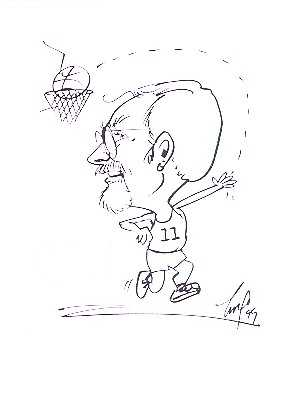
a sermon preached by the Rev. Dr. Tim W. Jensen
at The First Religious Society in Carlisle, Massachusetts
Sunday October 22nd, 2006
OPENING WORDS: American preachers have a task more difficult, perhaps, than those faced by us under South Africa’s apartheid, or Christians under Communism. We had obvious evils to engage; you have to unwrap your culture from years of red, white and blue myth. You have to expose, and confront, the great disconnect between the kindness, compassion and caring of most American people, and the ruthless way American power is experienced, directly and indirectly, by the poor of the earth. You have to help good people see how they have let their institutions do their sinning for them. This is not easy among people who really believe that their country does nothign but good, but it is necessary, not only for their future, but for us all. -- Peter Storey, former president of the Methodist Church of South Africa.
***
So just in case you arrived late to church, or were sleeping through the first part of the service, today really is my actual 50th birthday. It was fifty years ago today, at approximately this time in the morning (although three time zones to the west of here) that my mother gave birth to me at Ballard General Hospital in Seattle, after what I’m told was NOT an easy labor. And yes, this also really is the 575th sermon of my career (or at least the 575th sermon that I can document -- there may have actually been a few others that have now slipped my mind and been justifiably forgotten). But I thought it was so precious last Sunday when I shared this information during the Moment for All Ages, and young Roy Watson looked up at me in astonishment and asked “the same one?”
In any case, I’ve certainly had plenty of time to think about what I wanted to say here this morning, and plenty of previous material to draw on. And yet, when it actually came time to write it all out, rather than sitting down in front of my computer and staring for a few hours at a blinking cursor, I decided to put Parker on her leash and take a little walk through this “City in the Woods” that has been our home now for a little more than three years.
First we walked down Church Street and past the ball fields, where I ran into Dick and Carolyn Shohet on their way to watch their granddaughter play soccer, and then of course I also ran into Nancy and Rick, as well as Mark Szezesniak (and I’m guessing that his daughter was somewhere out on the field too, although I didn’t see her). I know there are a lot of folks here in town who aren’t really that keen about having a ball field right across the street from their homes, but for my part I love it.... I would much rather have young athletes cutting through my back yard than a bear, for instance... and I’m especially looking forward to the new outdoor basketball courts the RecCom is planning to build where the tennis courts are now (assuming, of course, that they can finally get their ballot measure passed in a couple of weeks).
And then we kept walking on down the hill to the Green Cemetery, where Parker and I used to walk quite a bit when we first moved to Carlisle, but not quite so much any more. Now when we go to the cemetery I always find myself drawn to the graves of people I’ve buried there. Dot Clark’s daughter Betty, for example, who is buried next to her father Guy on the opposite side from her brother Bill, with just enough space left over in the middle for Dot herself someday (although hopefully not any day soon).
Or James Deacon, who was only 41 at the time of his death, and whose grave is marked by a polished black monolith engraved with the words “Death lies on him like an untimely frost upon the sweetest flower of all the field,” and has a small statute of a sleeping dog curled up in front of it.
And of course, Jeanne Rourk, who I got to know so well in the last year of her life, and who gave me that great advice to “buy the red convertible.” I haven’t followed her advice yet, but maybe now that I’m fifty I will.
And then we walked back up the hill, and down the trail behind the parsonage to the library (where Parker always likes to get in a good sniff for bears), and then back up past the Common here to the front of FRS, just so I could take yet another good look at the reason I came to these woods in the first place, this “spiritual home in the heart of Carlisle” where I serve as the Parish Minister.
And I hope you all appreciate that even though it may seem like I talk an awful lot about myself up here (especially on a day like today), these sermons aren’t really about me at all. And they aren’t really about you either -- they’re about US: this community of faith where I am charged with the profound responsibility of trying to share things I have learned in fifty years of life and twenty-five years of ministry which might somehow be beneficial to some of you as well.
I know I can’t please all of the people all of the time. But I do have faith that if you stick around long enough, you will eventually hear something you think is worthwhile. Emerson once wrote that “The true preacher can be known by this, that he deals out to the people his life--life passed through the fire of thought.” This is what I do for a living...and believe me, it’s not nearly so easy as I try to make it look.
As I tried explaining to the kids last week, there comes a point in all our lives where we stop thinking so much about getting gifts on special occasions like our birthdays, and start thinking instead about the gifts we have to give, the best of which always come out of the essence of our own lives. It’s just like when we were kids ourselves, and people would ask us what we want to be when we grow up.
And then at some point we realize we ARE grown up, and have to start figuring out what it is we’ve become...even though most days we may still be feeling pretty “young at heart,” despite the evidence of our reflection in the mirror or the aches and pains of increasing age. And at this point in my life, I’ve been a minister for so long that it’s hard for me to imagine doing anything else... or perhaps more accurately, that I would ever stop BEING a minister no matter what I choose to do....
I know I’ve mentioned this before, but one of the ways I’ve been celebrating this milestone in my life is taking advantage of various opportunities open to me for personal and professional development. And this last August I had a chance to spend two days down at the Center for Career Development and Ministry in Dedham, where I learned lots of interesting new things about myself and my ministry.
This is actually the third time I’ve been through a program like this. I went once when I was still in my twenties, in preparation for my ordination; and then again when I was in my mid-thirties, a few years before starting my Ph.D., when I was feeling a little burnt out by ministry and considering a change of careers. This last time was probably the most interesting though. Here are just a few of the things I learned.
First, my Myers-Briggs type has changed from the previous times I’ve taken the test, from Introverted Intuitive Thinking Perceiver to Introverted Intuitive FEELING Perceiver...which I’m sure means nothing to those of you who aren’t familiar with the MBTI, but which I take to mean that, in twenty-five years of parish ministry, I have finally given up on trying to figure it all out, and have learned instead that there are times when you simply have to trust your gut and follow your heart.
My Strong-Campbell Interest Inventory profile was also kind of interesting. This is a test I’m sure many of you are familiar with, since I think in one form or another it’s been a staple of High School Guidance Counselors since before I was born. This is that test where they ask you to answer a series of questions, such as whether you would rather milk a cow or fly a jet, and then at the end of several hundred of these they tell you whether you should enlist in the Air Force or stay home on the farm....
Ministers tend to have high scores in the “Social/Helping” area (which I do), and in the past I’ve also scored high on both the “Analytical/Investigative” and “Enterprising/Influencing” scales...which is why I was interested in earning a Ph.D. in the first place, and also why I tend to be just a little more entrepreneurial than most parish ministers (believe it or not).
But this last time I took the test, my “Artistic/Creative” scores were four times higher than my next highest scale, which was something brand new, and which probably explains why I’ve noticed that my sermons have actually gotten a lot more subtle and carefully-crafted over the years, as well as something I’m really looking forward now to exploring in even greater depth.
But the most interesting insight to come out of this process was that somehow in the past 25 years, the naive youthful idealism which initially called me into ministry has somehow been replaced by a wise and mature cynicism.
Not Realism.
Cynicism.
This was a big surprise for me, notwithstanding my admiration for the original Cynic, Diogenes of Sinope, and his 19th century imitator, Henry David Thoreau, who was sometimes known in his own day as “The Diogenes of Concord.”
H.L. Mencken once described cynics as people “who, when [they] smell flowers, start looking around for a coffin,” while an idealist is someone “who, on noticing that roses smell better than a cabbage, concludes that they will also make better soup.” I’ve certainly seen plenty of coffins in my time; it’s something that pretty much comes with the job. But I’ve never been tempted to make soup out of roses, even when I’ve bothered to take the time to smell them.
The word “cynic” in Greek means “dog;” and Diogenes once said that he was “called a dog because I fawn on those who give me anything, I yelp at those who refuse, and I set my teeth in rascals” (which doesn’t really sound like such a bad job description for a minister, actually). I once wrote an entire sermon about him, entitled “It’s a Dog’s Life;” and if you Google it you may even be able to find it somewhere on the web, since I’ve preached it in a lot of places over the years.
But today I want to go in a little different direction. You see, I don’t really mind the fact that my youthful naiveté has been replaced by a more mature wisdom. Ever since I was just a kid, I’ve always aspired to be “wise beyond my years,” and now apparently I don’t have to worry about it any more. But it bothers me a lot that my idealism has apparently gone missing along with my naiveté. Because I’m wise enough to know that you’re never too old to be an idealist...even if one has grown a little cynical about it as well.
Idealists are basically people for whom Ideas are somehow more real and important than “what is.” They are Dreamers, who are sometimes dismissed as “unrealistic,” but who are capable of imagining new possibilities rather than simply seeing only the limitations of our present reality, and whose vision is often essential to leading us forward to places we’ve never been before. And cynics, I’ve often thought, are only “wounded” idealists; individuals who have seen good ideas crash and burn so frequently and routinely that they’ve grown skeptical, disappointed, and discouraged, and perhaps lost confidence in the power of a dream.
Of course, that was before I discovered that I am a cynic myself. Now I’m not really sure what I think. But I still believe that if we can just find the courage to trust our guts and follow our hearts, they will eventually lead us to something new and amazing, even if we can’t really see it clearly at the moment.
There’s one more thing I’d like to talk about this morning, and then we can all go downstairs and celebrate my birthday together. But I used to think that parish ministry was all about skills and credentials -- what I Knew and what I could Do to lead a church, as an institution, closer to the fulfillment of its mission. But over the years I’ve come to see that ministry is really a lot more about a relationship with a group of people -- a congregation -- who “congregate” together around their minister in the hope of receiving both inspiration and guidance, and who are hopefully satisfied more often than they are disappointed. And let me tell you, this is a lot harder than simply earning a few college degrees and knowing the latest techniques for evangelism and stewardship (or what in the “real world” would be known as marketing and finance).
And yet. the things that make ministry most challenging are also ultimately what make it most rewarding. Ministry is about helping people to get to know themselves a little bit better, and then encouraging them to use that knowledge to follow their dreams, to help others as they have been helped, and to make the world a better place for everyone in the process. And in this respect, we ALL become ministers of this church, whenever we congregate here together to guide and inspire one another.
According to the experts who study these things, a “serviceable pastoral relationship” essentially embodies four qualities, which together make the relationship possible. No minister is ever going to meet all of the expectations of all of their parishioners, and anyone naively idealistic enough to try will find themselves cynics soon enough. But attention to these four qualities make a serviceable relationship possible, even when we take it for granted that the Perfect Pastor is simply a figment of our imaginations.
The first of these qualities is Personal Integrity. Integrity is basically a function of knowing your own limits, and remaining true to yourself...of recognizing the boundary where you leave off and another person begins, and respecting those boundaries rather than compromising them. A boundary is not always a barrier between two entities -- it is also the place where they meet and come together as neighbors. And like the lines down the center of a highway, clear and healthy boundaries delineate the spaces which allow us to function safely and effectively together as a community.
The second quality is Trustworthiness. No one can compel another person to trust them. But they can attempt to earn that trust, by endeavoring always to behave in a trustworthy manner. Mutual Trust is essential to a serviceable pastoral relationship -- because if you can’t trust your minister, who CAN you trust? Yet as we see so often in the news these days, not all ministers are always worthy of that trust; and from time to time every minister is only human (although generally not on purpose). Many people in this suspicious age of ours find it difficult to trust anyone at all, which makes the challenge of establishing trust sometimes seem all but impossible. But the commitment to behaving in a trustworthy manner at least opens the door, and invites the other person to step safely inside.
The third quality is Spiritual Authenticity. A long robe like this one will cover a multitude of sins, and this is generally considered a good thing, since none of us is perfect -- and ministers often feel like we have to give up a good deal of ourselves in order to truly BE a minister. But there also needs to be a real person underneath the robe, who can understand and empathize with the real life concerns of other real people.
We are all spiritual beings, whether we recognize it or not. We all have questions about matters great and small which we will never fully understand; we all wrestle with issues of value and meaning and purpose for which absolute certainty is simply a comforting delusion. But authentic comfort comes not so much from the quality of our answers, but from the sincerity with which we approach the questions. And this sincerity is the source of an authentic spirituality, which not only acknowledges the difficulty of the questions, but also accepts and embraces both our personal shortcomings and the limitations of our answers, and still retains the ability to live life in the midst of the uncertainties.
This brings me to the final quality, which is a Humble, Confident Authority. This is perhaps the most difficult and challenging thing on the list, which is why I left it for last. But let’s face facts. It takes a lot of chutzpah to stand up here Sunday after Sunday, 25-30 times a year, year after year, 575 times total in my lifetime (so far), on the arrogant assumption that one has something to say that is actually worth listening to.
And yet, I could not do this job at all without a profound sense of humility regarding my own inadequacy for the task. It is only by bringing these two things together that I can find my own, unique “authorial” voice -- that I can find the courage to “speak the truth in love” (according to my own best understanding of it), both in gratitude for the many blessings and opportunities and advantages I have received, and in a spirit of generosity which shares willingly and openly whatever small wisdom my maturity may have brought me.
These four qualities: Personal Integrity, Trustworthiness, Spiritual Authenticity, and a Humble, Confident Authority grounded in sentiments of Gratitude and Generosity, are what make a serviceable pastoral relationship possible. But I hope you’ve also realized by now that they are NOT reserved for clergy alone. Rather, they are the qualities which make relationships possible, and make congregations vital and dynamic; which allow us to create profoundly meaningful communities of faith, and which drive out cynicism and restore idealism in a world too often wounded by disappointment and failure, skepticism and discouragement, and which desperately needs to be reminded of the forgotten power of a shared dream.
These are some of the things that I have learned in the first half-century of my lifetime. And I hope to be able to go on preaching them for another twenty-five years....
****
READING:
I have something a little unusual for the reading today. But this past week I received very lovely birthday cards from my parents, and I thought I’d share them with all of you this morning. I feel very fortunate that both of my parents are still living (although not with one another). My Dad, as many of you know, has remarried and lives in Sacramento California; while my Mom now lives right on the beach on Camano Island in Washington State, in the house my Grandmother built in the 1960’s to replace the one that had burned down during the Depression. And if Global Warming doesn’t get it first, I hope someday to live there too (in fact, you’ll hear a little in my mother’s card about the bulkhead between her house and the ocean).
But I do feel lucky, especially since I know so many people my own age (or even younger) who have already lost one or both of their parents...including a lot of people right here in this room. I attribute my own good fortune to good genes (which I hope I share), relatively clean living, and the fact that both my parents were still relatively young themselves when they became my parents. In fact, I’m told I was conceived during Finals Week of the Fall Semester of my mother’s Senior Year of college (which explains a lot, if you stop to think about it). In any event, I’ll begin with her card.
Dear Tim
So the big 50th birthday has arrived. When I got there, I thought the whole world would certainly stop in its tracks, but nothing at all changed. This was true of 60 + 70 as well, so I guess I’m pretty unimportant in the big scheme of things.
Hope your life is going well. I know you must be pretty busy with the start of the new church year. I enjoy your church bulletin. The church has lots of interesting things happening.
We have a higher dike now, and the new grass I planted up there is green and beautiful. Brian + Barbara + I all did the work at the same time. We were lucky with the weather -- Today is really the first cold + rainy day of autumn.
I’ve been talking to contractors about our bathroom remodel. It should be finished while I’m away for a quilting conference. May get up your way afterwards, if I can work it out. Love, Mom
Happy Birthday! Tim
I looked at all of the “50” cards and decided that they really aren’t “on target.” Turning 50 really isn’t funny and 50 isn’t really old. In fact, the way things have changed in recent years, I’m not so sure that the new cliché shouldn’t be “Life begins at 50.” Hopefully, by 50 one has all of the “stupid mistakes” they are going to make behind them and can focus on utilizing all of their meaningful experiences on having a healthy happy life. I certainly hope that is the case for you, because you have certainly “earned” the right to benefit in the future from all of the effort and hard work you have put in in the past.
I wish I had better words to express how proud I am of you and how much I love you! Dad.
Sunday, October 22, 2006

Sunday, October 15, 2006
A DIFFERENT WAY OF DOING CHURCH
a sermon preached by the Rev Dr Tim W Jensen
at the First Religious Society in Carlisle, Massachusetts
Sunday October 15th, 2006
I once heard a story about an earnest young county extension agent, just out of Ag School, who was eager to teach all of the farmers in surrounding area the latest techniques of scientific agriculture. There was one old-timer in particular, one of those irascible white-haired Scandinavian bachelor farmers, who’d been doing things just the way his grandfathers had done them for as long as anyone could remember, that this young man was especially eager to win over. He tried sending him letters, and then calling him on the telephone... and eventually he just started driving out to the farm in person, where early one morning he finally caught up with the old-timer out behind the barn repairing his tractor.
Astonished by his good luck, the Extension Agent immediately started to describe with great enthusiasm all of the new scientific techniques he’d learned about in college. But the farmer just started shaking his head.
“It’s no good, sonny” the old-timer said. “I already know how to farm better than I do....”
I love this story for a lot of reasons, not the least of which is because it reminds me that things are often a lot simpler than they appear, and that “success” (however we may choose to define that term for ourselves) often comes not so much from innovation as from a commitment to excellence. It’s not just a matter of learning how to do the latest thing, but rather remembering to do the things we already know HOW to do just a little bit better than we are doing them at the moment. Innovation can be good too, especially when it contributes to excellence... but we don’t have to reinvent the wheel to make certain that our tires are all inflated to the proper levels, correctly balanced and aligned in the same direction. And we certainly don’t have to have the latest GPS technology simply in order to figure out where it is we WANT to go.
Churches can often be like this. When you stop to think about it, “church” really hasn’t changed all that much in the past 2000 years. It’s still mostly about singing, and praying, and preaching, and breaking bread together. Worship, Education, Fellowship, Community Outreach and Pastoral Care (or what the old-timers would have called “evangelism” and “ministry”) -- five basic things that good churches all know how to do well, and struggling churches sometimes lose sight of, as they glance around the landscape looking for something new and innovative that will restore them to their good old “Glory Days.” It’s a very common situation, and not just in churches either. In any human activity, Complacency is often the offspring of Success, which in turn sows the seeds that form the roots of subsequent decline.
Of course, I’m not really sure it helps matters much that clergy are often a lot like that enthusiastic young County Extension Agent I was talking about earlier, always eager to embrace the latest innovation that comes down the pipeline from On High. I think UU ministers in particular like to think of ourselves as being part of the theological avant garde, out there on the “cutting edge” in terms of applying the timeless wisdom of the ages to the problems and challenges of contemporary society in fresh and innovative ways. So it’s easy for us to overlook that sometimes all people really want to hear is that Yes, life is often hard, but still it’s pretty good; and that God (or whatever passes for God these days) still loves us, and is still responsible for everything that is; and that our neighbors are basically pretty decent folks as well, despite their many obvious shortcomings, all of which we are generally well aware of, because we also share them simply by virtue of our own humanity.
In any event, it would be natural to assume from the title of today’s sermon, “A Different Way of Doing Church,” that I was planning to talk about something new and innovative this morning. But actually I want to talk about something tried and true, which probably goes back to the earliest days of religion itself (even if we do keep reinventing it in new and innovative ways in the attempt to keep it fresh and cutting edge). But as you already know, this month we are starting up a new Small Group Ministries program here at FRS. Small Group Ministries (capital “S,” capital “G,” capital “M”) are a relatively new and increasingly popular program in many Unitarian Universalist churches around the country these days. Sometimes known as “Chalice Circles” or “Covenant Groups,” they provide an opportunity for people to meet together once a month in groups of 8 to 10, either here at the church or in someone’s home, simply to talk with one another in a meaningful and intentional way about topics that are ultimately important to us all.
But small group ministries (small “s” small “g” small “m”) have been a staple of religious life from time immemorial. In fact, in many ways small “fellowship circles” are the building blocks out of which larger religious communities are built. The Choir. WomenSpirit. The Men’s Monthly Breakfast. The Green’s Sale Committee. And so on and so on and so on. Just about any group in church can become a fellowship circle, provided that it gives individuals enough time together that they are able to create significant, meaningful and authentic relationships with one another that go beyond a mere passing acquaintance.
A Covenant Group is just like that, only by design. In Covenant Groups, individuals intentionally promise one another (which is to say, they form a covenant) that they will meet together regularly for a given period of time for the specific purpose of creating significant, authentic, meaningful relationships intended to deepen and enrich the spiritual lives of everyone in the group. And in this respect, they truly are “a different way of doing church” -- a church which receives its inspiration from the ground up, rather than from the top down.
Unitarian Universalist Covenant Groups have a very unusual family tree, which can be traced back in two very different directions. The most obvious ancestors of this current generation of “Chalice Circles” are actually the “cell ministries” popular in Korean Christian megachurches, which were imported into this country by graduates of the evangelical Church Growth Institute at the conservative Fuller Theological Seminary in California, and then “borrowed” and modified by a handful of innovative UU ministers for use in our denomination about a decade ago. Some of these original Korean megachurches, such as the Yoido Full Gospel Assembly of God Church in Seoul, have over 700,000 members and approximately 25,000 “home cell groups” which meet regularly for prayer and Bible study.
But the more intriguing ancestor of Unitarian Universalist Covenant Groups are the “Basic Christian Communities” developed by Latin American Liberation Theologians among Roman Catholic compesinos in Central and South America. These basic communities also had their origin as Bible Study groups, but they also quickly evolved into “Bases” for Community Organizing and Political Activism among peasant villages whose needs were often overlooked or forgotten by a church hierarchy closely affiliated with the ruling elites. The “Base Community” concept came into the United States as part of the Sanctuary Movement in the 1980’s, where (as you might imagine) it quickly found a sympathetic home among politically active religious liberals of all denominational affiliations.
And yet, for both Religious Liberals and Evangelical Conservatives, “small group ministry” was not so much an alternative to traditional congregational life as it was a supplement and an enhancement to it. Just as distinct local parishes and congregations of whatever theological tradition all come together on some spiritual level to form “the Church Universal” -- each one of them doing God’s work as they understand it for their particular constituency of believers and seekers -- small group ministries might be thought of as the “cells” which make up the “body” of the church. Because even though it may be possible to be “spiritual” by yourself, it takes at least two or three souls to “be” a church. According to Roman Catholic theologian Fr. James O’Halloren, Church is a place that accepts us as we are, challenges us to grow, and creates an environment conducive to that growth. And small group ministries, of one form or another, are perhaps the most basic environment in which this process takes place.
Let me briefly explain again how our Small Group Ministry program works at FRS. The first thing you have to do is sign up for a group. We now have three groups to start out with: one group will meet on the 3rd Wednesday of every month (beginning next week) at 9:30 AM at Alison Saylor’s house, and is facilitated by Alison Saylor and Michael Dundorf. A second group will meet on the fourth Monday (beginning October 23rd) at 7:00 pm here at the church, and is facilitated by Ellen and Ernie Huber. And the third group will meet on the fourth Tuesday (beginning October 24th), also at 7:00 pm, and is facilitated by Steve Kirk and Bob Luoma, and will meet in one of their homes. Or if none of these times will work for you, you can also sign up for “option D” which means that you’re interested in joining a new group that will meet at a time and place still to be determined.
Once you’ve signed up, you also have to commit to showing up. This is really important, because the only way these groups really work is if everyone can count on everyone else being there. Obviously, sometimes things come up that keep us from keeping our commitments, and those things can’t really be helped. But the basic rule is that participation in the group is a priority, and that anything other than a real emergency gets scheduled around it. When I was part of a group of Unitarian ministers down in Texas, we were told that the only thing that should prevent us from attending a meeting was a funeral... our OWN! As I mentioned earlier, Small Group Ministries are ultimately about forming significant, meaningful, authentic relationships. And it’s hard to form a relationship with an empty chair.
You can read a lot more about the groups in the four-page Participant’s Handbook, which you’ll find near the clipboard with the sign-up sheets. But the basic format of a meeting goes like this. The participants gather in a circle around a chalice (which is why they are sometimes called “Chalice Circles”), and begin with a brief ceremony consisting of an opening reading and a chalice lighting. The next step is for group members to “check-in” with one another simply by sharing around the circle whatever important has happened in their lives since they were last together, much like we do on Sunday mornings during our “Candles of Community,” but on a slightly deeper level.
Then comes the “Topic of the Day,” which is an open discussion on a “religious” topic (broadly-defined) which has been selected in advance and is focused around a series of questions intended to evoke a thoughtful conversation. To start out with, each of the groups will be discussing the same topic at their monthly meetings, which will be selected by the group facilitators from a long list of potential topics we’ve “borrowed” from other churches. Finally, at the conclusion of the discussion there will be an opportunity for group members to briefly share their “Likes and Wishes” about the session, and a short ceremonial closing during which the chalice is extinguished.
And that’s the program. Simplicity itself, and all it takes is a commitment of a couple of hours a month. And yet I hope you can see how even among just a handful of people, participants can enjoy the experience of reverent Worship, engage in Fellowship with one another, and Educate themselves about spiritual matters simply by talking in a meaningful way about serious topics of religious significance.
But wait, there’s more! (and now I really am starting to feel like this sermon is turning into an infomercial). Because there are also aspects of Community Outreach and Pastoral Care to our Small Group Ministries program, which really DO make it a different way of doing everything else we try to do in church.
The Pastoral Care part I hope is obvious. It’s easy to get lost in a congregation of 600. It’s possible to get lost even in a congregation of 150. But there’s no way you can get lost in a Small Group of 10. If there is something significant going on in your life, the other members of your Covenant Group are going to know about it, and are going to be the first ones there to look after you, and to help gather the resources of the entire congregation to help you out.
The Community Outreach portion is a little more subtle. But as part of their mission, each Covenant Group is asked to take on one service project a year, either to the church or to the larger community. The project can be anything the members of the group decide among themselves they would like to do, large or small. But service is an essential component of the overall Small Group experience, both to remind us that service is also an essential part of our lives as people of faith, and also to prevent our Small Groups from becoming too inward-looking and self-absorbed, rather than connected to the larger community beyond our intimate circle.
I understand that life here in Carlisle can be much more busy and hectic than it was just a generation or two ago, when this truly was a sleepy little rural community of farmers, who worked long hours alone in their fields, yet craved a community church of their own, so that they could see all their neighbors on a Sunday morning, and avoid the long walk into the big city of Concord. And I truly believe that these new Small Group Ministries can help revitalize some of that community spirit as we approach our 250th year here on this hilltop. We already know how to do church better than we do. What we need is the commitment to one another, to do it as well as we know how....
***
READING: from Bonifacius or “Essays to Do Good” by Cotton Mather [1710]
WE CANNOT DISMISS this part of the subject without offering a proposal to animate and regulate private meetings of persons for the exercises of religion. It is very certain that when such private meetings have been maintained and well conducted, the Christians who have composed them have, like so many “coals of the altar,” kept one another alive, and been the means of maintaining a lively Christianity in the neighborhood. Such societies have been strong and approved instruments, to uphold the power of godliness. The disuse of such societies has been accompanied with a visible decay of religion, in proportion as they have been discontinued or disregarded in any place, the less has godliness flourished....
It is proposed that a select number of families, perhaps about twelve, agree to meet (the men and their wives) at each other’s houses alternately, once in a fortnight or a month, or otherwise, as shall be thought most proper, and spend a suitable time together in religious exercises....
The members of such a society should consider themselves as bound up in one “bundle of love,” and count themselves obliged, by very close and strong bonds, to be serviceable to one another. If anyone in the society should fall into affliction, all the rest should presently study to relieve and support the afflicted person in every possible way. If anyone should fall into temptation, the rest should watch over him, and with the “spirit of meekness,” with “meekness of wisdom” endeavor to recover him....
It is not easy to calculate the good offices which such a society may do to many other persons, besides its own members. The prayers of such well-disposed societies may fetch down marvelous favors from Heaven on their pastors; their lives may be prolonged, their gifts augmented, their graces brightened, and their labors prospered, in answer to the supplications of such associated families. The interests of religion may also be greatly promoted in the whole flock by their fervent supplications; and the Spirit of Grace mightily poured out upon the rising generation; yea, the country at large may be the better for them....
It is very certain that the devotions and conferences carried on in such a society will not only have a wonderful tendency to produce the “comforts of love” in the hearts of good men toward one another but that their ability to serve many valuable interests will also thereby be much increased....
at the First Religious Society in Carlisle, Massachusetts
Sunday October 15th, 2006
I once heard a story about an earnest young county extension agent, just out of Ag School, who was eager to teach all of the farmers in surrounding area the latest techniques of scientific agriculture. There was one old-timer in particular, one of those irascible white-haired Scandinavian bachelor farmers, who’d been doing things just the way his grandfathers had done them for as long as anyone could remember, that this young man was especially eager to win over. He tried sending him letters, and then calling him on the telephone... and eventually he just started driving out to the farm in person, where early one morning he finally caught up with the old-timer out behind the barn repairing his tractor.
Astonished by his good luck, the Extension Agent immediately started to describe with great enthusiasm all of the new scientific techniques he’d learned about in college. But the farmer just started shaking his head.
“It’s no good, sonny” the old-timer said. “I already know how to farm better than I do....”
I love this story for a lot of reasons, not the least of which is because it reminds me that things are often a lot simpler than they appear, and that “success” (however we may choose to define that term for ourselves) often comes not so much from innovation as from a commitment to excellence. It’s not just a matter of learning how to do the latest thing, but rather remembering to do the things we already know HOW to do just a little bit better than we are doing them at the moment. Innovation can be good too, especially when it contributes to excellence... but we don’t have to reinvent the wheel to make certain that our tires are all inflated to the proper levels, correctly balanced and aligned in the same direction. And we certainly don’t have to have the latest GPS technology simply in order to figure out where it is we WANT to go.
Churches can often be like this. When you stop to think about it, “church” really hasn’t changed all that much in the past 2000 years. It’s still mostly about singing, and praying, and preaching, and breaking bread together. Worship, Education, Fellowship, Community Outreach and Pastoral Care (or what the old-timers would have called “evangelism” and “ministry”) -- five basic things that good churches all know how to do well, and struggling churches sometimes lose sight of, as they glance around the landscape looking for something new and innovative that will restore them to their good old “Glory Days.” It’s a very common situation, and not just in churches either. In any human activity, Complacency is often the offspring of Success, which in turn sows the seeds that form the roots of subsequent decline.
Of course, I’m not really sure it helps matters much that clergy are often a lot like that enthusiastic young County Extension Agent I was talking about earlier, always eager to embrace the latest innovation that comes down the pipeline from On High. I think UU ministers in particular like to think of ourselves as being part of the theological avant garde, out there on the “cutting edge” in terms of applying the timeless wisdom of the ages to the problems and challenges of contemporary society in fresh and innovative ways. So it’s easy for us to overlook that sometimes all people really want to hear is that Yes, life is often hard, but still it’s pretty good; and that God (or whatever passes for God these days) still loves us, and is still responsible for everything that is; and that our neighbors are basically pretty decent folks as well, despite their many obvious shortcomings, all of which we are generally well aware of, because we also share them simply by virtue of our own humanity.
In any event, it would be natural to assume from the title of today’s sermon, “A Different Way of Doing Church,” that I was planning to talk about something new and innovative this morning. But actually I want to talk about something tried and true, which probably goes back to the earliest days of religion itself (even if we do keep reinventing it in new and innovative ways in the attempt to keep it fresh and cutting edge). But as you already know, this month we are starting up a new Small Group Ministries program here at FRS. Small Group Ministries (capital “S,” capital “G,” capital “M”) are a relatively new and increasingly popular program in many Unitarian Universalist churches around the country these days. Sometimes known as “Chalice Circles” or “Covenant Groups,” they provide an opportunity for people to meet together once a month in groups of 8 to 10, either here at the church or in someone’s home, simply to talk with one another in a meaningful and intentional way about topics that are ultimately important to us all.
But small group ministries (small “s” small “g” small “m”) have been a staple of religious life from time immemorial. In fact, in many ways small “fellowship circles” are the building blocks out of which larger religious communities are built. The Choir. WomenSpirit. The Men’s Monthly Breakfast. The Green’s Sale Committee. And so on and so on and so on. Just about any group in church can become a fellowship circle, provided that it gives individuals enough time together that they are able to create significant, meaningful and authentic relationships with one another that go beyond a mere passing acquaintance.
A Covenant Group is just like that, only by design. In Covenant Groups, individuals intentionally promise one another (which is to say, they form a covenant) that they will meet together regularly for a given period of time for the specific purpose of creating significant, authentic, meaningful relationships intended to deepen and enrich the spiritual lives of everyone in the group. And in this respect, they truly are “a different way of doing church” -- a church which receives its inspiration from the ground up, rather than from the top down.
Unitarian Universalist Covenant Groups have a very unusual family tree, which can be traced back in two very different directions. The most obvious ancestors of this current generation of “Chalice Circles” are actually the “cell ministries” popular in Korean Christian megachurches, which were imported into this country by graduates of the evangelical Church Growth Institute at the conservative Fuller Theological Seminary in California, and then “borrowed” and modified by a handful of innovative UU ministers for use in our denomination about a decade ago. Some of these original Korean megachurches, such as the Yoido Full Gospel Assembly of God Church in Seoul, have over 700,000 members and approximately 25,000 “home cell groups” which meet regularly for prayer and Bible study.
But the more intriguing ancestor of Unitarian Universalist Covenant Groups are the “Basic Christian Communities” developed by Latin American Liberation Theologians among Roman Catholic compesinos in Central and South America. These basic communities also had their origin as Bible Study groups, but they also quickly evolved into “Bases” for Community Organizing and Political Activism among peasant villages whose needs were often overlooked or forgotten by a church hierarchy closely affiliated with the ruling elites. The “Base Community” concept came into the United States as part of the Sanctuary Movement in the 1980’s, where (as you might imagine) it quickly found a sympathetic home among politically active religious liberals of all denominational affiliations.
And yet, for both Religious Liberals and Evangelical Conservatives, “small group ministry” was not so much an alternative to traditional congregational life as it was a supplement and an enhancement to it. Just as distinct local parishes and congregations of whatever theological tradition all come together on some spiritual level to form “the Church Universal” -- each one of them doing God’s work as they understand it for their particular constituency of believers and seekers -- small group ministries might be thought of as the “cells” which make up the “body” of the church. Because even though it may be possible to be “spiritual” by yourself, it takes at least two or three souls to “be” a church. According to Roman Catholic theologian Fr. James O’Halloren, Church is a place that accepts us as we are, challenges us to grow, and creates an environment conducive to that growth. And small group ministries, of one form or another, are perhaps the most basic environment in which this process takes place.
Let me briefly explain again how our Small Group Ministry program works at FRS. The first thing you have to do is sign up for a group. We now have three groups to start out with: one group will meet on the 3rd Wednesday of every month (beginning next week) at 9:30 AM at Alison Saylor’s house, and is facilitated by Alison Saylor and Michael Dundorf. A second group will meet on the fourth Monday (beginning October 23rd) at 7:00 pm here at the church, and is facilitated by Ellen and Ernie Huber. And the third group will meet on the fourth Tuesday (beginning October 24th), also at 7:00 pm, and is facilitated by Steve Kirk and Bob Luoma, and will meet in one of their homes. Or if none of these times will work for you, you can also sign up for “option D” which means that you’re interested in joining a new group that will meet at a time and place still to be determined.
Once you’ve signed up, you also have to commit to showing up. This is really important, because the only way these groups really work is if everyone can count on everyone else being there. Obviously, sometimes things come up that keep us from keeping our commitments, and those things can’t really be helped. But the basic rule is that participation in the group is a priority, and that anything other than a real emergency gets scheduled around it. When I was part of a group of Unitarian ministers down in Texas, we were told that the only thing that should prevent us from attending a meeting was a funeral... our OWN! As I mentioned earlier, Small Group Ministries are ultimately about forming significant, meaningful, authentic relationships. And it’s hard to form a relationship with an empty chair.
You can read a lot more about the groups in the four-page Participant’s Handbook, which you’ll find near the clipboard with the sign-up sheets. But the basic format of a meeting goes like this. The participants gather in a circle around a chalice (which is why they are sometimes called “Chalice Circles”), and begin with a brief ceremony consisting of an opening reading and a chalice lighting. The next step is for group members to “check-in” with one another simply by sharing around the circle whatever important has happened in their lives since they were last together, much like we do on Sunday mornings during our “Candles of Community,” but on a slightly deeper level.
Then comes the “Topic of the Day,” which is an open discussion on a “religious” topic (broadly-defined) which has been selected in advance and is focused around a series of questions intended to evoke a thoughtful conversation. To start out with, each of the groups will be discussing the same topic at their monthly meetings, which will be selected by the group facilitators from a long list of potential topics we’ve “borrowed” from other churches. Finally, at the conclusion of the discussion there will be an opportunity for group members to briefly share their “Likes and Wishes” about the session, and a short ceremonial closing during which the chalice is extinguished.
And that’s the program. Simplicity itself, and all it takes is a commitment of a couple of hours a month. And yet I hope you can see how even among just a handful of people, participants can enjoy the experience of reverent Worship, engage in Fellowship with one another, and Educate themselves about spiritual matters simply by talking in a meaningful way about serious topics of religious significance.
But wait, there’s more! (and now I really am starting to feel like this sermon is turning into an infomercial). Because there are also aspects of Community Outreach and Pastoral Care to our Small Group Ministries program, which really DO make it a different way of doing everything else we try to do in church.
The Pastoral Care part I hope is obvious. It’s easy to get lost in a congregation of 600. It’s possible to get lost even in a congregation of 150. But there’s no way you can get lost in a Small Group of 10. If there is something significant going on in your life, the other members of your Covenant Group are going to know about it, and are going to be the first ones there to look after you, and to help gather the resources of the entire congregation to help you out.
The Community Outreach portion is a little more subtle. But as part of their mission, each Covenant Group is asked to take on one service project a year, either to the church or to the larger community. The project can be anything the members of the group decide among themselves they would like to do, large or small. But service is an essential component of the overall Small Group experience, both to remind us that service is also an essential part of our lives as people of faith, and also to prevent our Small Groups from becoming too inward-looking and self-absorbed, rather than connected to the larger community beyond our intimate circle.
I understand that life here in Carlisle can be much more busy and hectic than it was just a generation or two ago, when this truly was a sleepy little rural community of farmers, who worked long hours alone in their fields, yet craved a community church of their own, so that they could see all their neighbors on a Sunday morning, and avoid the long walk into the big city of Concord. And I truly believe that these new Small Group Ministries can help revitalize some of that community spirit as we approach our 250th year here on this hilltop. We already know how to do church better than we do. What we need is the commitment to one another, to do it as well as we know how....
***
READING: from Bonifacius or “Essays to Do Good” by Cotton Mather [1710]
WE CANNOT DISMISS this part of the subject without offering a proposal to animate and regulate private meetings of persons for the exercises of religion. It is very certain that when such private meetings have been maintained and well conducted, the Christians who have composed them have, like so many “coals of the altar,” kept one another alive, and been the means of maintaining a lively Christianity in the neighborhood. Such societies have been strong and approved instruments, to uphold the power of godliness. The disuse of such societies has been accompanied with a visible decay of religion, in proportion as they have been discontinued or disregarded in any place, the less has godliness flourished....
It is proposed that a select number of families, perhaps about twelve, agree to meet (the men and their wives) at each other’s houses alternately, once in a fortnight or a month, or otherwise, as shall be thought most proper, and spend a suitable time together in religious exercises....
The members of such a society should consider themselves as bound up in one “bundle of love,” and count themselves obliged, by very close and strong bonds, to be serviceable to one another. If anyone in the society should fall into affliction, all the rest should presently study to relieve and support the afflicted person in every possible way. If anyone should fall into temptation, the rest should watch over him, and with the “spirit of meekness,” with “meekness of wisdom” endeavor to recover him....
It is not easy to calculate the good offices which such a society may do to many other persons, besides its own members. The prayers of such well-disposed societies may fetch down marvelous favors from Heaven on their pastors; their lives may be prolonged, their gifts augmented, their graces brightened, and their labors prospered, in answer to the supplications of such associated families. The interests of religion may also be greatly promoted in the whole flock by their fervent supplications; and the Spirit of Grace mightily poured out upon the rising generation; yea, the country at large may be the better for them....
It is very certain that the devotions and conferences carried on in such a society will not only have a wonderful tendency to produce the “comforts of love” in the hearts of good men toward one another but that their ability to serve many valuable interests will also thereby be much increased....
Sunday, October 1, 2006
A LITTLE GOOD NEWS ON A SUNDAY MORNING
a sermon preached by the Rev. Dr. Tim W. Jensen
at the First Religious Society in Carlisle, Massachusetts
Neighborhood Sunday, October 1st, 2006
“We know how to create spaces that invite the intellect to show up.... We know how to create spaces that invite the emotions into play.... We know how to create spaces that invite the ego to put in an appearance.... But we know very little about creating spaces that invite the soul to make itself known, [and to do its work in our midst]” --Parker Palmer, A Hidden Wholeness
A minister was standing at the door one Sunday, shaking hands as people left the church, when an excited little boy came running up to him and exclaimed “Reverend, when I grow up I’m going to come back here and give you a whole bunch of money!”
“Well, that’s very generous of you!” the startled minister replied. “What makes you want to do that?”
“I dunno,” said the little boy. “I guess it’s ’cause yesterday I heard my daddy tell the neighbors that you’re the poorest preacher we’ve ever had....”
OK, I don’t really know what your neighbors may have been saying about me, but I do want reassure you that whatever it is, good or bad, it’s probably only half-true. Of course, that’s kinda to be expected. We live our lives by half-truths much of the time; in many cases, it’s the best that we can do. Even when we know our own minds well enough to speak and live our own Truth with confidence, the ability to put ourselves in someone else’s place, to truly know and understand what’s on their minds (no matter how much empathy or compassion we maybefeeling), is at best an act of careful, two-way communication combined with no small degree of imagination and even outright projection.
It’s not that Truth itself changes, or that “The Truth” is in some way different for each of us. Rather, it is simply that our UNDERSTANDING of Truth (and for that matter, of one another), is always both limited, and evolving. Socrates famously declared that the reason the Oracle at Delphi considered him to be the wisest man in Athens was that he “knew that [he] knew nothing.” A certain degree of intellectual humility is, and has always been, the gateway to True Wisdom.
But just because we’re born knowing nothing doesn’t mean we have to stay that way. We all come into this world pretty much in the same condition: naked and ignorant of everything except the instinctive hunger of our own appetites. And yet even before we have drawn our first breath, “accidents of birth” begin to differentiate between “winners” and “losers,” (or perhaps more kindly and gently, between the fortunate and the less-fortunate).
Some of us are lucky enough to have been born with certain tangible (and intangible) advantages: good health; good genes; loving, prosperous, well-educated parents; American citizenship...the list is virtually unlimited once we have learned how to count our blessings. And others are born, through no fault of their own, into poverty, or with poor health, or any number of countless other afflictions which have tormented humanity from time immemorial.
And I guess the point I’m trying to make is that while good fortune is certainly nothing to be ashamed of, it’s nothing really to be especially proud of either. And yet so often when it comes to “keeping score,” we have a hard time distinguishing between the privileges of birth and the accomplishments of life, because the presence or absence of the former makes the achievements of the latter seem either absurdly easy or impossibly hard.
And yes, it’s true, that’s just the way the world is; and there’s not that much that any one of us can really do to change it. But if we are Wise, our understanding of THIS Truth can prevent us from making the terrible mistake of measuring our SELF-worth by our net worth, and teach us instead to measure our wealth according to the things we TRULY value. The Scripture tells us “where your treasure is, there will your heart be also.” But it seems to me that the other half of this proposition is also true: that if we simply find the courage to follow our hearts, we will discover something truly worthy of being treasured there at the end of that rainbow.
In any event, I promised you all a little “good news” this morning, and I certainly don’t intend to disappoint you. And I’m also sure that many of you here today already know that the English word “gospel” is derived from the Greek word euangelion (which is also the root of the word “evangelist”), and means, literally “a good message” or “Good News.” Yet if you were to walk up to random people on the street and ask them point blank “What IS the ‘good news’ of the Gospel?” I’ll bet you a dozen Dunkin Donuts to a day-old bran muffin that the answer you would hear most frequently (assuming you get an answer at all) would be some variation of John 3:16 -- “For God so loved the world that he gave his only begotten son, that whosoever believeth in him should not perish, but have everlasting life.”
And yet, what would probably be overlooked in that conversation -- the other half of the truth, if you will -- is the fact that this well-known chapter and verse is something that one evangelist (John) had to say ABOUT Jesus, and not something that was actually ever said by Jesus himself. If you want to know what Jesus had to say on the subject, you’ll have to look at the Gospels of the other three evangelists, all three of whom tell a slightly different story in pretty much the same way (probably, my Bible professors used to tell me, because two of them were copying off of the third one’s paper).
But for Matthew, Mark, and Luke, the Good News begins with the a quotation from the prophet Isaiah [40:3]: “Behold, I am sending my messenger before you, who will prepare your way, the voice of one crying out in the wilderness, Prepare the way of the Lord, make his paths straight.” This is then followed by the story of John the Baptist, dressed in camel’s hair and a leather belt, surviving on locusts and wild honey, and baptizing sinners in the River Jordan. Jesus comes to be baptized, has a vision of a dove descending and hears a voice from “the heavens” quoting the Second Psalm (a story that gets more and more elaborate in each retelling, and is worthy of an entire sermon in its own right some other day), and then immediately goes out into the wilderness to fast and pray for forty days while he tries to figure out what this vision means. Jesus returns from the desert to proclaim his new message, and then afterwards calls his first two disciples, the fishermen Simon and his brother Andrew, with the same invitation he basically made to all his disciples: “stop what you’re doing, and follow me, and I will make you something different.”
But it’s the content of this “good message from the wilderness” that I want to focus on today. Mark puts it this way: “The time is fulfilled, and the kingdom of God is at hand; repent, and believe in the gospel.” [Mk 1:15] Matthew’s version is even simpler: “Repent, for the kingdom of heaven has come near.” [Mt 4:17] And we’ll get to what Luke has to say in just a second. But first I just want to point out that the language of this proclamation is so familiar to us now, and so burdened by 2000 years worth of theological commentary, that it’s easy to lose sight of what it might have meant to the people who were hearing it for the first time...when it was just a few words from the lips of a homeless (and I imagine rather scruffy after forty days fasting in the wilderness) carpenter’s son, back before there was any such thing as “Christianity.”
Those of you who attend services here regularly know that I don’t usually spend this much time interpreting passages from the Bible. But I did spend an awful lot of time in school learning how to do it properly, so from time to time I think it’s only proper that I should share some of that learning with you. And in this case, there are really only five key “loaded” words that I would quickly like to disarm, so that you can safely turn them over a little in your own minds. The word “Gospel” we already know in Greek is “euangelion,” or “good news.” The word basileia or “kingdom” (as in Kingdom of God or Kingdom of Heaven) doesn’t really refer to a specific place; rather it’s a reference to the “reign” or “rule” of God; while the word “time” (kairos as opposed to the more familiar chronos) basically refers to a season or a specific period of time with special characteristics that distinguish it from other times. So the first part of the Good News is easy: the season has come for us to remember that G-d (or the spiritual, heavenly force within the Universe which gives us life and created all that is) is always near at hand, and still in charge of everything we see.
It’s the second part that sometimes feels a little uncomfortable to rational and scientific Unitarians and Universalists. Metanoeite kai Pisteuete -- “Repent and Believe.” Two imperative verbs with very intimidating connotations, especially if you don’t particularly believe that you have anything in particular to repent about. But when we strip away all the fire and brimstone, the Good News itself is actually a lot more palatable and easy to swallow. The word metanoia basically means to “transform one’s mind.” It’s analogous to the more familiar word metamorphosis or a “transformation of shape” -- such as a caterpillar being transformed into a butterfly. Likewise, the word pisteuo doesn’t so much mean “believe” as it does “trust” or “have confidence in.” Its corresponding noun, pistis, is the Greek word generally translated into English as “Faith.” And Faith, properly understood, is not so much “belief without evidence” as it is the confidence to Trust the Truth of things we know are true, but can’t necessarily prove objectively. Or to put it another way, Faith is the ability to live our own Truth -- half-truth that it is -- both confidently and humbly, knowing that there is more to life than meets the eye, and wise enough to accept our own unavoidable limitations and ignorance for what they are. And once we get our minds around this idea, it has the power to transform our whole lives, and open up an entire universe of new possibilities.
Which brings us at last to the Gospel of Luke. Luke’s “Good News” is much more elaborate than Matthew’s or Mark’s. Luke shows Jesus going to the synagogue in his home town of Nazareth, and reading another passage from the Prophet Isaiah [61: 1-2]: “The Spirit of the Lord is upon me, because he has anointed me to bring good news to the poor. He has sent me to proclaim release to the captives, and recovery of sight to the blind, to let the oppressed go free, to proclaim the year of the Lord’s favor.” And then he returns the scroll to the attendant, and says “Today this scripture has been fulfilled in your hearing.”
Now obviously, there’s a lot going on in that passage. But it all boils down to this notion of “The Year of the Lord’s Favor.” Some scholars see this as merely another reference to kairos: a season when the prophecies of old will finally be fulfilled, right before our very eyes. But others (myself included) feel that it is more likely a reference to the “Year of Jubilee” described in the book of Leviticus.
According to Levitical law, every seventh year was to be a “sabbatical” year, during which the land was to lie fallow, and all personal debts were to be forgiven. And every 50 years -- after seven cycles of sabbatical years -- came the year of Jubilee, when those who had sold themselves and their families into slavery in order to escape poverty and starvation would be set free, and all agricultural land which had been bought and sold in the past half-century would revert to the family of its original owner.
The reason for this practice was that the ancient Israelites believed that the land itself belonged to G-d, and that human beings were merely sojourners here on Earth. And thus land could neither be bought or sold; only the right to harvest what it produced for a certain number of seasons.
And likewise, human beings (or at least other Israelites) could not be bought or sold either; it was only their labor which was for sale, in exchange for adequate food and shelter. And every fifty years -- basically, once a generation -- society cleared the books, so that everyone could enjoy a fresh start....
Sounds like a pretty radical concept, doesn’t it?
And it was in Jesus’s own time as well.
But here’s the good news...
You don’t have to believe that something is truly possible in order to believe that it’s a good idea, and to live your own life according to that Truth.
You don’t even have to believe in God to believe that if there were a God, She would want us all to treat one another a certain way -- more frolicking, and less keeping score -- and to live your own life according to THAT Truth.
And it doesn’t really matter whether you were born rich or poor, or somewhere in between; it doesn’t matter how smart you are, or what you look like; how much you have accomplished with your life, or how much you have failed to accomplish...we all still live in that same “middle place” between finding the courage to follow the Truth we THINK we know, and the humility to acknowledge the many truths we will NEVER know, no matter how hard we may try to understand them, or attempt to ignore them.
Because life itself is nothing but an unexpected and undeserved gift from the Universe. And as I’ve said here many times before, no matter how great or how small that gift may seem, the only appropriate response to our good fortune is one of gratitude combined with generosity, and well-seasoned with liberal amounts of compassion, understanding and forgiveness.
And once we manage to “transform our minds” and our hearts and our souls so that we can live our lives trusting this Great Truth, then the real Good News becomes as plain as the noses on our faces: that in the eyes of our Creator, we are ALL children of G-d and brothers and sisters to one another, every one of us possessing inherent worth and dignity, and bound together in an interdependent web of all existence, of which we are a part....
READING: “Snake” by Anne Herbert (from Co-Evolution Quarterly)
IN THE BEGINNING God didn't just make one or two people, he made a bunch of us. Because he wanted us to have a lot of fun and he said you can't really have fun unless there's a whole gang of you. So he put us all in this sort of playground park place called Eden and told us to enjoy.
At first we did have fun just like he expected. We played all the time. We rolled down the hills, waded in the streams, climbed the trees, swung on the vines, ran in the meadows, frolicked in the woods, hid in the forest, and acted silly. We laughed a lot.
Then one day this snake told us that we weren't having real fun because we weren't keeping score. Back then, we didn't know what score was. When he explained it, we still couldn't see the fun. But he said that we should give an apple to the person who was best at playing and we'd never know who was best unless we kept score. We could all see the fun of that. We were all sure we were best.
It was different after that. We yelled a lot. We had to make up new scoring rules for most of the games we played. Other games, like frolicking, we stopped playing because they were too hard to score. By the time God found out about our new fun, we were only spending about forty-five minutes a day in actual playing and rest of the time working out the score. God was wroth about that - very, very wroth. He said we couldn't use the garden any more because we weren't having any fun. We said we were having lots of fun and we were. He shouldn't have got upset just because it wasn't exactly the kind of fun he had in mind.
He wouldn't listen. He kicked us out and said we couldn't come back until we stopped keeping score. To rub it in (to get our attention, he said), he told us that we were all going to die anyway and our scores wouldn't mean anything.
He was wrong. My cumulative all-game score is now 16,548, and that means a lot to me. If I can raise it to 20,000 before I die I'll know I've accomplished something. Even if I can't my life has a great deal of meaning because I've taught my children to score high and they'll all be able to reach 20,000 or even 30,000 I know.
Really, it was life in Eden that didn't mean anything. Fun is great in its place, but without scoring there's no reason for it. God has a very superficial view of life and I'm glad my children are being raised away from his influence. We were lucky to get out. We're all very grateful to the snake.
at the First Religious Society in Carlisle, Massachusetts
Neighborhood Sunday, October 1st, 2006
“We know how to create spaces that invite the intellect to show up.... We know how to create spaces that invite the emotions into play.... We know how to create spaces that invite the ego to put in an appearance.... But we know very little about creating spaces that invite the soul to make itself known, [and to do its work in our midst]” --Parker Palmer, A Hidden Wholeness
A minister was standing at the door one Sunday, shaking hands as people left the church, when an excited little boy came running up to him and exclaimed “Reverend, when I grow up I’m going to come back here and give you a whole bunch of money!”
“Well, that’s very generous of you!” the startled minister replied. “What makes you want to do that?”
“I dunno,” said the little boy. “I guess it’s ’cause yesterday I heard my daddy tell the neighbors that you’re the poorest preacher we’ve ever had....”
OK, I don’t really know what your neighbors may have been saying about me, but I do want reassure you that whatever it is, good or bad, it’s probably only half-true. Of course, that’s kinda to be expected. We live our lives by half-truths much of the time; in many cases, it’s the best that we can do. Even when we know our own minds well enough to speak and live our own Truth with confidence, the ability to put ourselves in someone else’s place, to truly know and understand what’s on their minds (no matter how much empathy or compassion we maybefeeling), is at best an act of careful, two-way communication combined with no small degree of imagination and even outright projection.
It’s not that Truth itself changes, or that “The Truth” is in some way different for each of us. Rather, it is simply that our UNDERSTANDING of Truth (and for that matter, of one another), is always both limited, and evolving. Socrates famously declared that the reason the Oracle at Delphi considered him to be the wisest man in Athens was that he “knew that [he] knew nothing.” A certain degree of intellectual humility is, and has always been, the gateway to True Wisdom.
But just because we’re born knowing nothing doesn’t mean we have to stay that way. We all come into this world pretty much in the same condition: naked and ignorant of everything except the instinctive hunger of our own appetites. And yet even before we have drawn our first breath, “accidents of birth” begin to differentiate between “winners” and “losers,” (or perhaps more kindly and gently, between the fortunate and the less-fortunate).
Some of us are lucky enough to have been born with certain tangible (and intangible) advantages: good health; good genes; loving, prosperous, well-educated parents; American citizenship...the list is virtually unlimited once we have learned how to count our blessings. And others are born, through no fault of their own, into poverty, or with poor health, or any number of countless other afflictions which have tormented humanity from time immemorial.
And I guess the point I’m trying to make is that while good fortune is certainly nothing to be ashamed of, it’s nothing really to be especially proud of either. And yet so often when it comes to “keeping score,” we have a hard time distinguishing between the privileges of birth and the accomplishments of life, because the presence or absence of the former makes the achievements of the latter seem either absurdly easy or impossibly hard.
And yes, it’s true, that’s just the way the world is; and there’s not that much that any one of us can really do to change it. But if we are Wise, our understanding of THIS Truth can prevent us from making the terrible mistake of measuring our SELF-worth by our net worth, and teach us instead to measure our wealth according to the things we TRULY value. The Scripture tells us “where your treasure is, there will your heart be also.” But it seems to me that the other half of this proposition is also true: that if we simply find the courage to follow our hearts, we will discover something truly worthy of being treasured there at the end of that rainbow.
In any event, I promised you all a little “good news” this morning, and I certainly don’t intend to disappoint you. And I’m also sure that many of you here today already know that the English word “gospel” is derived from the Greek word euangelion (which is also the root of the word “evangelist”), and means, literally “a good message” or “Good News.” Yet if you were to walk up to random people on the street and ask them point blank “What IS the ‘good news’ of the Gospel?” I’ll bet you a dozen Dunkin Donuts to a day-old bran muffin that the answer you would hear most frequently (assuming you get an answer at all) would be some variation of John 3:16 -- “For God so loved the world that he gave his only begotten son, that whosoever believeth in him should not perish, but have everlasting life.”
And yet, what would probably be overlooked in that conversation -- the other half of the truth, if you will -- is the fact that this well-known chapter and verse is something that one evangelist (John) had to say ABOUT Jesus, and not something that was actually ever said by Jesus himself. If you want to know what Jesus had to say on the subject, you’ll have to look at the Gospels of the other three evangelists, all three of whom tell a slightly different story in pretty much the same way (probably, my Bible professors used to tell me, because two of them were copying off of the third one’s paper).
But for Matthew, Mark, and Luke, the Good News begins with the a quotation from the prophet Isaiah [40:3]: “Behold, I am sending my messenger before you, who will prepare your way, the voice of one crying out in the wilderness, Prepare the way of the Lord, make his paths straight.” This is then followed by the story of John the Baptist, dressed in camel’s hair and a leather belt, surviving on locusts and wild honey, and baptizing sinners in the River Jordan. Jesus comes to be baptized, has a vision of a dove descending and hears a voice from “the heavens” quoting the Second Psalm (a story that gets more and more elaborate in each retelling, and is worthy of an entire sermon in its own right some other day), and then immediately goes out into the wilderness to fast and pray for forty days while he tries to figure out what this vision means. Jesus returns from the desert to proclaim his new message, and then afterwards calls his first two disciples, the fishermen Simon and his brother Andrew, with the same invitation he basically made to all his disciples: “stop what you’re doing, and follow me, and I will make you something different.”
But it’s the content of this “good message from the wilderness” that I want to focus on today. Mark puts it this way: “The time is fulfilled, and the kingdom of God is at hand; repent, and believe in the gospel.” [Mk 1:15] Matthew’s version is even simpler: “Repent, for the kingdom of heaven has come near.” [Mt 4:17] And we’ll get to what Luke has to say in just a second. But first I just want to point out that the language of this proclamation is so familiar to us now, and so burdened by 2000 years worth of theological commentary, that it’s easy to lose sight of what it might have meant to the people who were hearing it for the first time...when it was just a few words from the lips of a homeless (and I imagine rather scruffy after forty days fasting in the wilderness) carpenter’s son, back before there was any such thing as “Christianity.”
Those of you who attend services here regularly know that I don’t usually spend this much time interpreting passages from the Bible. But I did spend an awful lot of time in school learning how to do it properly, so from time to time I think it’s only proper that I should share some of that learning with you. And in this case, there are really only five key “loaded” words that I would quickly like to disarm, so that you can safely turn them over a little in your own minds. The word “Gospel” we already know in Greek is “euangelion,” or “good news.” The word basileia or “kingdom” (as in Kingdom of God or Kingdom of Heaven) doesn’t really refer to a specific place; rather it’s a reference to the “reign” or “rule” of God; while the word “time” (kairos as opposed to the more familiar chronos) basically refers to a season or a specific period of time with special characteristics that distinguish it from other times. So the first part of the Good News is easy: the season has come for us to remember that G-d (or the spiritual, heavenly force within the Universe which gives us life and created all that is) is always near at hand, and still in charge of everything we see.
It’s the second part that sometimes feels a little uncomfortable to rational and scientific Unitarians and Universalists. Metanoeite kai Pisteuete -- “Repent and Believe.” Two imperative verbs with very intimidating connotations, especially if you don’t particularly believe that you have anything in particular to repent about. But when we strip away all the fire and brimstone, the Good News itself is actually a lot more palatable and easy to swallow. The word metanoia basically means to “transform one’s mind.” It’s analogous to the more familiar word metamorphosis or a “transformation of shape” -- such as a caterpillar being transformed into a butterfly. Likewise, the word pisteuo doesn’t so much mean “believe” as it does “trust” or “have confidence in.” Its corresponding noun, pistis, is the Greek word generally translated into English as “Faith.” And Faith, properly understood, is not so much “belief without evidence” as it is the confidence to Trust the Truth of things we know are true, but can’t necessarily prove objectively. Or to put it another way, Faith is the ability to live our own Truth -- half-truth that it is -- both confidently and humbly, knowing that there is more to life than meets the eye, and wise enough to accept our own unavoidable limitations and ignorance for what they are. And once we get our minds around this idea, it has the power to transform our whole lives, and open up an entire universe of new possibilities.
Which brings us at last to the Gospel of Luke. Luke’s “Good News” is much more elaborate than Matthew’s or Mark’s. Luke shows Jesus going to the synagogue in his home town of Nazareth, and reading another passage from the Prophet Isaiah [61: 1-2]: “The Spirit of the Lord is upon me, because he has anointed me to bring good news to the poor. He has sent me to proclaim release to the captives, and recovery of sight to the blind, to let the oppressed go free, to proclaim the year of the Lord’s favor.” And then he returns the scroll to the attendant, and says “Today this scripture has been fulfilled in your hearing.”
Now obviously, there’s a lot going on in that passage. But it all boils down to this notion of “The Year of the Lord’s Favor.” Some scholars see this as merely another reference to kairos: a season when the prophecies of old will finally be fulfilled, right before our very eyes. But others (myself included) feel that it is more likely a reference to the “Year of Jubilee” described in the book of Leviticus.
According to Levitical law, every seventh year was to be a “sabbatical” year, during which the land was to lie fallow, and all personal debts were to be forgiven. And every 50 years -- after seven cycles of sabbatical years -- came the year of Jubilee, when those who had sold themselves and their families into slavery in order to escape poverty and starvation would be set free, and all agricultural land which had been bought and sold in the past half-century would revert to the family of its original owner.
The reason for this practice was that the ancient Israelites believed that the land itself belonged to G-d, and that human beings were merely sojourners here on Earth. And thus land could neither be bought or sold; only the right to harvest what it produced for a certain number of seasons.
And likewise, human beings (or at least other Israelites) could not be bought or sold either; it was only their labor which was for sale, in exchange for adequate food and shelter. And every fifty years -- basically, once a generation -- society cleared the books, so that everyone could enjoy a fresh start....
Sounds like a pretty radical concept, doesn’t it?
And it was in Jesus’s own time as well.
But here’s the good news...
You don’t have to believe that something is truly possible in order to believe that it’s a good idea, and to live your own life according to that Truth.
You don’t even have to believe in God to believe that if there were a God, She would want us all to treat one another a certain way -- more frolicking, and less keeping score -- and to live your own life according to THAT Truth.
And it doesn’t really matter whether you were born rich or poor, or somewhere in between; it doesn’t matter how smart you are, or what you look like; how much you have accomplished with your life, or how much you have failed to accomplish...we all still live in that same “middle place” between finding the courage to follow the Truth we THINK we know, and the humility to acknowledge the many truths we will NEVER know, no matter how hard we may try to understand them, or attempt to ignore them.
Because life itself is nothing but an unexpected and undeserved gift from the Universe. And as I’ve said here many times before, no matter how great or how small that gift may seem, the only appropriate response to our good fortune is one of gratitude combined with generosity, and well-seasoned with liberal amounts of compassion, understanding and forgiveness.
And once we manage to “transform our minds” and our hearts and our souls so that we can live our lives trusting this Great Truth, then the real Good News becomes as plain as the noses on our faces: that in the eyes of our Creator, we are ALL children of G-d and brothers and sisters to one another, every one of us possessing inherent worth and dignity, and bound together in an interdependent web of all existence, of which we are a part....
READING: “Snake” by Anne Herbert (from Co-Evolution Quarterly)
IN THE BEGINNING God didn't just make one or two people, he made a bunch of us. Because he wanted us to have a lot of fun and he said you can't really have fun unless there's a whole gang of you. So he put us all in this sort of playground park place called Eden and told us to enjoy.
At first we did have fun just like he expected. We played all the time. We rolled down the hills, waded in the streams, climbed the trees, swung on the vines, ran in the meadows, frolicked in the woods, hid in the forest, and acted silly. We laughed a lot.
Then one day this snake told us that we weren't having real fun because we weren't keeping score. Back then, we didn't know what score was. When he explained it, we still couldn't see the fun. But he said that we should give an apple to the person who was best at playing and we'd never know who was best unless we kept score. We could all see the fun of that. We were all sure we were best.
It was different after that. We yelled a lot. We had to make up new scoring rules for most of the games we played. Other games, like frolicking, we stopped playing because they were too hard to score. By the time God found out about our new fun, we were only spending about forty-five minutes a day in actual playing and rest of the time working out the score. God was wroth about that - very, very wroth. He said we couldn't use the garden any more because we weren't having any fun. We said we were having lots of fun and we were. He shouldn't have got upset just because it wasn't exactly the kind of fun he had in mind.
He wouldn't listen. He kicked us out and said we couldn't come back until we stopped keeping score. To rub it in (to get our attention, he said), he told us that we were all going to die anyway and our scores wouldn't mean anything.
He was wrong. My cumulative all-game score is now 16,548, and that means a lot to me. If I can raise it to 20,000 before I die I'll know I've accomplished something. Even if I can't my life has a great deal of meaning because I've taught my children to score high and they'll all be able to reach 20,000 or even 30,000 I know.
Really, it was life in Eden that didn't mean anything. Fun is great in its place, but without scoring there's no reason for it. God has a very superficial view of life and I'm glad my children are being raised away from his influence. We were lucky to get out. We're all very grateful to the snake.
Sunday, September 24, 2006
THE COURAGE TO PRAY OUT LOUD
a sermon preached by the Rev. Dr. Tim W. Jensen
at the First Religious Society in Carlisle
Sunday September 24, 2006 [Rosh Hashanah, 5767]
Where is the Dwelling Place of God?
God Dwells wherever we will let God in.
This is the Ultimate Purpose: to let God in. But we can let God in only where we really stand, where we live, where we have a true life. If we maintain holy [conversation] with the little world entrusted to us, if we help the holy spiritual substance to accomplish itself in that section of Creation in which we are living, then we are establishing, in this our place, a dwelling for the Divine Presence --Martin Buber
I thought I’d start out on just a slightly more academic note than I usually do , just so I can create a little bit of context for some things I want to say later on. But first I want to make it clear that by “academic” I don’t mean “irrelevant;” I simply mean that I’m going to talk briefly about some topics that don’t normally get much discussion outside of a classroom. And by “slightly” I mean that what you are about to hear does contain some pretty broad generalizations, and that in no way will there be anything even slightly resembling a midterm....
But consider for a moment that, despite their obvious differences, the three major “Abrahamic” faiths: Christianity, Judaism, and Islam, are all basically variations on a single theme -- the theme of Radical Monotheism, which declares that God is ONE and everything in heaven and on earth is under God’s dominion.
Islam is the “youngest” and most recent of these faith traditions to emerge, but in many ways it is also still the most foreign to Americans, and also the most “traditional” (or at least least modern) of the three, which is to say that it has been the least influenced by the secular philosophy of post-Enlightenment European Modernism, and more recently the relativistic philosophy of 20th century postmodern Structuralist/ Deconstructionist critical “theory.” God is still sovereign in the Muslim world; the word Islam itself means simply “to submit,” which makes a Muslim someone who willingly submits to the will and the word of Allah.
Christianity, on the other hand, is probably the most innovative (which is to say, the most derivative) of the three faith traditions. Christians have “borrowed” freely and without apology from every culture they have ever encountered, and have assimilated those beliefs into the “One True Faith” simply by claiming the ideas of other cultures as their own. As a result, Christianity is at once both the most diverse and historically the most contentious of the three faith traditions; and in effect invented the ideas of Toleration and Secularism simply to put an end to centuries of theologically-inspired religious warfare.
From the destruction of Herod’s temple (in the year 3830), to the creation of the State of Israel in 1948 of the Common Era, (and in reality for even longer and still today) Judaism has been a religion of the Diaspora, a civilization in exile, confronted by the challenge of maintaining the integrity of it’s own cultural traditions while surviving within a surrounding dominant culture, and balancing the pressure to assimilate with the need to get along. Judaism’s view of pluralism is not a question of learning to practice tolerance, but rather the experience of being “the Other,” and subject to either benign neglect or outright extermination depending upon the whims of their more powerful neighbors.
All three faith traditions understand the Hebrew Bible as “Scripture,” although for each tradition that understanding means something a little different. And all three religions also have additional religious writings that are uniquely their own. For Muslims, the Qu’ran is understood to have been recited by Muhammad, in Arabic, in precisely the exact same words that God had the angel Gabriel place into his mouth. It is God’s final and most perfect revelation to humanity, and therefore the words themselves are Holy, not even to be translated into other languages.
Christianity created a “New” Testament to compliment the scriptures it had inherited from Judaism, and although in historical terms both text and canon are clearly the product of human agency, there are many Fundamentalist Christians today who also subscribe to the doctrines of literal verbal inspiration, and textual inerrancy -- essentially that the Bible was dictated word for word into the ears of its various authors exactly the way God wanted it to be, and is without mistake in either fact or doctrine.
Judaism, however, created the Talmud -- a collection of oral tradition and Rabbinic commentary on the Torah, which describes, explains (and often debates the meaning of) the traditional 613 commandments or mitzvot which stand at the heart of Jewish Law, or halakhah. Devotional practices like keeping kosher, observing the Sabbath, even the study of Scripture and the Talmud itself, are all part of halakhah -- which means literally to “walk,” as in “to walk with God.”
Which brings me at long last to the subject of Prayer. Within Islam, prayer is one of the five pillars of the faith -- it is a highly physical, corporate and communal act which takes place at fixed intervals five times daily. Christianity, as you might expect, has a very eclectic view of prayer: there are rote devotional prayers like the Rosary, well-rehersed public prayers in churches and on other “ceremonial” occasions, including the familiar “Lord’s Prayer” attributed to Jesus himself; and, of course, a rich tradition of private and spontaneous prayer, silent prayer, contemplative prayer and meditation...which also go back to New Testament admonitions attributed to Jesus about going into one’s closet to pray, and avoiding ostentatious prayers which draw unwarranted attention to the one who is praying, rather than focusing attention upon the One [God] being prayed to....
The role of prayer in Judaism in some ways resembles the practices of Christianity and Islam, but in others goes far beyond them. When I was living on Nantucket, the congregation I served there shared its building with a seasonal synagogue. Every spring, when the Unitarians moved upstairs into the large, (and largely unheated) 400 seat 19th-century sanctuary, the members of Congregation Shirat Ha Yam would move into the much more intimate downstairs quarters of Hendrix Hall, where they held their Friday evening Shabbat services all summer long. Until, of course, the ten days which come each year right around now, when the two congregations would swap accommodations, so that the members of the synagogue might celebrate the Jewish High Holy days -- Rosh Hashanah, Yom Kipper, and the “Days of Awe” which fall between them -- in a space large enough to comfortably accommodate all of the Jews on the island. And I still have vivid memories of Rabbi Rachel Sabbath (isn’t that a great name for a Rabbi?) blowing her Shofar (in the middle of my sermon) in order to summon her people to repentance, so that they might be prepared to atone for their sins of the past year on Yom Kippur, asking forgiveness both of God and of one another, and thus beginning the New Year not only with a closed book, but also a clean slate.
The centrality of prayer in the Jewish tradition is profound. For an observant Jew, prayer is constant practice interwoven into their daily routine -- an on-going reminder of God’s presence in the world, and in life itself, even during the most ordinary activities of everyday living. Jewish prayers basically fall into three categories. There are prayers of Adoration or Blessing, which are essentially expressions of wonder and amazement at the Creator’s generosity toward us all. There are prayers of Thanksgiving and Confession, which acknowledge our Gratitude and our own fundamental unworthiness to receive the blessings God has given. And then there are Prayers of Petition, which essentially ask God for a favor.
Yet even these categories don’t really begin to describe the profound role that prayer potentially plays in the life of a truly observant Jew. There are prayers for before one gets out of bed in the morning, thanking God for returning the soul to the body, and prayers for when one retires to bed at night; prayers to recite before performing any mitzvah (such as lighting a candle or washing your hands) or enjoying any material pleasure; prayers for all sorts of special or unusual occasions and occurrences; formal prayers to be recited at services; or before and after meals; literally, prayers for almost every kind of situation you can think of. And the point is NOT that Jews can’t get through a day without praying. The point of prayer in the Jewish tradition is to cultivate an introspective awareness of one’s role in the universe and one’s relationship with God, so that one is constantly mindful of that role, and that relationship, in everything one does.
This principle of “mindfulness” or kavvanah (which is sometimes also translated as “concentration” or “intent”) is essential to creating an effective attitude of prayer. Without it, one is merely going through the motions and mouthing the words...reciting rather than really praying. The basic awareness that one is talking to God, that one intends to pray and has cleared one’s mind of other thoughts and distractions, is what keeps routine prayer authentic rather than empty and hollow.
Spirituality is a profound thing, but it can (and should be) also a very simple and mundane thing. We often think of “spiritual” time as time set aside from other, more worldly things. It may be as simple as time spent sitting in a circle around a candle reading poetry aloud, or lying silently on one’s back in a meadow looking up at the sky; but still it is time set aside from the “real world” to focus on spiritual things. But a discipline of prayer which acknowledges the sacred in every daily and mundane activity we experience reminds us of the constant presence of the spiritual in our lives in a way that is difficult to replicate through any other practice.
This brings me to the next point I want to make about prayer, which is the importance of regular practice itself. Prayer, (or any form of worship, really), is a skill or an ability which one can learn and improve through practice. If you’re not satisfied with your own spiritual life, if you tend to feel more frustrated than inspired by your attempts to pray, or your experience of worship in general, it’s probably because you aren’t doing it often enough. [As we heard in our reading], learning how to pray effectively is like learning a musical instrument or going to the gym. The desired outcome often depends less on the quality of the experience than the consistency of one’s participation: I don’t care how good your personal trainer is, if you’re only working out once a month (rather than daily, or even three times a week) you aren’t going to experience very good results. So why should we think that our spiritual lives are any different?
The Talmud teaches that when we ask God for a favor, we need to keep our expectations reasonable. Pray for wisdom, pray for courage, pray for guidance or patience or fortitude -- and, if you must, pray for a miracle, knowing that miracles are few and far between. But don’t pray for something that is well within your own reach, and then blame God when your prayers are answered only with silence. Make the effort. Overcome your frustrations. Judaism teaches us all to Praise the Creator of the Universe for the blessings we have already received, and to Give Thanks for having received them despite our own unworthiness. And maybe then our other prayers will be answered with something more than silence.
This brings me to the last thing I want to talk about today, which is the language of prayer, and the challenge of learning to Pray Out Loud. The Talmud teaches that one may pray in any language they understand, but many Jews feel that it is preferable to pray in Hebrew, since “Hebrew is the language of Jewish though.” Muslims, of course, pray only in Arabic; and I know of many Catholics who still miss the Latin Mass. There’s a wonderful Hassidic story about an unlettered man who wanted to pray in Hebrew, but did not know the language. So he went to the Shul and recited over and over again the only Hebrew he knew: the Hebrew alphabet. When the Rabbi asked him what he was doing, the man replied: “The Holy One, Blessed is He, knows what is in my heart. I will give Him the letters, and He can put the words together.”
For my own part, I have often wondered in the past whether it was possible to pray without words -- knowing that God knows what is in my heart even before I do. Having grown up a Unitarian, which (like many faith traditions produced by the Radical Reformation, tends to be highly individualistic and favors personal piety over public performance) I tend to prefer private, silent, contemplative prayers, along with practices like meditation and journal writing; and am by nature a little skeptical of the entire idea of prayer to begin with, especially sanctimonious and overly ceremonial group prayer on public occasions, which I’ve so often seen abused as a instrument of imposed conformity and social control.
When I was serving our congregation in Midland Texas, we competed in an ecumenical church basketball league against all the other congregations in town: Baptists and Methodists and Roman Catholics... congregations which often had their own gyms, as well as thousands of members from which to draw players to form multiple teams of various levels of skill. At age 32, I was the youngest player on our squad of eight...and possibly the most athletic as well, so you can just imagine what it was like to try to keep up with our opponents. And there was always that awkward moment, right before tip-off, when the referee would gather both teams at center court, and invite someone to lead the entire group in prayer. Generally we Unitarians all looked at our shoes until someone from the other side spoke up; until that one fateful night when the referee asked specifically whether our team, as visitors there in the “Gym of the Lord,” would like to offer the prayer that evening, and of course all of my teammates looked directly at me....
Now obviously, as a minister, I’d prayed out loud in public before... generally in church, with a script, and a nice long “moment of silence” in my hip pocket to finish things off; or perhaps a brief table grace I had memorized, or something else I had written out in advance. But this was different. This was crunch time. And so we all clasped hands there at center court, Unitarians and Baptists alike; and I prayed. I just said out loud what I was feeling in my heart about what I thought we all needed to hear while standing there in the the Gym of the Lord, in the presence of the Spirit of Creation itself. I took my time and didn’t hurry or go searching for fancy language or turns of phrase; and pretty soon I was finished, and it was over... and I could tell that the ref in particular had been moved by my prayer, because afterwards I noticed him nodding in agreement, and EVERY questionable call that night went our way, and I made it all the way to the fourth quarter before finally fouling out.
It still wasn’t enough for us to win, but it was the start of a big change in my life, because from that day forward I made up my mind that I would no longer be afraid to pray out lout, and that whenever I was asked unexpectedly to pray in public, I would simply take a moment to center myself, to connect as best I could with all the people around me, to focus my attention on the real presence of the Spirit of God... and to say out loud what I was feeling in my heart, without hurrying or searching for the perfect words, in the hope that whatever I had to say would somehow be heard by whoever needed to hear it....
It’s a practice I heartily recommend to all of you as well....
Pray with me now, won’t you?
Mysterious Source of all that is.
We come here today with humble, grateful hearts...
Hoping to have them filled with hope...
Hoping to have them filled with love...
Hoping to have them filled with the Spirit of Life itself,
that creative spirit through which all things are made new.
Teach us how to open our hearts, that they might be filled with a wisdom that surpasses the wisdom of the world, and a peace that passes understanding itself....
Amen. And Blessed Be.
READING: “The Need for Prayer”
by Tracey R Rich (Judaism 101 www.jewfaq.org)
Many people today do not see the need for regular, formal prayer. "I pray when I feel inspired to, when it is meaningful to me," they say. This attitude overlooks two important things: the purpose of prayer, and the need for practice.
One purpose of prayer is to increase your awareness of G-d in your life and the role that G-d plays in your life. If you only pray when you feel inspired (that is, when you are already aware of G-d), then you will not increase your awareness of G-d.
In addition, if you want to do something well, you have to practice it continually, even when you don't feel like doing it. This is as true of prayer as it is of playing a sport, playing a musical instrument, or writing. The sense of humility and awe of G-d that is essential to proper prayer does not come easily to modern man, and will not simply come to you when you feel the need to pray. If you wait until inspiration strikes, you will not have the skills you need to pray effectively. Before I started praying regularly, I found that when I wanted to pray, I didn't know how. I didn't know what to say, or how to say it, or how to establish the proper frame of mind. If you pray regularly, you will learn how to express yourself in prayer.
at the First Religious Society in Carlisle
Sunday September 24, 2006 [Rosh Hashanah, 5767]
Where is the Dwelling Place of God?
God Dwells wherever we will let God in.
This is the Ultimate Purpose: to let God in. But we can let God in only where we really stand, where we live, where we have a true life. If we maintain holy [conversation] with the little world entrusted to us, if we help the holy spiritual substance to accomplish itself in that section of Creation in which we are living, then we are establishing, in this our place, a dwelling for the Divine Presence --Martin Buber
I thought I’d start out on just a slightly more academic note than I usually do , just so I can create a little bit of context for some things I want to say later on. But first I want to make it clear that by “academic” I don’t mean “irrelevant;” I simply mean that I’m going to talk briefly about some topics that don’t normally get much discussion outside of a classroom. And by “slightly” I mean that what you are about to hear does contain some pretty broad generalizations, and that in no way will there be anything even slightly resembling a midterm....
But consider for a moment that, despite their obvious differences, the three major “Abrahamic” faiths: Christianity, Judaism, and Islam, are all basically variations on a single theme -- the theme of Radical Monotheism, which declares that God is ONE and everything in heaven and on earth is under God’s dominion.
Islam is the “youngest” and most recent of these faith traditions to emerge, but in many ways it is also still the most foreign to Americans, and also the most “traditional” (or at least least modern) of the three, which is to say that it has been the least influenced by the secular philosophy of post-Enlightenment European Modernism, and more recently the relativistic philosophy of 20th century postmodern Structuralist/ Deconstructionist critical “theory.” God is still sovereign in the Muslim world; the word Islam itself means simply “to submit,” which makes a Muslim someone who willingly submits to the will and the word of Allah.
Christianity, on the other hand, is probably the most innovative (which is to say, the most derivative) of the three faith traditions. Christians have “borrowed” freely and without apology from every culture they have ever encountered, and have assimilated those beliefs into the “One True Faith” simply by claiming the ideas of other cultures as their own. As a result, Christianity is at once both the most diverse and historically the most contentious of the three faith traditions; and in effect invented the ideas of Toleration and Secularism simply to put an end to centuries of theologically-inspired religious warfare.
From the destruction of Herod’s temple (in the year 3830), to the creation of the State of Israel in 1948 of the Common Era, (and in reality for even longer and still today) Judaism has been a religion of the Diaspora, a civilization in exile, confronted by the challenge of maintaining the integrity of it’s own cultural traditions while surviving within a surrounding dominant culture, and balancing the pressure to assimilate with the need to get along. Judaism’s view of pluralism is not a question of learning to practice tolerance, but rather the experience of being “the Other,” and subject to either benign neglect or outright extermination depending upon the whims of their more powerful neighbors.
All three faith traditions understand the Hebrew Bible as “Scripture,” although for each tradition that understanding means something a little different. And all three religions also have additional religious writings that are uniquely their own. For Muslims, the Qu’ran is understood to have been recited by Muhammad, in Arabic, in precisely the exact same words that God had the angel Gabriel place into his mouth. It is God’s final and most perfect revelation to humanity, and therefore the words themselves are Holy, not even to be translated into other languages.
Christianity created a “New” Testament to compliment the scriptures it had inherited from Judaism, and although in historical terms both text and canon are clearly the product of human agency, there are many Fundamentalist Christians today who also subscribe to the doctrines of literal verbal inspiration, and textual inerrancy -- essentially that the Bible was dictated word for word into the ears of its various authors exactly the way God wanted it to be, and is without mistake in either fact or doctrine.
Judaism, however, created the Talmud -- a collection of oral tradition and Rabbinic commentary on the Torah, which describes, explains (and often debates the meaning of) the traditional 613 commandments or mitzvot which stand at the heart of Jewish Law, or halakhah. Devotional practices like keeping kosher, observing the Sabbath, even the study of Scripture and the Talmud itself, are all part of halakhah -- which means literally to “walk,” as in “to walk with God.”
Which brings me at long last to the subject of Prayer. Within Islam, prayer is one of the five pillars of the faith -- it is a highly physical, corporate and communal act which takes place at fixed intervals five times daily. Christianity, as you might expect, has a very eclectic view of prayer: there are rote devotional prayers like the Rosary, well-rehersed public prayers in churches and on other “ceremonial” occasions, including the familiar “Lord’s Prayer” attributed to Jesus himself; and, of course, a rich tradition of private and spontaneous prayer, silent prayer, contemplative prayer and meditation...which also go back to New Testament admonitions attributed to Jesus about going into one’s closet to pray, and avoiding ostentatious prayers which draw unwarranted attention to the one who is praying, rather than focusing attention upon the One [God] being prayed to....
The role of prayer in Judaism in some ways resembles the practices of Christianity and Islam, but in others goes far beyond them. When I was living on Nantucket, the congregation I served there shared its building with a seasonal synagogue. Every spring, when the Unitarians moved upstairs into the large, (and largely unheated) 400 seat 19th-century sanctuary, the members of Congregation Shirat Ha Yam would move into the much more intimate downstairs quarters of Hendrix Hall, where they held their Friday evening Shabbat services all summer long. Until, of course, the ten days which come each year right around now, when the two congregations would swap accommodations, so that the members of the synagogue might celebrate the Jewish High Holy days -- Rosh Hashanah, Yom Kipper, and the “Days of Awe” which fall between them -- in a space large enough to comfortably accommodate all of the Jews on the island. And I still have vivid memories of Rabbi Rachel Sabbath (isn’t that a great name for a Rabbi?) blowing her Shofar (in the middle of my sermon) in order to summon her people to repentance, so that they might be prepared to atone for their sins of the past year on Yom Kippur, asking forgiveness both of God and of one another, and thus beginning the New Year not only with a closed book, but also a clean slate.
The centrality of prayer in the Jewish tradition is profound. For an observant Jew, prayer is constant practice interwoven into their daily routine -- an on-going reminder of God’s presence in the world, and in life itself, even during the most ordinary activities of everyday living. Jewish prayers basically fall into three categories. There are prayers of Adoration or Blessing, which are essentially expressions of wonder and amazement at the Creator’s generosity toward us all. There are prayers of Thanksgiving and Confession, which acknowledge our Gratitude and our own fundamental unworthiness to receive the blessings God has given. And then there are Prayers of Petition, which essentially ask God for a favor.
Yet even these categories don’t really begin to describe the profound role that prayer potentially plays in the life of a truly observant Jew. There are prayers for before one gets out of bed in the morning, thanking God for returning the soul to the body, and prayers for when one retires to bed at night; prayers to recite before performing any mitzvah (such as lighting a candle or washing your hands) or enjoying any material pleasure; prayers for all sorts of special or unusual occasions and occurrences; formal prayers to be recited at services; or before and after meals; literally, prayers for almost every kind of situation you can think of. And the point is NOT that Jews can’t get through a day without praying. The point of prayer in the Jewish tradition is to cultivate an introspective awareness of one’s role in the universe and one’s relationship with God, so that one is constantly mindful of that role, and that relationship, in everything one does.
This principle of “mindfulness” or kavvanah (which is sometimes also translated as “concentration” or “intent”) is essential to creating an effective attitude of prayer. Without it, one is merely going through the motions and mouthing the words...reciting rather than really praying. The basic awareness that one is talking to God, that one intends to pray and has cleared one’s mind of other thoughts and distractions, is what keeps routine prayer authentic rather than empty and hollow.
Spirituality is a profound thing, but it can (and should be) also a very simple and mundane thing. We often think of “spiritual” time as time set aside from other, more worldly things. It may be as simple as time spent sitting in a circle around a candle reading poetry aloud, or lying silently on one’s back in a meadow looking up at the sky; but still it is time set aside from the “real world” to focus on spiritual things. But a discipline of prayer which acknowledges the sacred in every daily and mundane activity we experience reminds us of the constant presence of the spiritual in our lives in a way that is difficult to replicate through any other practice.
This brings me to the next point I want to make about prayer, which is the importance of regular practice itself. Prayer, (or any form of worship, really), is a skill or an ability which one can learn and improve through practice. If you’re not satisfied with your own spiritual life, if you tend to feel more frustrated than inspired by your attempts to pray, or your experience of worship in general, it’s probably because you aren’t doing it often enough. [As we heard in our reading], learning how to pray effectively is like learning a musical instrument or going to the gym. The desired outcome often depends less on the quality of the experience than the consistency of one’s participation: I don’t care how good your personal trainer is, if you’re only working out once a month (rather than daily, or even three times a week) you aren’t going to experience very good results. So why should we think that our spiritual lives are any different?
The Talmud teaches that when we ask God for a favor, we need to keep our expectations reasonable. Pray for wisdom, pray for courage, pray for guidance or patience or fortitude -- and, if you must, pray for a miracle, knowing that miracles are few and far between. But don’t pray for something that is well within your own reach, and then blame God when your prayers are answered only with silence. Make the effort. Overcome your frustrations. Judaism teaches us all to Praise the Creator of the Universe for the blessings we have already received, and to Give Thanks for having received them despite our own unworthiness. And maybe then our other prayers will be answered with something more than silence.
This brings me to the last thing I want to talk about today, which is the language of prayer, and the challenge of learning to Pray Out Loud. The Talmud teaches that one may pray in any language they understand, but many Jews feel that it is preferable to pray in Hebrew, since “Hebrew is the language of Jewish though.” Muslims, of course, pray only in Arabic; and I know of many Catholics who still miss the Latin Mass. There’s a wonderful Hassidic story about an unlettered man who wanted to pray in Hebrew, but did not know the language. So he went to the Shul and recited over and over again the only Hebrew he knew: the Hebrew alphabet. When the Rabbi asked him what he was doing, the man replied: “The Holy One, Blessed is He, knows what is in my heart. I will give Him the letters, and He can put the words together.”
For my own part, I have often wondered in the past whether it was possible to pray without words -- knowing that God knows what is in my heart even before I do. Having grown up a Unitarian, which (like many faith traditions produced by the Radical Reformation, tends to be highly individualistic and favors personal piety over public performance) I tend to prefer private, silent, contemplative prayers, along with practices like meditation and journal writing; and am by nature a little skeptical of the entire idea of prayer to begin with, especially sanctimonious and overly ceremonial group prayer on public occasions, which I’ve so often seen abused as a instrument of imposed conformity and social control.
When I was serving our congregation in Midland Texas, we competed in an ecumenical church basketball league against all the other congregations in town: Baptists and Methodists and Roman Catholics... congregations which often had their own gyms, as well as thousands of members from which to draw players to form multiple teams of various levels of skill. At age 32, I was the youngest player on our squad of eight...and possibly the most athletic as well, so you can just imagine what it was like to try to keep up with our opponents. And there was always that awkward moment, right before tip-off, when the referee would gather both teams at center court, and invite someone to lead the entire group in prayer. Generally we Unitarians all looked at our shoes until someone from the other side spoke up; until that one fateful night when the referee asked specifically whether our team, as visitors there in the “Gym of the Lord,” would like to offer the prayer that evening, and of course all of my teammates looked directly at me....
Now obviously, as a minister, I’d prayed out loud in public before... generally in church, with a script, and a nice long “moment of silence” in my hip pocket to finish things off; or perhaps a brief table grace I had memorized, or something else I had written out in advance. But this was different. This was crunch time. And so we all clasped hands there at center court, Unitarians and Baptists alike; and I prayed. I just said out loud what I was feeling in my heart about what I thought we all needed to hear while standing there in the the Gym of the Lord, in the presence of the Spirit of Creation itself. I took my time and didn’t hurry or go searching for fancy language or turns of phrase; and pretty soon I was finished, and it was over... and I could tell that the ref in particular had been moved by my prayer, because afterwards I noticed him nodding in agreement, and EVERY questionable call that night went our way, and I made it all the way to the fourth quarter before finally fouling out.
It still wasn’t enough for us to win, but it was the start of a big change in my life, because from that day forward I made up my mind that I would no longer be afraid to pray out lout, and that whenever I was asked unexpectedly to pray in public, I would simply take a moment to center myself, to connect as best I could with all the people around me, to focus my attention on the real presence of the Spirit of God... and to say out loud what I was feeling in my heart, without hurrying or searching for the perfect words, in the hope that whatever I had to say would somehow be heard by whoever needed to hear it....
It’s a practice I heartily recommend to all of you as well....
Pray with me now, won’t you?
Mysterious Source of all that is.
We come here today with humble, grateful hearts...
Hoping to have them filled with hope...
Hoping to have them filled with love...
Hoping to have them filled with the Spirit of Life itself,
that creative spirit through which all things are made new.
Teach us how to open our hearts, that they might be filled with a wisdom that surpasses the wisdom of the world, and a peace that passes understanding itself....
Amen. And Blessed Be.
READING: “The Need for Prayer”
by Tracey R Rich (Judaism 101 www.jewfaq.org)
Many people today do not see the need for regular, formal prayer. "I pray when I feel inspired to, when it is meaningful to me," they say. This attitude overlooks two important things: the purpose of prayer, and the need for practice.
One purpose of prayer is to increase your awareness of G-d in your life and the role that G-d plays in your life. If you only pray when you feel inspired (that is, when you are already aware of G-d), then you will not increase your awareness of G-d.
In addition, if you want to do something well, you have to practice it continually, even when you don't feel like doing it. This is as true of prayer as it is of playing a sport, playing a musical instrument, or writing. The sense of humility and awe of G-d that is essential to proper prayer does not come easily to modern man, and will not simply come to you when you feel the need to pray. If you wait until inspiration strikes, you will not have the skills you need to pray effectively. Before I started praying regularly, I found that when I wanted to pray, I didn't know how. I didn't know what to say, or how to say it, or how to establish the proper frame of mind. If you pray regularly, you will learn how to express yourself in prayer.
Sunday, September 17, 2006
THE BREATHTAKING EMPTY SPACE OF AN OPEN DOOR
a sermon preached by the Rev. Dr. Tim W. Jensen
at the First Religious Society in Carlisle, Massachusetts
Sunday September 17, 2006
I thought I’d begin my message this morning by sharing with you all an embarrassing story about myself, just so you’ll all know just how monk-like I can let myself get sometimes. And by “monk-like” I mean Adrian Monk, not Thomas Merton or Saint Francis of Assisi. But last Sunday I made a comment about how the title of my sermon should really have been “A Few Plain, Simple Truths about the Most Important Thing in the Universe (part 438).” The purpose of that apparently “off-hand” remark was to indicate that Yes, I have been doing this for quite a long time now, and Yes, I do tend to repeat myself frequently; and also to foreshadow the fact that a little later on in my sermon I was planning to quote at some length from the message I’d presented five years earlier to my congregation on Nantucket on the Sunday following September 11th. Because I want you to know that even though I very work hard to make it sound like I’m just standing up here sharing a bunch of random thoughts with a room full of my closest friends, these sermons are actually subtle and carefully-crafted works of literary composition. (Just don’t ruin the illusion by letting anybody else in on the secret, OK?)
But that number -- 438 -- was basically just something I’d pulled out of the air, after doing a few quick calculations on my fingers. And afterwards, it started to bother me a little (as somebody with a PhD in history from a University which, by the skin of their teeth, still has a top-25 ranked football team) that I actually didn’t know how many sermons I’ve preached in my lifetime....or how many weddings I’ve performed, how many funerals and memorial services I’ve conducted, or even how many babies I’ve christened. I have some rough idea of course, and pretty good records from the times in my life when I’ve actually been serving just one church full-time. But for the first few years of my career (when I was still in Divinity School and for a few years afterwards); and then again during my second incarnation as a graduate student (when I was managing a bookstore while my former wife was earning her law degree, and later working on my own doctorate), my records are a lot more spotty.
So Tuesday afternoon (which is generally my day off anyway) after getting back home from the Harvard Divinity School Field Education supervisor site fair, I sat down on the floor of my upstairs study in the parsonage with my three-foot-high stack of old sermon manuscripts, and my old appointment calendars (which I’m embarrassed to say I’ve also kept), a legal pad and a laptop computer, and about ten hours later I actually had a fairly complete list of all the sermons I’ve preached over the past quarter-century, along with where and when I preached them. It’s still not a perfect list, of course (and probably never will be -- at least not in MY lifetime)...but it’s a lot better than what I had before. And it turns out that last Sunday I actually UNDERESTIMATED my homiletic productivity by approximately 129 sermons (or 29.4% -- not even close enough for government work), not including the double- (and on occasion even triple-) headers, when I’ve preached the same sermon multiple times at multiple services on the same Sunday morning.
Of course, even this number, as I mentioned last week, is still a little deceptive, since it also doesn’t really indicate what percentage of that number represent times I’ve preached the same sermon to different congregations on different Sunday mornings. When I was an intern at University Unitarian Church in Seattle, for example, I preached a sermon I called “The Palace Bridge in Prague” 13 different times to 13 different congregations in Washington, Oregon, Idaho and British Columbia in just nine months...and also in front of a cameraman in a small, local-access cable TV studio so that it could be videotaped and broadcast late at night for the spiritual edification of insomniacs.
And there are a few others (basically, my personal favorites) which, over the years, have received ALMOST as much exposure, although I still have a long way to go before I catch up with the over 5000 times Temple University founder Russell Conwell preached his famous “Acres of Diamonds” sermon. But it was a fascinating experience for me to sit there cross-legged in the midst of all that paper, the physical artifacts of half a lifetime of hard work, and to reflect back upon what it really means.
During that same 25-year period I have also officiated at over 200 weddings, beginning with my brother Kurt and sister-in-law Lynn’s on Queen Ann Hill in Seattle on July 11th, 1981 (exactly a month after my ordination) and most recently Margie Oleksiak and her husband Doug’s right here in this room on August 6th. I still haven’t added up all the christenings or the funerals. The babies, I’m a little ashamed to say, all start to run together in my mind after awhile (since I haven’t really stayed in one place long enough to see any of them grow up); while each funeral and memorial service is unique and special, and generally evokes unexpectedly powerful (and often painful) memories in me, which means that it’s going to take me a lot longer than I’d counted on to sit down and count them all. Still, the entire experience (and this is my point) was a vivid personal reminder of just how much a Church truly is a “cradle to grave” institution, with something different to offer us in every era in our lives.
Today also just so happens to be my father’s 72nd birthday. I feel very fortunate that both my parents are still living (although not with one another), and I’m also grateful that they both seem to be enjoying relatively good health as well. My Dad in particular has been a real inspiration for me with respect to how one can age gracefully while remaining young at heart, and with luck bounce back from adversity and personal disappointment no matter what your age, through hard work, an optimistic attitude, and the willingness to learn from one’s mistakes and move forward rather than dwelling in the past. These lessons have seemed especially important to me as I’ve looked around at all the significant milestones in my own life right now: the 25th anniversary of my ordination as I just mentioned, my own 50th birthday coming up next month, and of course the 250th anniversary of the founding of this congregation, just around the corner on July 1st, 2008.
Contrary to what you may have heard, it’s never really too late for an old dog to learn a few new tricks. This summer I took advantage of an opportunity to spend a couple of days at the Center for Career Development and Ministry in Dedham, getting my 25-year/God-only-knows-how-many-hundreds-of-thousands-of-miles professional tune-up; and then a few weeks later I invested another lovely Summer day at the Glastonbury Abbey in Hingham at a retreat led by my Divinity School classmate Larry Peers on the theme of Ministry in Midlife.
Larry was the one who taught me the Celtic prayer I used to open the service, and from which I took the title of this sermon. “The Breathtaking Empty Space of an Open Door.” It’s an image full of potential and opportunity, yet also one of hesitation and doubt. We stand at the threshold of we know not what, looking out at unexplored territory, and uncertain whether to embrace the risk of change and step through the open doorway, or to remain indoors where at least it feels safe and familiar, effectively closing the door on anything new or different, including the possibility of growth and discovery.
Of course, open or shut are not the only potentialities present in an open door. Most doors actually swing both ways, and sometimes we find ourselves standing outside a door, wondering whether or not we should knock first before entering. We have grown accustomed in our society to thinking and speaking of “spiritual growth” as a journey or pilgrimage: a quest for personal self-discovery leading to greater wisdom and insight. But pilgrims generally depend upon the hospitality of strangers in order to sustain themselves on their journey, and often our most important moments of insight come as we are recuperating from wounds and injuries sustained along the road.
Saint Ignatius Loyola began composing his “Spiritual Exercises” while recovering from wounds he had received in battle, and later went on to found the Jesuit religious order. Likewise, wise people of all ages and cultures know that Wisdom itself is generally the product of failure, which forces us to learn the things we need to know in order to transcend it. And without someone to provide them with basic food and shelter, something to eat and a place to sleep, most pilgrims would never make it much farther than a few miles from their own front doors. The ministry of hospitality is an essential compliment to the quest for enlightenment and self-discovery: that “free and responsible search for truth and meaning” which stands at the heart of our Unitarian Universalist Principles and Purposes.
This is one of the reasons I’m so proud of the work this congregation does with Habitat for Humanity. Not only are we helping to provide shelter for people who desperately need homes of their own, but by participating in Habitat we become part of an international partnership of people of faith and good will, which breaks down walls and opens doors, and creates profoundly intimate connections between people of dramatically different backgrounds and circumstances, yet who share a common humanity. We need not always see eye to eye in order to walk together, or to share a meal and a roof over our heads while seeking shelter from the rigors of the road.
In the second volume of his “Tales of the Hassidic Masters,” Martin Buber recounts the story of “Rabbi Bunam,” who
...used to tell young men who came to him for the first time the story of Rabbi Eisik, son of Rabbi Yekel in Cracow. After many years of great poverty which had never shaken his faith in God, he dreamed someone bade him look for a treasure in Prague, under the bridge which leads to the king's palace. When the dream recurred a third time, Rabbi Eisik prepared for the journey and set out for Prague. But the bridge was guarded day and night and he did not dare to start digging. Nevertheless he went to the bridge every morning and kept walking around it until evening.
Finally the captain of the guards, who had been watching him, asked in a kindly way whether he was looking for something or waiting for somebody. Rabbi Eisik told him of the dream which had brought him here from a faraway country. The captain laughed: "And so to please the dream, you poor fellow wore out your shoes to come here! As for having faith in dreams, if I had had it, I should have had to get going when a dream once told me to go to Cracow and dig for treasure under the stove in the room of a Jew—Eisik, son of Yekel, that was the name! Eisik, son of Yekel! I can just imagine what it would be like, how I should have to try every house over there, where one half of the Jews are named Eisik, and the other Yekel!" And he laughed again.
Rabbi Eisik bowed, traveled home, dug up the treasure from under the stove, and built the House of Prayer which is called "Reb Eisik's Shul...."
At the end of every pilgrimage is a homecoming. It may not be the same home we left behind, or it may simply seem like a different place because we have changed so much in our absence. But the experience of arriving where we started, and knowing the place for the first time, is the real treasure we gain at the end of all our exploring. Even so, it was poet Robert Frost, and not T. S. Eliot, who observed that “Home is the place where, when you have to go there, They have to take you in.” And when we decide, as people of faith, to offer hospitality to pilgrims along their journey, we essentially invite them to make our home their own.
Building a House of Prayer with the treasure we discover under our very own noses not only requires that we learn to listen to and trust our own dreams, it also means learning to listen to and trust the dreams of others -- the dreams of people who we haven’t even met, who are still essentially strangers to us. It means learning to listen with our hearts, and letting go our our doubts, our restlessness, our discontent and despair, as we reorganize our lives in the direction of simplicity.
A couple of years ago now, this church struggled far more than it probably needed to over the decision to declare ourselves officially a “Welcoming Congregation.” And something I think was often overlooked in that distressing and sometimes painful struggle was that, by voting to call ourselves “Welcoming,” we didn’t actually decide to change anything about FRS itself. As far as I can tell, it has ALWAYS been the policy at FRS that “All Are Welcome Here.” So the actual conflict was apparently over something else, and the sooner we can figure out what that thing really was, the sooner we can resolve it, and come back together again around our more basic mission of providing hospitality and a spiritual home to ALL the explorers and pilgrims who pass through this community.
Understanding and articulating HOW we hope to be in relationship with one another -- the obligations and responsibilities we owe to one another, and the expectations we have of one another as well, is essential to our well-being as a community of faith. As best I can figure out, much of our struggle over welcoming seemed to be between people who felt that it was a shame that FRS should HAVE to declare itself officially a Welcoming Congregation, and others who felt it was a shame that we hadn’t done so already. And when all was said and done, the one thing we all seemed to have in common is that we were all feeling a little ashamed, so much so that some of us still feel a little uncomfortable about showing our faces here in church on a Sunday morning.
And that’s a real shame. A crying shame...
Shame is an emotion we feel when we know that our actions and our behaviors haven’t really lived up to our ideals. And even though it feels terrible, occasionally feeling a little shame is nothing to be ashamed of. Shame can actually be a good emotion -- because it helps us find our way back to the path we HOPE to follow, rather than getting stuck on the one we’ve wandered off on.
Of course, it’s been my experience that Unitarian Universalists don’t really talk all that much about shame, mostly I think because we tend to believe that all paths are pretty much equally good, provided that they start out in the right direction and end up at a good place. And we don’t really care that much for the straight and narrow path either; we tend to prefer the meandering paths, with lots of twists and turns and different viewpoints as we slowly make our way at our own comfortable pace toward the top of the mountain.
But when we notice that our neighbors and fellow creatures are no longer on the path with us, and possibly even lost in the woods, we really do have a responsibility to seek them out again, and tell them that we’ve missed them It may well be that they have simply chosen to follow a different path for awhile, which may or may not eventually bring them back home again here to FRS. But at the very least, we need to keep the door open, and put the kettle on to boil, and extend to them the same kind of radical hospitality we would offer to a stranger who showed up on our doorstep seeking shelter and something to eat. It’s what we’ve been doing up here on this hill for nearly 250 years now. And what I hope we will continue to do for another 250....
OPENING WORDS:
Lord, help me now to unclutter my life,
to organize myself in the direction of simplicity.
Lord, teach me to listen to my heart;
teach me to welcome change, instead of fearing it.
Lord, I give You these stirrings inside me,
I give You my discontent,
I give You my restlessness,
I give You my doubt,
I give You my despair,
I give You all the longings I hold inside.
Help me listen to these signs of change, of growth:
to listen seriously and follow where they lead
through the breathtaking empty space of an open door.
-a Celtic prayer from the Northumbria Community
at the First Religious Society in Carlisle, Massachusetts
Sunday September 17, 2006
I thought I’d begin my message this morning by sharing with you all an embarrassing story about myself, just so you’ll all know just how monk-like I can let myself get sometimes. And by “monk-like” I mean Adrian Monk, not Thomas Merton or Saint Francis of Assisi. But last Sunday I made a comment about how the title of my sermon should really have been “A Few Plain, Simple Truths about the Most Important Thing in the Universe (part 438).” The purpose of that apparently “off-hand” remark was to indicate that Yes, I have been doing this for quite a long time now, and Yes, I do tend to repeat myself frequently; and also to foreshadow the fact that a little later on in my sermon I was planning to quote at some length from the message I’d presented five years earlier to my congregation on Nantucket on the Sunday following September 11th. Because I want you to know that even though I very work hard to make it sound like I’m just standing up here sharing a bunch of random thoughts with a room full of my closest friends, these sermons are actually subtle and carefully-crafted works of literary composition. (Just don’t ruin the illusion by letting anybody else in on the secret, OK?)
But that number -- 438 -- was basically just something I’d pulled out of the air, after doing a few quick calculations on my fingers. And afterwards, it started to bother me a little (as somebody with a PhD in history from a University which, by the skin of their teeth, still has a top-25 ranked football team) that I actually didn’t know how many sermons I’ve preached in my lifetime....or how many weddings I’ve performed, how many funerals and memorial services I’ve conducted, or even how many babies I’ve christened. I have some rough idea of course, and pretty good records from the times in my life when I’ve actually been serving just one church full-time. But for the first few years of my career (when I was still in Divinity School and for a few years afterwards); and then again during my second incarnation as a graduate student (when I was managing a bookstore while my former wife was earning her law degree, and later working on my own doctorate), my records are a lot more spotty.
So Tuesday afternoon (which is generally my day off anyway) after getting back home from the Harvard Divinity School Field Education supervisor site fair, I sat down on the floor of my upstairs study in the parsonage with my three-foot-high stack of old sermon manuscripts, and my old appointment calendars (which I’m embarrassed to say I’ve also kept), a legal pad and a laptop computer, and about ten hours later I actually had a fairly complete list of all the sermons I’ve preached over the past quarter-century, along with where and when I preached them. It’s still not a perfect list, of course (and probably never will be -- at least not in MY lifetime)...but it’s a lot better than what I had before. And it turns out that last Sunday I actually UNDERESTIMATED my homiletic productivity by approximately 129 sermons (or 29.4% -- not even close enough for government work), not including the double- (and on occasion even triple-) headers, when I’ve preached the same sermon multiple times at multiple services on the same Sunday morning.
Of course, even this number, as I mentioned last week, is still a little deceptive, since it also doesn’t really indicate what percentage of that number represent times I’ve preached the same sermon to different congregations on different Sunday mornings. When I was an intern at University Unitarian Church in Seattle, for example, I preached a sermon I called “The Palace Bridge in Prague” 13 different times to 13 different congregations in Washington, Oregon, Idaho and British Columbia in just nine months...and also in front of a cameraman in a small, local-access cable TV studio so that it could be videotaped and broadcast late at night for the spiritual edification of insomniacs.
And there are a few others (basically, my personal favorites) which, over the years, have received ALMOST as much exposure, although I still have a long way to go before I catch up with the over 5000 times Temple University founder Russell Conwell preached his famous “Acres of Diamonds” sermon. But it was a fascinating experience for me to sit there cross-legged in the midst of all that paper, the physical artifacts of half a lifetime of hard work, and to reflect back upon what it really means.
During that same 25-year period I have also officiated at over 200 weddings, beginning with my brother Kurt and sister-in-law Lynn’s on Queen Ann Hill in Seattle on July 11th, 1981 (exactly a month after my ordination) and most recently Margie Oleksiak and her husband Doug’s right here in this room on August 6th. I still haven’t added up all the christenings or the funerals. The babies, I’m a little ashamed to say, all start to run together in my mind after awhile (since I haven’t really stayed in one place long enough to see any of them grow up); while each funeral and memorial service is unique and special, and generally evokes unexpectedly powerful (and often painful) memories in me, which means that it’s going to take me a lot longer than I’d counted on to sit down and count them all. Still, the entire experience (and this is my point) was a vivid personal reminder of just how much a Church truly is a “cradle to grave” institution, with something different to offer us in every era in our lives.
Today also just so happens to be my father’s 72nd birthday. I feel very fortunate that both my parents are still living (although not with one another), and I’m also grateful that they both seem to be enjoying relatively good health as well. My Dad in particular has been a real inspiration for me with respect to how one can age gracefully while remaining young at heart, and with luck bounce back from adversity and personal disappointment no matter what your age, through hard work, an optimistic attitude, and the willingness to learn from one’s mistakes and move forward rather than dwelling in the past. These lessons have seemed especially important to me as I’ve looked around at all the significant milestones in my own life right now: the 25th anniversary of my ordination as I just mentioned, my own 50th birthday coming up next month, and of course the 250th anniversary of the founding of this congregation, just around the corner on July 1st, 2008.
Contrary to what you may have heard, it’s never really too late for an old dog to learn a few new tricks. This summer I took advantage of an opportunity to spend a couple of days at the Center for Career Development and Ministry in Dedham, getting my 25-year/God-only-knows-how-many-hundreds-of-thousands-of-miles professional tune-up; and then a few weeks later I invested another lovely Summer day at the Glastonbury Abbey in Hingham at a retreat led by my Divinity School classmate Larry Peers on the theme of Ministry in Midlife.
Larry was the one who taught me the Celtic prayer I used to open the service, and from which I took the title of this sermon. “The Breathtaking Empty Space of an Open Door.” It’s an image full of potential and opportunity, yet also one of hesitation and doubt. We stand at the threshold of we know not what, looking out at unexplored territory, and uncertain whether to embrace the risk of change and step through the open doorway, or to remain indoors where at least it feels safe and familiar, effectively closing the door on anything new or different, including the possibility of growth and discovery.
Of course, open or shut are not the only potentialities present in an open door. Most doors actually swing both ways, and sometimes we find ourselves standing outside a door, wondering whether or not we should knock first before entering. We have grown accustomed in our society to thinking and speaking of “spiritual growth” as a journey or pilgrimage: a quest for personal self-discovery leading to greater wisdom and insight. But pilgrims generally depend upon the hospitality of strangers in order to sustain themselves on their journey, and often our most important moments of insight come as we are recuperating from wounds and injuries sustained along the road.
Saint Ignatius Loyola began composing his “Spiritual Exercises” while recovering from wounds he had received in battle, and later went on to found the Jesuit religious order. Likewise, wise people of all ages and cultures know that Wisdom itself is generally the product of failure, which forces us to learn the things we need to know in order to transcend it. And without someone to provide them with basic food and shelter, something to eat and a place to sleep, most pilgrims would never make it much farther than a few miles from their own front doors. The ministry of hospitality is an essential compliment to the quest for enlightenment and self-discovery: that “free and responsible search for truth and meaning” which stands at the heart of our Unitarian Universalist Principles and Purposes.
This is one of the reasons I’m so proud of the work this congregation does with Habitat for Humanity. Not only are we helping to provide shelter for people who desperately need homes of their own, but by participating in Habitat we become part of an international partnership of people of faith and good will, which breaks down walls and opens doors, and creates profoundly intimate connections between people of dramatically different backgrounds and circumstances, yet who share a common humanity. We need not always see eye to eye in order to walk together, or to share a meal and a roof over our heads while seeking shelter from the rigors of the road.
In the second volume of his “Tales of the Hassidic Masters,” Martin Buber recounts the story of “Rabbi Bunam,” who
...used to tell young men who came to him for the first time the story of Rabbi Eisik, son of Rabbi Yekel in Cracow. After many years of great poverty which had never shaken his faith in God, he dreamed someone bade him look for a treasure in Prague, under the bridge which leads to the king's palace. When the dream recurred a third time, Rabbi Eisik prepared for the journey and set out for Prague. But the bridge was guarded day and night and he did not dare to start digging. Nevertheless he went to the bridge every morning and kept walking around it until evening.
Finally the captain of the guards, who had been watching him, asked in a kindly way whether he was looking for something or waiting for somebody. Rabbi Eisik told him of the dream which had brought him here from a faraway country. The captain laughed: "And so to please the dream, you poor fellow wore out your shoes to come here! As for having faith in dreams, if I had had it, I should have had to get going when a dream once told me to go to Cracow and dig for treasure under the stove in the room of a Jew—Eisik, son of Yekel, that was the name! Eisik, son of Yekel! I can just imagine what it would be like, how I should have to try every house over there, where one half of the Jews are named Eisik, and the other Yekel!" And he laughed again.
Rabbi Eisik bowed, traveled home, dug up the treasure from under the stove, and built the House of Prayer which is called "Reb Eisik's Shul...."
At the end of every pilgrimage is a homecoming. It may not be the same home we left behind, or it may simply seem like a different place because we have changed so much in our absence. But the experience of arriving where we started, and knowing the place for the first time, is the real treasure we gain at the end of all our exploring. Even so, it was poet Robert Frost, and not T. S. Eliot, who observed that “Home is the place where, when you have to go there, They have to take you in.” And when we decide, as people of faith, to offer hospitality to pilgrims along their journey, we essentially invite them to make our home their own.
Building a House of Prayer with the treasure we discover under our very own noses not only requires that we learn to listen to and trust our own dreams, it also means learning to listen to and trust the dreams of others -- the dreams of people who we haven’t even met, who are still essentially strangers to us. It means learning to listen with our hearts, and letting go our our doubts, our restlessness, our discontent and despair, as we reorganize our lives in the direction of simplicity.
A couple of years ago now, this church struggled far more than it probably needed to over the decision to declare ourselves officially a “Welcoming Congregation.” And something I think was often overlooked in that distressing and sometimes painful struggle was that, by voting to call ourselves “Welcoming,” we didn’t actually decide to change anything about FRS itself. As far as I can tell, it has ALWAYS been the policy at FRS that “All Are Welcome Here.” So the actual conflict was apparently over something else, and the sooner we can figure out what that thing really was, the sooner we can resolve it, and come back together again around our more basic mission of providing hospitality and a spiritual home to ALL the explorers and pilgrims who pass through this community.
Understanding and articulating HOW we hope to be in relationship with one another -- the obligations and responsibilities we owe to one another, and the expectations we have of one another as well, is essential to our well-being as a community of faith. As best I can figure out, much of our struggle over welcoming seemed to be between people who felt that it was a shame that FRS should HAVE to declare itself officially a Welcoming Congregation, and others who felt it was a shame that we hadn’t done so already. And when all was said and done, the one thing we all seemed to have in common is that we were all feeling a little ashamed, so much so that some of us still feel a little uncomfortable about showing our faces here in church on a Sunday morning.
And that’s a real shame. A crying shame...
Shame is an emotion we feel when we know that our actions and our behaviors haven’t really lived up to our ideals. And even though it feels terrible, occasionally feeling a little shame is nothing to be ashamed of. Shame can actually be a good emotion -- because it helps us find our way back to the path we HOPE to follow, rather than getting stuck on the one we’ve wandered off on.
Of course, it’s been my experience that Unitarian Universalists don’t really talk all that much about shame, mostly I think because we tend to believe that all paths are pretty much equally good, provided that they start out in the right direction and end up at a good place. And we don’t really care that much for the straight and narrow path either; we tend to prefer the meandering paths, with lots of twists and turns and different viewpoints as we slowly make our way at our own comfortable pace toward the top of the mountain.
But when we notice that our neighbors and fellow creatures are no longer on the path with us, and possibly even lost in the woods, we really do have a responsibility to seek them out again, and tell them that we’ve missed them It may well be that they have simply chosen to follow a different path for awhile, which may or may not eventually bring them back home again here to FRS. But at the very least, we need to keep the door open, and put the kettle on to boil, and extend to them the same kind of radical hospitality we would offer to a stranger who showed up on our doorstep seeking shelter and something to eat. It’s what we’ve been doing up here on this hill for nearly 250 years now. And what I hope we will continue to do for another 250....
OPENING WORDS:
Lord, help me now to unclutter my life,
to organize myself in the direction of simplicity.
Lord, teach me to listen to my heart;
teach me to welcome change, instead of fearing it.
Lord, I give You these stirrings inside me,
I give You my discontent,
I give You my restlessness,
I give You my doubt,
I give You my despair,
I give You all the longings I hold inside.
Help me listen to these signs of change, of growth:
to listen seriously and follow where they lead
through the breathtaking empty space of an open door.
-a Celtic prayer from the Northumbria Community
Sunday, September 10, 2006
THE PLAIN, SIMPLE TRUTH ABOUT THE MOST IMPORTANT THING IN THE UNIVERSE
a sermon preached by the Rev. Dr. Tim W. Jensen
at the First Religious Society in Carlisle, Massachusetts
Sunday September 10th, 2006
Tell me, what is it you plan to do with your one wild and precious life? --Mary Oliver, “The Summer Day”
I’m just a little curious, but how many of you read the title of today’s sermon, and came here this morning expecting to hear a message about money? Don’t worry -- you’re safe. But it does bring to mind another question, which is: How many of us, either intentionally or by default, live our lives AS IF Money truly were the most important thing in the Universe?
It’s easy to succumb to this temptation, I know, especially here in America, in this day and age. Money seems so tangible. We can see it and touch it (even taste it and smell it if we wish). It’s easy to count, and to add up.... It’s specific, measurable, and reasonably attainable, and perhaps most importantly, in most everyday situations money can be readily converted into things that really do seem to matter: like freedom, security, status, power.... While a lack of money often feels like a very important thing indeed.
And yet, if I were to stand up here in this pulpit, as a spiritual leader, and seriously suggest that Money really IS the most important thing in the Universe, I suspect it wouldn’t be too long before even Unitarian Universalists would be quoting back to me passages of Scripture to the contrary. Things like how “the love of money is the root of all evil,” and “it is easier for a camel to pass through the eye of a needle than it is for a rich man to enter the kingdom of heaven.” And yet the Idea, the Metaphor of Money often persists at the heart of our more abstract speculations about what we really DO “Value,” what is TRULY “Worthwhile,” what “Enriches" our lives in ways that mere Money never can. So much of our experience in this world simply feels like a transaction: what must we obtain in order to feel satisfied, and what price are we going to have to pay in order to acquire it? And so we barter away our birthright, in exchange for a little bread and a bowl of lentils.
Just after I publicized the title of today’s sermon it occurred to me that I’d actually made a mistake. The title should have been “A few Plain, Simple Truths about the Most Important Thing in the Universe (part 438).” Or something like that. Actually, it’s a little difficult for me to say exactly what that number should be, since I haven’t really kept track of all the sermons I’ve preached over the past twenty-five years...and a lot of the time I’ve just been repeating myself anyway. But that number is somewhere in the ballpark... and I do know that the five boxes of sermon manuscripts (that I’ve kept), when stacked on top of one another, come up to about my waist. And I imagine I’ll get them up over my head before I’m through. I even thought about hauling them all over here today just so you could see for yourselves, but then I thought “What’s the Point?” Especially now that all this same information can easily be stored on a USB flash drive about the size of my little finger, and summed up in a couple of paragraphs.
Let me tell you the plain, simple truth about the most important thing in the Universe.
None of us asked to be born. And yet, through chance, or destiny, or a simple accident of fate, each of us was given this amazing gift of life. Each of us is unique. There has never been anyone exactly like us before, and there will never be anyone exactly like us ever again. And every one of us is going to die someday -- some of us sooner than others, but all of us eventually in our own time. And we are powerless to change that fact, wish as we will that it were not so.
That’s the plain, simple truth.
And what we CHOOSE to do with this gift: this random and undeserved chance to live and love and BE ALIVE...is the most Important Thing in the Universe...for us. It is literally a once in a lifetime opportunity. Yet it doesn’t take place in isolation, without a context. Our lives are experiments in Meaning-Making. And what we learn, through trial and error, is added to the collective store of human wisdom.
I hope this isn’t all starting to seem just a little too morbid for a Sunday Morning, especially the first Sunday back after a long vacation from preaching. But I’ve been thinking about these topics a lot over the summer, and not just because tomorrow is the fifth anniversary of the 9/11 attacks; or the recent and untimely deaths of Steve Irwin, the “Crocodile Hunter,” and our own Scott Munroe (whose memorial service, as you’ve already heard, will be later this afternoon). And I also hope you appreciate that there’s nothing especially new or newsworthy about what I’ve been saying here today. I’m sure you’ve heard it all many times before, and will no doubt hear it many times again.
The Plain, Simple Truth about our accidental Birth and our inevitable Death is the easy part. It’s the in-between, the living and dying and being alive part, which gets complicated, which takes a lifetime to explore and discover and understand. And it’s not really all that important whether or not we get it through our heads, this undeniable truth that all life is mortal. The real issue is whether or not we will take it to heart; whether we will live our lives in fear of the shadow of death, or embrace the fact of our own mortality, and live our lives meaningfully and courageously in spite of it.
I would like to say just a few words about September 11th. Five years ago, our nation was brutally attacked by a small band of ruthless and evil fanatics who cared as little for their own lives as they did for the lives of their victims. And here is a little of what I had to say at the time to my congregation on Nantucket, on the Sunday following that “Mind-Numbing Act of Senseless Violence.” After first drawing a distinction between between a “tragedy” and a “catastrophe,” I went on to point out that:
...a catastrophe is a calamity, a disaster, an event which inflicts widespread destruction and suffering. But tragedy contains an additional element: the fact that the cause of that calamity originates in the arrogant pride or hubris of an otherwise heroic figure, which blinds him or her to a fatal flaw within their character, which then becomes the source of their undoing. The same quality which makes the hero great also makes them vulnerable, and their destruction becomes tragic because it might have so easily been avoided, had the hero simply exercised a little more humility.
Think for a moment about the tragedies of Oedipus, or Othello. A calamity becomes tragic because a hero’s greatness, their capacity for bold, courageous, decisive action, unleashes a chain of events beyond their control, which eventually overtakes them and robs them of their own freedom to decide their destiny. Their fate becomes sealed, because their pride has in some way outraged and offended the Gods, who are ultimately responsible for preserving justice, and order, and equity in the Universe.
The events of last Tuesday [September 11th] were without question calamitous. But they will become tragic only if we allow ourselves, in our arrogant pride, to set out blindly upon a course of action that will eventually transform us into something we can not abide. Don’t misunderstand me on this point. It is essential that we commit the resources of this nation to bringing the perpetrators of this crime to justice. But, in doing so, it is equally essential that we do not allow ourselves to become criminals in our own right. I really can’t say it any more plainly than that. There is too much blood on our hands already; we are not always the heroic defenders of freedom and justice that we like to see ourselves as being. So long as we persist in remaining blind to our own faults, we risk unleashing a tragic calamity of truly catastrophic proportion.
Simply because we have been wronged does not make us right. Simply because we are powerful enough to hurt those whom we perceive to be our enemies does not in any sense justify our doing so. If our actions are to be regarded as just and proper, we must seek out the cooperation of the international community, behave consistently with standards of due process, and truly become the champions of freedom, justice, and human rights that we so often claim to be.
And above all...we must believe and trust the words of America’s first (and in my mind still the best) Republican President, Abraham Lincoln, and remember that we most truly succeed in destroying our enemies when we are able to make them our friends....
Obviously, a lot has happened in the past five years. I don’t have to spell it out -- we’ve all lived through it, and you can follow the news as well as I can. The Patriot Act. Two foreign wars. Thousands of casualties; billions in debt. Secret (and not so secret) prisons. Torture by any other name. Our leaders have changed their stories several times, but I still stand by the wisdom of everything I said that day, and it breaks my heart to see the course our nation has chosen to pursue instead. I only hope that we will come to our senses before it’s too late, and find some way to redeem our nation’s honor from the shameful depths to which it has been dragged....
A moment ago I observed that even though each of us is unique, we do not live our lives in isolation, and that whatever meaning we find in life is added to the collective store of human wisdom. This wisdom is ours to draw upon whenever we wish, if only we are willing to take the time to study and learn it. The path to greater wisdom begins by embracing the attitude of a learner, or (more accurately) three interconnected attitudes which together create an open, curious heart.
The first of these attitudes (which all preachers love, because it alliterates) is the Attitude of Gratitude. Gratitude is more the merely feeling thankful for the lucky accident of having been born. Gratitude is the realization that our own good fortune is not always (or even often) entirely of our own doing -- that we begin our lives indebted to people we may never meet in ways that we can only begin to imagine, and will never be able to repay. Psychologist Melodie Beattie has written: “Gratitude unlocks the fullness of life. It turns what we have into enough, and more. It turns denial into acceptance, chaos into order, confusion into clarity.... It turns problems into gifts, failures into success, the unexpected into perfect timing, and mistakes into important events. Gratitude makes sense of our past, brings peace for today and creates a vision for tomorrow.” It is only when we can truly appreciate how fortunate we are simply to have the opportunity to be disappointed, that we can raise our eyes beyond the limitations of our own lives to see the larger world beyond ourselves.
The compliment to Gratitude is an Attitude of Generosity. Again, Generosity is more than merely a feeling of Noblesse Oblige: the realization that to those to whom much has been given, much will be expected. True Generosity is much more complicated than that. It is only by expressing our Generosity that we gain access to our Creativity as well -- that part of our personality which Scripture tells us is created in the image of God. And this is true not only in terms of artistic creativity, or our capacity to exercise our imaginations through the use of ingenuity and invention. It also extends to the most basic act of biological procreation, which results in the generous creation of a new Generation. The nurturing generosity of parenthood, and all which that entails, is for many people both life’s greatest challenge and life’s greatest reward. And yet, we need not be biological parents in order to give birth to something new and exciting and valuable and important, out of the substance of our own lives.
So far this morning I’ve been talking an awful lot about what a great gift life is, and how fortunate we all are to have this wonderful and priceless opportunity to experience it. But what about those times when life doesn’t seem all that great? Real Life is full of disappointment, of reverses and setbacks, frustration, discouragement, even outright defeat...not to mention no small measure of apparently arbitrary affliction and meaningless suffering. Evil is real. Life isn’t fair. And these feelings can’t simply be dismissed as just a lot of self-absorbed ingratitude.
When life does treat us unfairly, we have many different options to consider, but basically they boil down to two. We can try to get even, or we can try to get over it. Our first instinct is often to attempt the former, to allow our feelings of anger and outrage and righteous indignation to take control of our lives, and inspire us to return evil for evil. But wisdom teaches us that more often than not, living well truly is the best revenge. An Attitude of Forgiveness is sometimes mistaken for weakness, or an inappropriate retreat from the principles of Justice and Accountability. But forgiving someone does not mean that they cease to be responsible for their actions. It merely relieves us of the responsibility of punishing them for their transgressions personally.
What truly lies at the heart of Forgiveness is a profound sense of personal humility, and a well-developed capacity for empathy. “To understand all is to forgive all,” wrote the French Existentialist philosopher Albert Camus. The ability to see things from another person’s point of view, while at the same time recognizing and acknowledging one’s own imperfections and shortcomings, is not only the secret of a forgiving attitude, it is also essential for developing honest and authentic relationships with other human beings. Or to put it another way, we learn to forgive others by learning to accept and forgive ourselves, which in turn leads us to deeper levels of understanding, and the possibility of real friendship. “An eye for an eye and a tooth for a tooth” is one definition of Justice. Learning to “do unto others as we would have others do unto us” takes us to an entirely different place altogether.
In her poem, “When Death Comes, “ Mary Oliver writes:
When death comes
like the hungry bear in autumn
when death comes and takes all the bright coins from his purse
to buy me, and snaps his purse shut;
when death comes
like the measle pox;
when death comes
like an iceberg between the shoulder blades,
I want to step through the door full of curiosity, wondering;
what is it going to be like, that cottage of darkness?
And therefore I look upon everything
as a brotherhood and a sisterhood,
and I look upon time as no more than an idea,
and I consider eternity as another possibility,
and I think of each life as a flower, as common
as a field daisy, and as singular,
and each name a comfortable music in the mouth
tending as all music does, toward silence,
and each body a lion of courage, and something
precious to the earth.
When it's over, I want to say: all my life
I was a bride married to amazement.
I was a bridegroom, taking the world into my arms.
When it's over, I don't want to wonder
if I have made of my life something particular, and real.
I don't want to find myself sighing and frightened
or full of argument.
I don't want to end up simply having visited this world.
When we can learn to wake up each morning, and ask ourselves “What small thing can I do today, to make the world a little better?”
When we remember, each night before we go to bed, to remind ourselves how lucky we are to be alive, and to express our gratitude for that gift.
And if in-between, when things don’t exactly go the way we’d hoped, we can find somewhere deep within us the ability to put ourselves in the other guy’s shoes, to accept the fact that life isn’t fair, and to keep in mind that we aren’t exactly perfect either....
Then we will have taken those first, important steps towards making our lives something particular, and something real. We will have chosen the path that leads to a wisdom larger than ourselves, rather than succumbing to a self-serving search for personal satisfaction.
And in the end, we will be happier for having done so.
And that is the Plain, Simple Truth about the Most Important Thing in the Universe.
at the First Religious Society in Carlisle, Massachusetts
Sunday September 10th, 2006
Tell me, what is it you plan to do with your one wild and precious life? --Mary Oliver, “The Summer Day”
I’m just a little curious, but how many of you read the title of today’s sermon, and came here this morning expecting to hear a message about money? Don’t worry -- you’re safe. But it does bring to mind another question, which is: How many of us, either intentionally or by default, live our lives AS IF Money truly were the most important thing in the Universe?
It’s easy to succumb to this temptation, I know, especially here in America, in this day and age. Money seems so tangible. We can see it and touch it (even taste it and smell it if we wish). It’s easy to count, and to add up.... It’s specific, measurable, and reasonably attainable, and perhaps most importantly, in most everyday situations money can be readily converted into things that really do seem to matter: like freedom, security, status, power.... While a lack of money often feels like a very important thing indeed.
And yet, if I were to stand up here in this pulpit, as a spiritual leader, and seriously suggest that Money really IS the most important thing in the Universe, I suspect it wouldn’t be too long before even Unitarian Universalists would be quoting back to me passages of Scripture to the contrary. Things like how “the love of money is the root of all evil,” and “it is easier for a camel to pass through the eye of a needle than it is for a rich man to enter the kingdom of heaven.” And yet the Idea, the Metaphor of Money often persists at the heart of our more abstract speculations about what we really DO “Value,” what is TRULY “Worthwhile,” what “Enriches" our lives in ways that mere Money never can. So much of our experience in this world simply feels like a transaction: what must we obtain in order to feel satisfied, and what price are we going to have to pay in order to acquire it? And so we barter away our birthright, in exchange for a little bread and a bowl of lentils.
Just after I publicized the title of today’s sermon it occurred to me that I’d actually made a mistake. The title should have been “A few Plain, Simple Truths about the Most Important Thing in the Universe (part 438).” Or something like that. Actually, it’s a little difficult for me to say exactly what that number should be, since I haven’t really kept track of all the sermons I’ve preached over the past twenty-five years...and a lot of the time I’ve just been repeating myself anyway. But that number is somewhere in the ballpark... and I do know that the five boxes of sermon manuscripts (that I’ve kept), when stacked on top of one another, come up to about my waist. And I imagine I’ll get them up over my head before I’m through. I even thought about hauling them all over here today just so you could see for yourselves, but then I thought “What’s the Point?” Especially now that all this same information can easily be stored on a USB flash drive about the size of my little finger, and summed up in a couple of paragraphs.
Let me tell you the plain, simple truth about the most important thing in the Universe.
None of us asked to be born. And yet, through chance, or destiny, or a simple accident of fate, each of us was given this amazing gift of life. Each of us is unique. There has never been anyone exactly like us before, and there will never be anyone exactly like us ever again. And every one of us is going to die someday -- some of us sooner than others, but all of us eventually in our own time. And we are powerless to change that fact, wish as we will that it were not so.
That’s the plain, simple truth.
And what we CHOOSE to do with this gift: this random and undeserved chance to live and love and BE ALIVE...is the most Important Thing in the Universe...for us. It is literally a once in a lifetime opportunity. Yet it doesn’t take place in isolation, without a context. Our lives are experiments in Meaning-Making. And what we learn, through trial and error, is added to the collective store of human wisdom.
I hope this isn’t all starting to seem just a little too morbid for a Sunday Morning, especially the first Sunday back after a long vacation from preaching. But I’ve been thinking about these topics a lot over the summer, and not just because tomorrow is the fifth anniversary of the 9/11 attacks; or the recent and untimely deaths of Steve Irwin, the “Crocodile Hunter,” and our own Scott Munroe (whose memorial service, as you’ve already heard, will be later this afternoon). And I also hope you appreciate that there’s nothing especially new or newsworthy about what I’ve been saying here today. I’m sure you’ve heard it all many times before, and will no doubt hear it many times again.
The Plain, Simple Truth about our accidental Birth and our inevitable Death is the easy part. It’s the in-between, the living and dying and being alive part, which gets complicated, which takes a lifetime to explore and discover and understand. And it’s not really all that important whether or not we get it through our heads, this undeniable truth that all life is mortal. The real issue is whether or not we will take it to heart; whether we will live our lives in fear of the shadow of death, or embrace the fact of our own mortality, and live our lives meaningfully and courageously in spite of it.
I would like to say just a few words about September 11th. Five years ago, our nation was brutally attacked by a small band of ruthless and evil fanatics who cared as little for their own lives as they did for the lives of their victims. And here is a little of what I had to say at the time to my congregation on Nantucket, on the Sunday following that “Mind-Numbing Act of Senseless Violence.” After first drawing a distinction between between a “tragedy” and a “catastrophe,” I went on to point out that:
...a catastrophe is a calamity, a disaster, an event which inflicts widespread destruction and suffering. But tragedy contains an additional element: the fact that the cause of that calamity originates in the arrogant pride or hubris of an otherwise heroic figure, which blinds him or her to a fatal flaw within their character, which then becomes the source of their undoing. The same quality which makes the hero great also makes them vulnerable, and their destruction becomes tragic because it might have so easily been avoided, had the hero simply exercised a little more humility.
Think for a moment about the tragedies of Oedipus, or Othello. A calamity becomes tragic because a hero’s greatness, their capacity for bold, courageous, decisive action, unleashes a chain of events beyond their control, which eventually overtakes them and robs them of their own freedom to decide their destiny. Their fate becomes sealed, because their pride has in some way outraged and offended the Gods, who are ultimately responsible for preserving justice, and order, and equity in the Universe.
The events of last Tuesday [September 11th] were without question calamitous. But they will become tragic only if we allow ourselves, in our arrogant pride, to set out blindly upon a course of action that will eventually transform us into something we can not abide. Don’t misunderstand me on this point. It is essential that we commit the resources of this nation to bringing the perpetrators of this crime to justice. But, in doing so, it is equally essential that we do not allow ourselves to become criminals in our own right. I really can’t say it any more plainly than that. There is too much blood on our hands already; we are not always the heroic defenders of freedom and justice that we like to see ourselves as being. So long as we persist in remaining blind to our own faults, we risk unleashing a tragic calamity of truly catastrophic proportion.
Simply because we have been wronged does not make us right. Simply because we are powerful enough to hurt those whom we perceive to be our enemies does not in any sense justify our doing so. If our actions are to be regarded as just and proper, we must seek out the cooperation of the international community, behave consistently with standards of due process, and truly become the champions of freedom, justice, and human rights that we so often claim to be.
And above all...we must believe and trust the words of America’s first (and in my mind still the best) Republican President, Abraham Lincoln, and remember that we most truly succeed in destroying our enemies when we are able to make them our friends....
Obviously, a lot has happened in the past five years. I don’t have to spell it out -- we’ve all lived through it, and you can follow the news as well as I can. The Patriot Act. Two foreign wars. Thousands of casualties; billions in debt. Secret (and not so secret) prisons. Torture by any other name. Our leaders have changed their stories several times, but I still stand by the wisdom of everything I said that day, and it breaks my heart to see the course our nation has chosen to pursue instead. I only hope that we will come to our senses before it’s too late, and find some way to redeem our nation’s honor from the shameful depths to which it has been dragged....
A moment ago I observed that even though each of us is unique, we do not live our lives in isolation, and that whatever meaning we find in life is added to the collective store of human wisdom. This wisdom is ours to draw upon whenever we wish, if only we are willing to take the time to study and learn it. The path to greater wisdom begins by embracing the attitude of a learner, or (more accurately) three interconnected attitudes which together create an open, curious heart.
The first of these attitudes (which all preachers love, because it alliterates) is the Attitude of Gratitude. Gratitude is more the merely feeling thankful for the lucky accident of having been born. Gratitude is the realization that our own good fortune is not always (or even often) entirely of our own doing -- that we begin our lives indebted to people we may never meet in ways that we can only begin to imagine, and will never be able to repay. Psychologist Melodie Beattie has written: “Gratitude unlocks the fullness of life. It turns what we have into enough, and more. It turns denial into acceptance, chaos into order, confusion into clarity.... It turns problems into gifts, failures into success, the unexpected into perfect timing, and mistakes into important events. Gratitude makes sense of our past, brings peace for today and creates a vision for tomorrow.” It is only when we can truly appreciate how fortunate we are simply to have the opportunity to be disappointed, that we can raise our eyes beyond the limitations of our own lives to see the larger world beyond ourselves.
The compliment to Gratitude is an Attitude of Generosity. Again, Generosity is more than merely a feeling of Noblesse Oblige: the realization that to those to whom much has been given, much will be expected. True Generosity is much more complicated than that. It is only by expressing our Generosity that we gain access to our Creativity as well -- that part of our personality which Scripture tells us is created in the image of God. And this is true not only in terms of artistic creativity, or our capacity to exercise our imaginations through the use of ingenuity and invention. It also extends to the most basic act of biological procreation, which results in the generous creation of a new Generation. The nurturing generosity of parenthood, and all which that entails, is for many people both life’s greatest challenge and life’s greatest reward. And yet, we need not be biological parents in order to give birth to something new and exciting and valuable and important, out of the substance of our own lives.
So far this morning I’ve been talking an awful lot about what a great gift life is, and how fortunate we all are to have this wonderful and priceless opportunity to experience it. But what about those times when life doesn’t seem all that great? Real Life is full of disappointment, of reverses and setbacks, frustration, discouragement, even outright defeat...not to mention no small measure of apparently arbitrary affliction and meaningless suffering. Evil is real. Life isn’t fair. And these feelings can’t simply be dismissed as just a lot of self-absorbed ingratitude.
When life does treat us unfairly, we have many different options to consider, but basically they boil down to two. We can try to get even, or we can try to get over it. Our first instinct is often to attempt the former, to allow our feelings of anger and outrage and righteous indignation to take control of our lives, and inspire us to return evil for evil. But wisdom teaches us that more often than not, living well truly is the best revenge. An Attitude of Forgiveness is sometimes mistaken for weakness, or an inappropriate retreat from the principles of Justice and Accountability. But forgiving someone does not mean that they cease to be responsible for their actions. It merely relieves us of the responsibility of punishing them for their transgressions personally.
What truly lies at the heart of Forgiveness is a profound sense of personal humility, and a well-developed capacity for empathy. “To understand all is to forgive all,” wrote the French Existentialist philosopher Albert Camus. The ability to see things from another person’s point of view, while at the same time recognizing and acknowledging one’s own imperfections and shortcomings, is not only the secret of a forgiving attitude, it is also essential for developing honest and authentic relationships with other human beings. Or to put it another way, we learn to forgive others by learning to accept and forgive ourselves, which in turn leads us to deeper levels of understanding, and the possibility of real friendship. “An eye for an eye and a tooth for a tooth” is one definition of Justice. Learning to “do unto others as we would have others do unto us” takes us to an entirely different place altogether.
In her poem, “When Death Comes, “ Mary Oliver writes:
When death comes
like the hungry bear in autumn
when death comes and takes all the bright coins from his purse
to buy me, and snaps his purse shut;
when death comes
like the measle pox;
when death comes
like an iceberg between the shoulder blades,
I want to step through the door full of curiosity, wondering;
what is it going to be like, that cottage of darkness?
And therefore I look upon everything
as a brotherhood and a sisterhood,
and I look upon time as no more than an idea,
and I consider eternity as another possibility,
and I think of each life as a flower, as common
as a field daisy, and as singular,
and each name a comfortable music in the mouth
tending as all music does, toward silence,
and each body a lion of courage, and something
precious to the earth.
When it's over, I want to say: all my life
I was a bride married to amazement.
I was a bridegroom, taking the world into my arms.
When it's over, I don't want to wonder
if I have made of my life something particular, and real.
I don't want to find myself sighing and frightened
or full of argument.
I don't want to end up simply having visited this world.
When we can learn to wake up each morning, and ask ourselves “What small thing can I do today, to make the world a little better?”
When we remember, each night before we go to bed, to remind ourselves how lucky we are to be alive, and to express our gratitude for that gift.
And if in-between, when things don’t exactly go the way we’d hoped, we can find somewhere deep within us the ability to put ourselves in the other guy’s shoes, to accept the fact that life isn’t fair, and to keep in mind that we aren’t exactly perfect either....
Then we will have taken those first, important steps towards making our lives something particular, and something real. We will have chosen the path that leads to a wisdom larger than ourselves, rather than succumbing to a self-serving search for personal satisfaction.
And in the end, we will be happier for having done so.
And that is the Plain, Simple Truth about the Most Important Thing in the Universe.
Subscribe to:
Posts (Atom)